


The dead didn’t eat. That was the whole point of being dead.
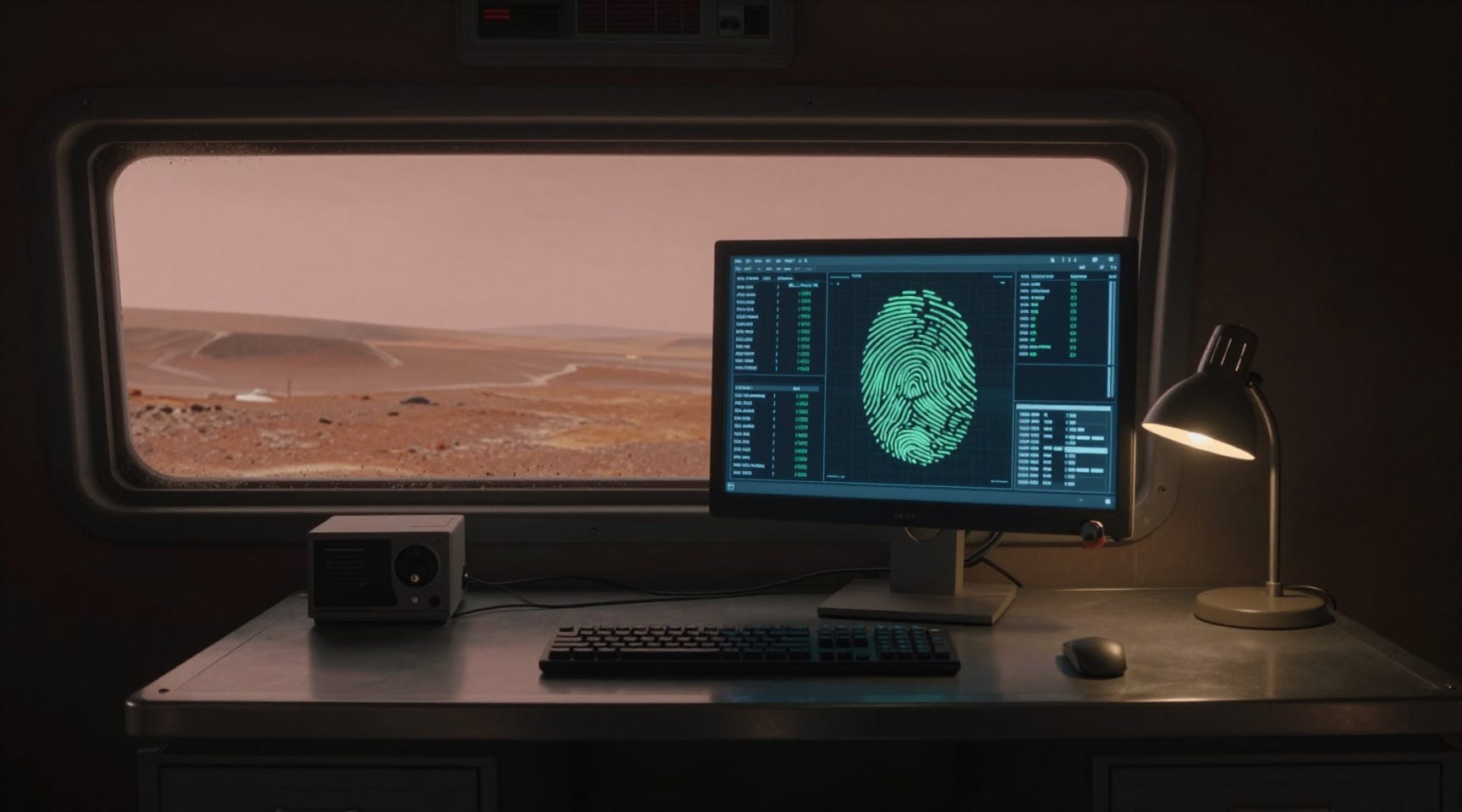
Maëva Soto pulled up the biometric ledger for Ares Flats and scrolled through the morning’s authentication logs. Four hundred and twelve successful ration draws against a registered population of three hundred and ninety-one. Twenty-one surplus draws. Each one tagged with a valid biometric signature, a valid citizen ID, and a valid allocation code. Each one belonging to someone whose death certificate was filed in the Mars Colonial Registry.
She’d found the first discrepancy two months ago. A woman named Katrin Brauer, age sixty-three, cause of death listed as respiratory failure following habitat decompression in Sector Nine. Katrin Brauer had drawn her weekly water ration fourteen days after her funeral. The biometric reader at Distribution Point Eleven had recorded her thumbprint, confirmed her vascular pattern, and dispensed 4.2 liters of potable water into a container that Katrin Brauer’s dead hands could not have carried.
Maëva had flagged it as a system error. Biometric readers glitched. Everyone knew that. Mars dust worked into the sensor housings, degraded the optical arrays, produced false positives. She’d filed a maintenance request and moved on.
Then she’d found another. Then five more. Then twenty-one.
Twenty-one dead colonists, all drawing rations on schedule, all authenticated by biometric readers that showed no signs of malfunction. She’d pulled the sensor diagnostics herself. The readers were clean. The prints were real.
Someone had cloned the biometric profiles.
The process wasn’t simple. Biometric authentication on Mars used a triple-layer system: thumbprint topography, sub-dermal vascular mapping, and pulse verification. You couldn’t fake it with a silicone mold or a printed overlay. You needed access to the raw biometric data, the encryption keys for the colony’s identity database, and enough technical knowledge to fabricate a physical proxy that could fool all three layers simultaneously.
She knew three people on Mars with that capability. She was one of them.
The office was quiet. Third shift at the Ares Flats Administrative Center meant empty corridors and disabled surveillance feeds. The feeds went down every night at 0200 for a scheduled maintenance window that lasted forty minutes. Nobody had ever questioned the window. It appeared in the original system architecture, documented and approved, a legacy feature from the settlement’s founding year. Maëva had written the documentation herself, back when the system was new and the population was small enough that forty minutes of blind spots didn’t matter.
Someone was using her maintenance window.
She pulled up the authentication timestamps for the ghost draws. Every one fell between 0200 and 0240. Every one used Distribution Point Eleven, the farthest reader from the administrative center, located in a storage corridor that saw no foot traffic after midnight.
Her terminal chimed. A message from Dustin Teixeira, the night logistics coordinator. Two words: Check complete.
Dustin handled the physical side of distribution: inventory counts, container tracking, dispenser maintenance. He’d been at Ares Flats for three years. Reliable. Methodical. The kind of worker who filed his reports early and never called in sick. She’d worked alongside him for eighteen months without learning anything about his life outside the logistics bay.
She messaged back: Come to my office.
He arrived four minutes later. His coveralls were clean, his boots dry, his expression the same measured neutrality he wore for every shift. He sat in the chair across from her desk without being asked.
“Twenty-one ghost draws,” she said. “All during my maintenance window. All at Point Eleven.”
He didn’t flinch. “You found the pattern.”
“I built the pattern. That window exists because I wrote it into the system six years ago.”
“I know.”
The admission landed without weight. He’d known about the window. He’d known she’d built it. He’d been counting on the fact that she wouldn’t look at her own blind spot.
“Who are you feeding?” she asked.
“Sector Nine overflow. Forty-three people living in the decompression zone that the Colonial Authority condemned after the blowout. They sealed the breach with hull patches and moved back in because there’s nowhere else to go. The Authority doesn’t count them because they don’t officially exist in a habitable zone. No census entry, no ration allocation, no water credits.”
“They’re drawing dead people’s rations.”
“Dead people don’t need water.” He leaned forward. “A crew called the Lattice handles the biometric proxies. They take the raw profiles from deceased colonists before the death certificates propagate to the authentication database. There’s a seventy-two-hour lag between Registry filing and biometric purge. The Lattice builds the proxies during that window. Once the proxy is active, it authenticates independently. The original profile can purge on schedule and the proxy keeps drawing.”
Seventy-two hours. She knew about the lag. She’d flagged it in three separate system reviews as a security vulnerability. The Colonial Authority had deprioritized the fix each time. Insufficient resources. Other priorities. The lag persisted because nobody with authority considered it a threat.
“Twenty-one proxies feeding forty-three people,” she said. “The math doesn’t work.”
“Half rations. The Lattice splits each draw across two recipients. Nobody gets a full allocation. Everyone gets enough to stay alive.”
The ventilation system hummed above them. Mars air, recycled and filtered, carrying the faint mineral taste that every colonist learned to stop noticing after the first year. The office lights buzzed at a frequency she’d memorized years ago, a sound she associated with late shifts and empty hallways and the particular loneliness of maintaining systems that nobody else understood.
“If I close the lag, the proxies die,” she said.
“Yes.”
“If I report the Lattice, the Authority relocates the Sector Nine residents. Forcibly. They’ve done it before. The last forced relocation put eighty people in temporary housing for nine months. Eleven died from exposure-related illness during that period.”
“Yes.”
She turned back to her terminal. The biometric ledger glowed in the dim office, twenty-one lines of data that represented twenty-one dead colonists whose fingerprints still dispensed water into containers carried by living hands.
She could close the vulnerability in ten minutes. Patch the lag, force immediate biometric purge on death certificate filing, kill every proxy the Lattice had built. Clean, efficient, documented. Her system review reports would finally show a resolved finding. The Colonial Authority would commend her thoroughness.
Forty-three people would lose access to water within a week.
She opened the system architecture file. The maintenance window code sat where she’d written it six years ago, clean and well-commented, a forty-minute gap in surveillance coverage that she’d designed for legitimate diagnostic purposes and that someone had repurposed into a lifeline.
“The next system review is in four months,” she said. “I’ll flag the biometric lag as a known issue with a proposed remediation timeline of six months. That gives the Lattice ten months before the patch goes live.”
Dustin’s expression shifted. Not gratitude. Recognition. The look of someone who understood exactly what she was offering and what it cost.
“Ten months is enough,” he said.
“Enough for what?”
“Enough for the Sector Nine petition to reach the Colonial Housing Board. If the residents can demonstrate twelve months of continuous habitation, the Authority has to reclassify the zone. Legal precedent from the Titan settlements. They’ve been there eight months already.”
She hadn’t known about the petition. She hadn’t wanted to know. The geometry was cleaner without the details. Twenty-one ghost draws. Forty-three living people. A six-month remediation timeline that gave them the runway they needed.
“Get out of my office,” she said.
He stood, nodded once, and left.
Maëva closed the biometric ledger and opened her system review draft. She typed the finding, the risk assessment, the proposed timeline. Her language was precise, bureaucratic, and technically accurate. The vulnerability was real. The remediation was reasonable. The timeline was defensible. Nothing in the report mentioned the Lattice, the proxies, or the forty-three people drinking dead colonists’ water in a condemned habitat on the wrong side of a hull patch.
The maintenance window would run tonight at 0200, same as every night. Distribution Point Eleven would authenticate twenty-one biometric profiles that belonged to people who no longer breathed Mars air. The containers would fill. Someone would carry them to Sector Nine.
She saved the draft and closed her terminal.
Author’s Note: The seventy-two-hour lag between death certificate filing and biometric purge exists because the Mars Colonial Authority’s identity systems were built fast, during the scramble years, by engineers solving immediate problems with limited resources. Nobody designed the lag deliberately. Nobody needed to. In systems built under pressure, the vulnerabilities aren’t malicious; they’re structural. The Lattice didn’t create the gap. They found it, the same way water finds cracks in stone. By Year 15, Mars settlements house over two hundred thousand people across dozens of habitats, and the administrative infrastructure still runs on architecture designed for a fraction of that population. The dead outnumber the living in the biometric database by a ratio of three to one. Most of those records will never matter. Twenty-one of them keep forty-three people alive.
If you enjoyed this story, you can follow the main story arc in The Exodus Rush, the first book in The Vethrak Requiem series.