


Fernanda Oliveira wrote the first draft in fifty-three minutes. She deleted it in twelve seconds. She started over at 0617 ship time with the piece due in two hours and the apartment around her in a state of organized neglect that she would have called working conditions and her mother would have called a health hazard.
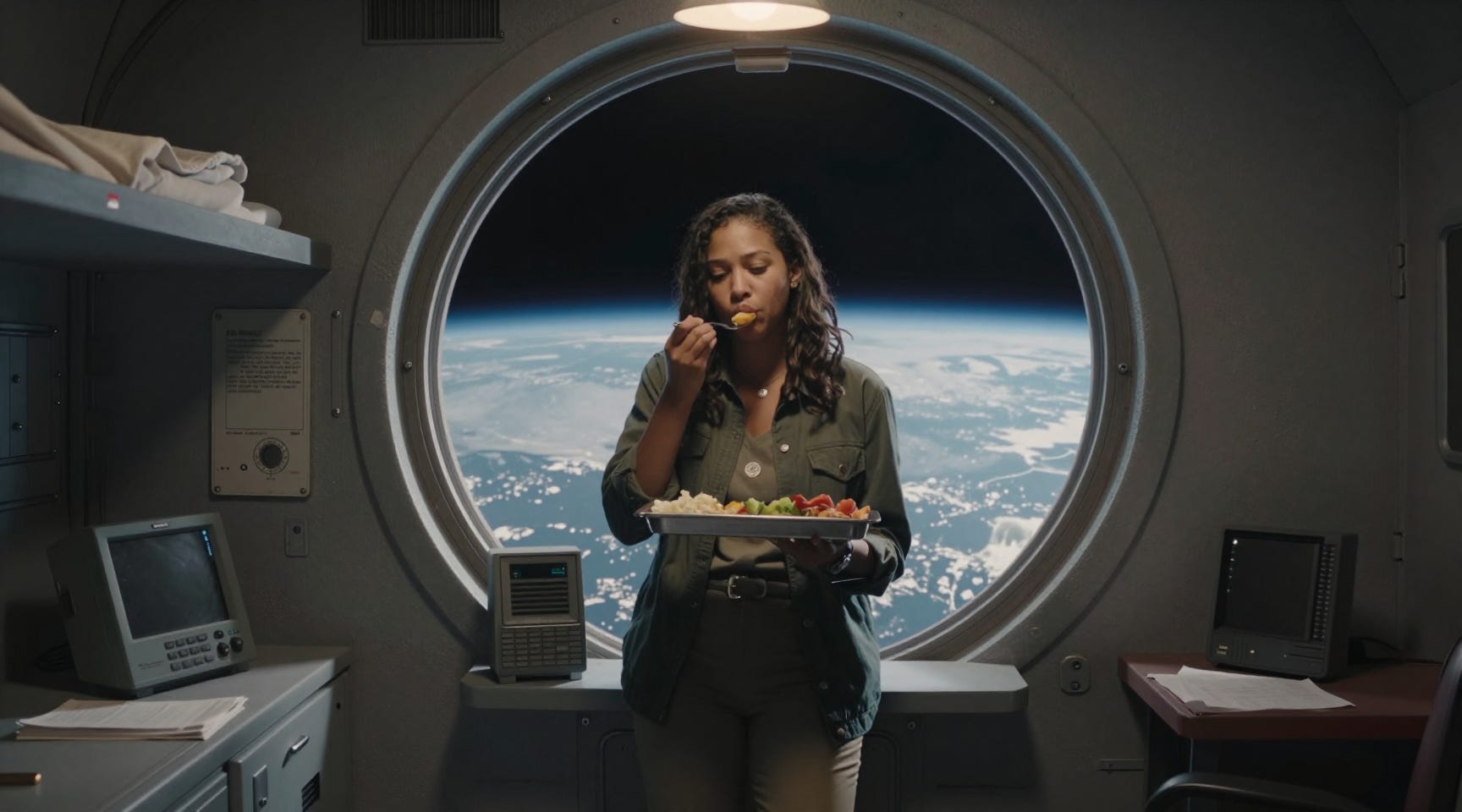
The Fleet press apartment was a single room on Prometheus Station’s civilian deck. A desk. A bunk. A small food dispenser that produced the same four meals. A viewport that showed Earth rising and setting on a schedule that had nothing to do with daylight. She had been living in it for seventeen days.
Her editor wanted a follow-up piece. The commissioning color piece had performed well. The audience remembered the ceremony, the ships, the captains’ faces. The editor wanted more of that. What are they doing now? Show the reader the daily life. Human interest.
Fernanda had written that piece twice. She had deleted it twice. She closed her eyes. She was not in the apartment anymore. She was on the observation deck seventeen days ago, watching three captains accept their colors under a window two hundred meters wide, and she was thinking about the line that had lodged in her chest and would not dislodge. Admiral Chen at the podium. The silence has lasted long enough to fool us into thinking it is peace.
She opened a new document. She did not write the piece her editor wanted.
The story began:
Twelve Years of Silence: What the First Three Are Listening For
By Fernanda Oliveira, UEN Fleet Press Corps
PROMETHEUS STATION, SOL ORBIT. At ten-hundred hours on the first day of Year 12, three warships received their colors and left their slips.
The ceremony was broadcast to every inhabited orbital habitat, every deep-space relay station, and every major city on Earth that still had a functioning network. Admiral Helena Chen spoke for four minutes. The three captains accepted their commissions. A moment of silence was observed for the eleven billion who did not live to see the ships completed. By twenty-two-hundred hours that same day, the reactors were spinning up and the First Three were ready to fly.
Seventeen days later, they are still flying. There is nothing to report. That is the story.
The UENS Vanguard, Defiant, and Hope are the first warships humanity has built since the invasion of Year Zero. They are the product of twelve years of salvage and reverse engineering and political negotiation. They carry the most advanced technology Earth can produce: Cascade Reactors that generate terawatts from matter-antimatter annihilation, Aurora Drives that bend gravity to push a ship through space at speeds that would have been unthinkable before the war, and Fold Drives salvaged from Vethrak wreckage that allow them to cross light-years in hours. They carry four hundred fifty crew each, chosen from the best and the brightest of a generation that grew up knowing the enemy would return.
Right now, they are running routine patrols in the outer system. The same patrols that Fleet has been running for twelve years with whatever ships could be scraped together from the wreckage of the pre-invasion fleet. The same patrols that have found nothing.
The silence has lasted long enough to fool us into thinking it is peace.
The quote belongs to Chen. She delivered it at the podium on Commissioning Day, and it was the truest thing anyone said during the entire ceremony. Because the silence has fooled us. It has fooled us into asking questions we would not have asked twelve years ago. Questions like: Are we building warships against a ghost?
That was the question a senator from the Pacific reconstruction zone asked during the appropriations hearing that preceded the commissioning. She asked it seriously, not as rhetoric. She asked it because her district is still being rebuilt, because every ton of steel that goes into a warship is a ton of steel that does not go into a school or a hospital or an apartment block for the displaced. She asked it because twelve years without a Vethrak sighting is a long time.
It is a question that deserves an honest answer. The honest answer is: nobody knows.
The captains do not know. Admiral Chen does not know. The crew of every ship in Fleet has the same data the public has: twelve years of silence from an enemy that came once, took what it wanted, and left. Nobody on Earth or in orbit can say with certainty whether the silence means the Vethrak are gone, or pausing, or already on their way back.
That uncertainty is the only honest thing about the entire enterprise.
I have spent seventeen days embedded with the Fleet press corps. I have spoken with engineers, tactical officers, deck crew, and one of the three captains. I have walked the corridors of Prometheus Station and watched the orbital slips where the First Three were built. I have stood on the observation deck at night, alone, and watched the ships’ running lights trace their slow cyan arcs against the starfield.
The ships are real. The crew are real. The drills are real, and the maintenance schedules, and the endless cycle of watches that keep a warship alive in the emptiness between stars. What the ships are for, whether they will ever need to fight, is the question the silence has not yet answered.
The First Three are not the answer to the question of whether the enemy will return. They are the question itself, asked out loud. The answer will come when the silence ends.
We are still listening.
Fernanda saved the document. She did not read it over. She did not have time. She filed it at 0803, nineteen minutes before deadline, and did not look at the datapad when the editor’s response notification pinged a few minutes later.
She had not written the piece her editor wanted. She had written the piece she needed to write. There was a difference. She was not sure what it was going to cost, but she had been standing on the observation deck seventeen days ago and she had counted to sixty with three hundred officers who were carrying a weight that the appropriations subcommittee had not factored into its cost projections, and she knew, with the certainty of someone too young to have learned how to be wrong about the things that mattered, that the piece she had written was the right one.
She stood at the viewport. Earth was rising. The apartment was cold. The food dispenser offered the same four meals. She told it to surprise her and it produced a tray of something that might have been pasta. She ate it cold, standing at the window, watching the planet turn.
She did not know yet that the piece had reached two million views in its first twelve hours. She did not know that her editor’s notification had been a single sentence: This is what I was hoping you would write. She did not know that a Lieutenant Commander on the bridge of the UENS Hope, several million kilometers away, had read the piece during a shift break and closed it without comment because the line about listening had made her think of her aunt, and she was not ready to think about her aunt yet.
Fernanda Oliveira ate cold pasta at a viewport and watched the planet she had grown up on turn beneath her. She was twenty-three years old. She had written something true. The silence had not ended, but she had said something worth saying about what it meant. That was not nothing.
She set the empty tray in the recycler. She sat down at her desk. She started the next piece.
If you enjoyed this story, you can follow the main story arc in The Exodus Rush, the first book in The Vethrak Requiem series.