


The data arrived at 0847, a secure transfer from the depot analysis team, and Sarah Vance opened the first file before the transfer notification finished flashing.
Seventeen thousand records.
She opened the second file. The tenth. The number settled over her like a weight she had not known she was bracing for. Supply manifests. Patrol schedules and their gaps. Communication logs in Vethrak script, the translation layer rendering them in flat Courier beneath the original glyphs. Maintenance reports. Crew rotations. A manifest for the cold-storage bays, the contents redacted by depot security protocols that had not survived the Skarreth decryption suite intact. The data was a goldmine. Sarah had spent eleven years on Sanctuary panning for flecks of gold in a river of static. She had never seen a goldmine before, and the scale of it was paralyzing.
She opened the fortieth file. The hundredth. Each one was a window into an enemy she had been studying for fourteen years without ever having this much glass.
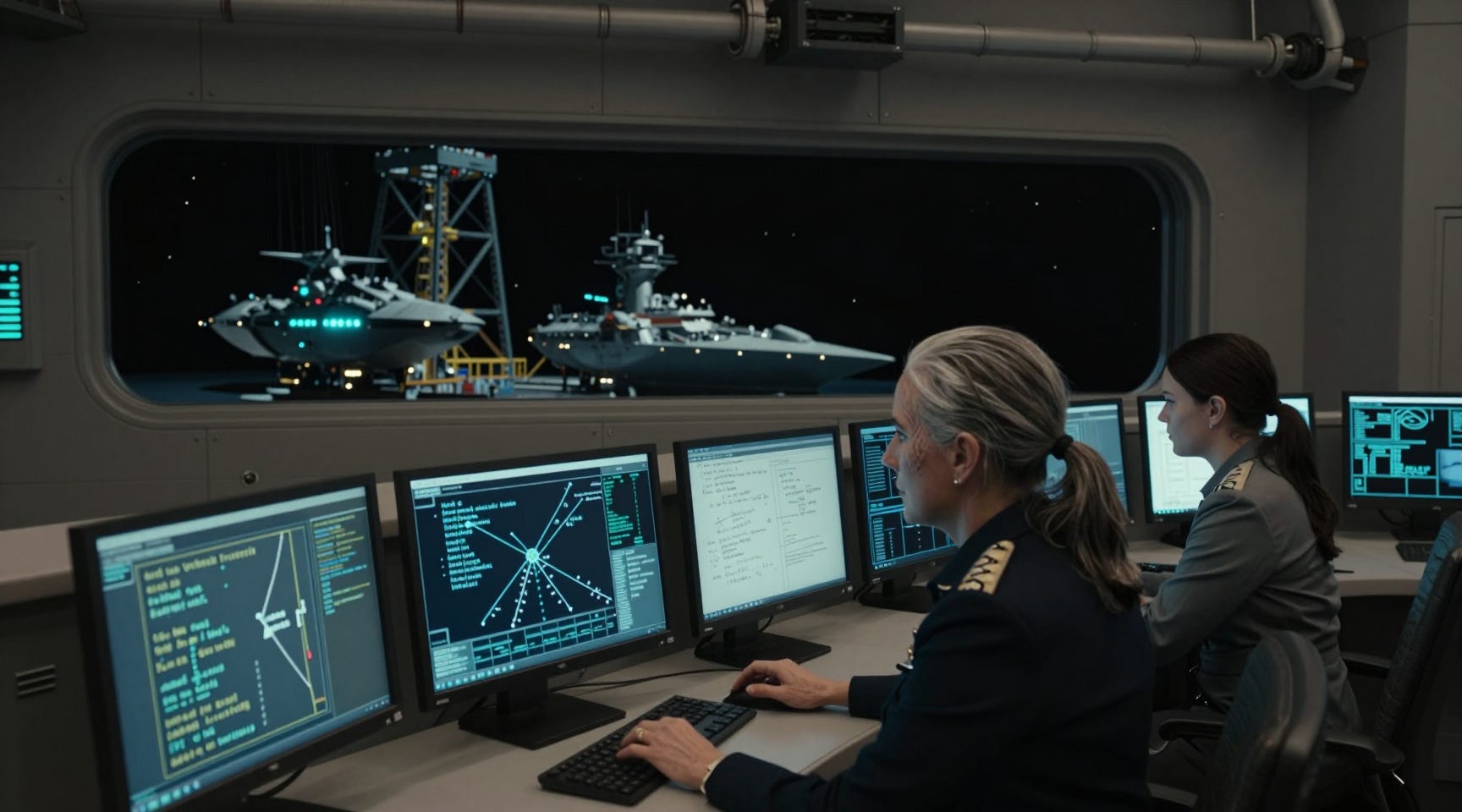
The intelligence section was quiet. Prometheus Station ran on a twenty-four-hour cycle, the lights never dimming, the air never changing from the cool recycled hum she had learned to stop noticing. Her station was in the corner, by the viewport that faced away from Earth, toward the shipyard where the First Three were docked. Vanguard. Defiant. Hope. She could see their running lights from her chair, cyan-blue traces against the darkness, and the sight had become a kind of talisman. The ships were out there. The ships meant someone was still fighting.
Vasquez was at the adjacent station. She had arrived at 0730, which was normal for her, and had been sorting by technical classification for an hour before the transfer arrived. Her screen was a mosaic of engineering diagrams: power coupling schematics, fold drive maintenance logs, the particular notation system Vasquez had developed for cataloging Vethrak technology by functional category rather than by ship of origin. She worked with a speed that Sarah had initially mistaken for impatience. She knew now that it was not impatience. It was competence that had been waiting for a worthy problem.
Vasquez did not look up. “I am sorting by technical classification. You will want the operational patterns first. Patrol schedules, supply movements, communication timestamps. That is your language.”
Sarah turned from her screen. “You know my language.”
“I pay attention.” Vasquez highlighted a section of the depot manifest and forwarded it to Sarah’s terminal without breaking her rhythm. “There is a five-day gap in the communications log for the outer supply stations. Day thirty-one through thirty-five, pre-harvest. The gap is not present in the inner stations. I do not know what it means, but you will.”
Sarah stared at the forwarded section. The gap was there, a clean absence in the chatter between the depot and the harvesting fleet’s forward outposts. Five days. Not a system failure; the inner stations were still transmitting. Not a scheduled maintenance window; the patrol logs showed normal activity in the same window.
Five days in which the Vethrak had stopped talking to their own supply lines.
She pulled up the patrol schedules. Cross-referenced them against the gap. The patrols had been redirected. Not stopped. Redirected. The vectors pointed inward, toward the core sectors. Toward whatever anomaly had tripped the outer stations’ sensors.
“Patrols redeployed inward during the gap,” she said. “The outer stations went quiet and the Vethrak pulled their patrols closer to the core. That is not a communications failure. That is a response to something.”
Vasquez did not stop working. Her hands moved across the interface, pulling engineering diagrams into sorted folders with a precision that Sarah recognized. It was the same precision Sarah used on intercept patterns. Different language, same grammar.
“A threat?” Vasquez asked.
“Or a distraction. Or an internal event.” Sarah marked the gap. Tagged it with a priority flag she had not used since Sanctuary. The flag meant: this matters and I do not yet know why. “The Vethrak do not adjust patrol schedules without cause. Their operational doctrine is conservative to the point of ritual. Something made them react.”
“That is your language,” Vasquez said. The words were quiet. They were not a question.
Sarah worked. The method was the same method she had developed in the archive room on Sanctuary, hunched over salvaged computers with walls covered in handwritten notes. Mark the interval. Cross-reference the supply deliveries. Note the communication silence patterns. Find the anomaly and hold it until a second anomaly locked into place beside it.
The difference was the scale. On Sanctuary she had worked with fragments: an intercepted transmission here, a partial sensor reading there, the kind of data that required extrapolation and prayer in equal measure. Now she had seventeen thousand records, and each one contained a dozen threads that could lead somewhere or nowhere. The volume was not the problem. The volume was the gift. The problem was that she had been a woman with her hands cupped under a faucet for eleven years, catching what she could, and now she was standing under a waterfall and could not decide which drop to drink first.
Vasquez pushed her chair back. The sound broke Sarah’s focus. Vasquez was holding a datapad with a technical schematic, a power distribution node from one of the depot’s secondary relay stations. The design was Vethrak. The annotations were in Vasquez’s handwriting, a blend of Spanish abbreviations and Salvage Protocol reference codes that had become the de facto language of the reverse-engineering division.
“I have something for you,” Vasquez said. “The power distribution patterns in the depot’s supply network. They prioritize the cold-storage bays over the barracks, the command sections, and the weapons maintenance bays. The cold storage draws forty-three percent of total depot power. That is disproportionate for a storage facility whose primary function is to supply a harvesting fleet. The Vethrak are efficient. They do not waste power on things they do not value.”
Sarah looked at the schematic. The power draw was mapped in Vasquez’s clean, angular script, the priority lines marked in red. Cold storage. The bays the inventory had listed with redacted contents. Whatever the Vethrak kept in those bays, it was important enough to starve their own weapon systems of power.
“That is not a supply depot,” Sarah said. “Or not only a supply depot.”
“No,” Vasquez said. “It is a vault. The supplies were the cover. The vault is what matters.”
The two women looked at each other across the narrow gap between their stations. Vasquez’s expression held the same thing Sarah’s probably held: the particular stillness of an analyst who has just found the thread.
The chronometer read 1122. They had been working for less than three hours. In three hours they had identified a communications gap the Vethrak did not want observed and a power allocation pattern the Vethrak did not want analyzed. The depot was a black box, and the box was beginning to open.
Vasquez returned to her schematics. Sarah returned to the patrol logs. The work continued. Neither of them said what they were both thinking, because neither of them needed to.
Sarah marked the power allocation pattern. Tagged it with the second priority flag. The flag meant the same thing it had always meant: this matters. I do not yet know why. I will find out.
She had spent eleven years on Sanctuary being the smartest person in the room because she was the only person in the room. The solitude had forged her. She had not known how heavy it was until it lifted. Vasquez was at the adjacent station, sorting through engineering diagrams with the same methodical hunger Sarah brought to intercept patterns, and Sarah did not have to explain why the gap mattered or how the patrol vectors pointed inward or what the cold-storage priority implied. Vasquez already understood. Vasquez had found her own thread and handed it to Sarah like an offering.
Sarah opened the two-hundredth file. The three-hundredth. The data kept coming. She kept working. Outside the viewport, the First Three held their positions in the shipyard, cyan lights steady against the void. The war was not over. The data was not finished. The woman at the adjacent station did not slow down.
Neither did Sarah.
If you enjoyed this story, you can follow the main story arc in The Exodus Rush, the first book in The Vethrak Requiem series. The story continues in The Reclaimed Stars, Book 5 of The Vethrak Requiem.