


Salt haze clung to the cargo deck of CSV Mercy’s Answer when Njeri Wamalwa keyed the ration grid awake. Four years after the Vethrak ships left their scars, every delivery run still felt like triage disguised as logistics.
Columns of numbers bloomed in the air between the crate stacks. Brazos Cluster requested eight cascade cells to restart the desalination line. Ward 19, the inland fever dome, flagged an urgent need for med-foam cartridges and the same cascade cells to keep their isolation wing cold. The Salvage Protocol allocation board had already routed Mercy’s cargo toward Ward 19. The projection redrew the gulf map as if the Brazos outpost could wait another week for water.
Sipho Naidoo jogged up the ramp with the morning manifest clamped beneath his arm. “Commander Soliman signed the directive,” he said. “Full payload goes north. He cited cholera spread.”
“Cholera spreads faster when people drink from open vats,” Njeri said. The grid flickered while she overlaid satellite humidity bands. The Brazos air plant had been cooling ninety thousand liters per day before the cascade stack burned out. Without replacement cells the settlement would ration by bone dice before sunset.
“Rumor says Ward 19 has two ministers from the UEC Council,” Sipho added softly. “That is why the board jumped.”
Njeri shut down the projection long enough to study the stacks. Crate seals glowed blue, each one tagged with biosensor glyphs that still unnerved her. “Fly with me during the drop,” she said. “If I can re-balance the load midair, both sites get what they need.”
Sipho hesitated. “Splitting will ping Geneva. They will audit the crate tags before we clear orbit.”
“I will spoof the mass readings through the ballast pumps,” Njeri said. “Protocol monitors trust our water weights more than our med weights. That buys ten hours.”
“You owe me a crate of spice wafers if this ends with me in review court,” Sipho said.
“I will bake you wafers from desal salt if we get through the day.”
The shuttle bay opened like a throat above the gulf. Spray hammered the hull while Njeri strapped into the loadmaster chair. Sipho’s hands danced over the control halo in front of the cockpit, feeding power to the thrusters that lifted them toward the low clouds. Commander Ibrahim Soliman patched into their loop before they cleared the pier.
“Mercy’s Answer, confirm you received the directive,” he said. His voice carried the clipped patience of someone who had memorized every procedural manual left on Earth.
“Directive acknowledged,” Njeri said. “Requesting permission to adjust sequencing to avoid the storm cell over Trinity Marsh.”
“Denied. Fly the filed path. Ward 19 cannot wait.”
The hatch sealed, muffling the gulf. Njeri leaned toward the mic. “Sir, Brazos reports desal output at eighteen percent. They have seventeen thousand civilians listed in the ration queue. If we skip them, the black market will sell them back their own water at riot pricing.”
“Every site believes it holds the worst problem,” Soliman replied. “Ward 19 houses the last antibiotic incubators in region fourteen. Failure there spreads south within a week. Deliver as instructed.”
The channel clicked silent. Njeri ran her thumb along the fabric band on her wrist, woven by her sister when the invasion sirens wailed across Nairobi. Logistics had been her way to stop other streets from vanishing.
“We split anyway,” Sipho murmured.
“We split anyway,” she echoed.
Ward 19 sat inland inside a ring of shattered railcars. Floodwaters pooled around the berm, reflecting the shuttle’s running lights as Sipho brought them in. Njeri rerouted half the cascade cells to the pallet earmarked for Brazos, then overlaid a cooling shroud to hide the weight change. Two med techs in patchwork suits waited beside the landing cones.
“We need everything today,” the lead tech said. His voice rasped through a broken filter. “The isolation wing lost power twice last night.”
“You will have enough cells to stabilize your grid,” Njeri said. “Tell Commander Soliman the remainder stayed aboard to counterbalance the storm.”
“You expect me to lie to a UEC officer?”
“I expect you to keep your wing alive. That includes the nineteen patients you would lose if Brazos lines dry up and the fever migrants surge this way.” She slid a data slate across the crate. “Sign for six cells, fourteen med-foam cartridges, and the antibiotics. The system will record a full delivery. The extra weight stays on my manifest.”
The tech hesitated, then pressed his palm against the slate. “If this circles back, I was never here.”
“Same.”
Sipho banked the shuttle before the tech finished speaking. The aircraft clawed altitude through the first wall of the storm. Njeri rerouted ballast to keep the remaining crates pinned.
“When was the last time you slept?” Sipho asked.
Cascade cells pulsed behind the transparent crate lid, each prism thrumming with captured energy. “Sleep wastes hours the grid needs,” she said.
“Spoken like someone who thinks hour twenty belongs to the machine, not you.”
“Hour twenty belongs to the line waiting with empty cans.”
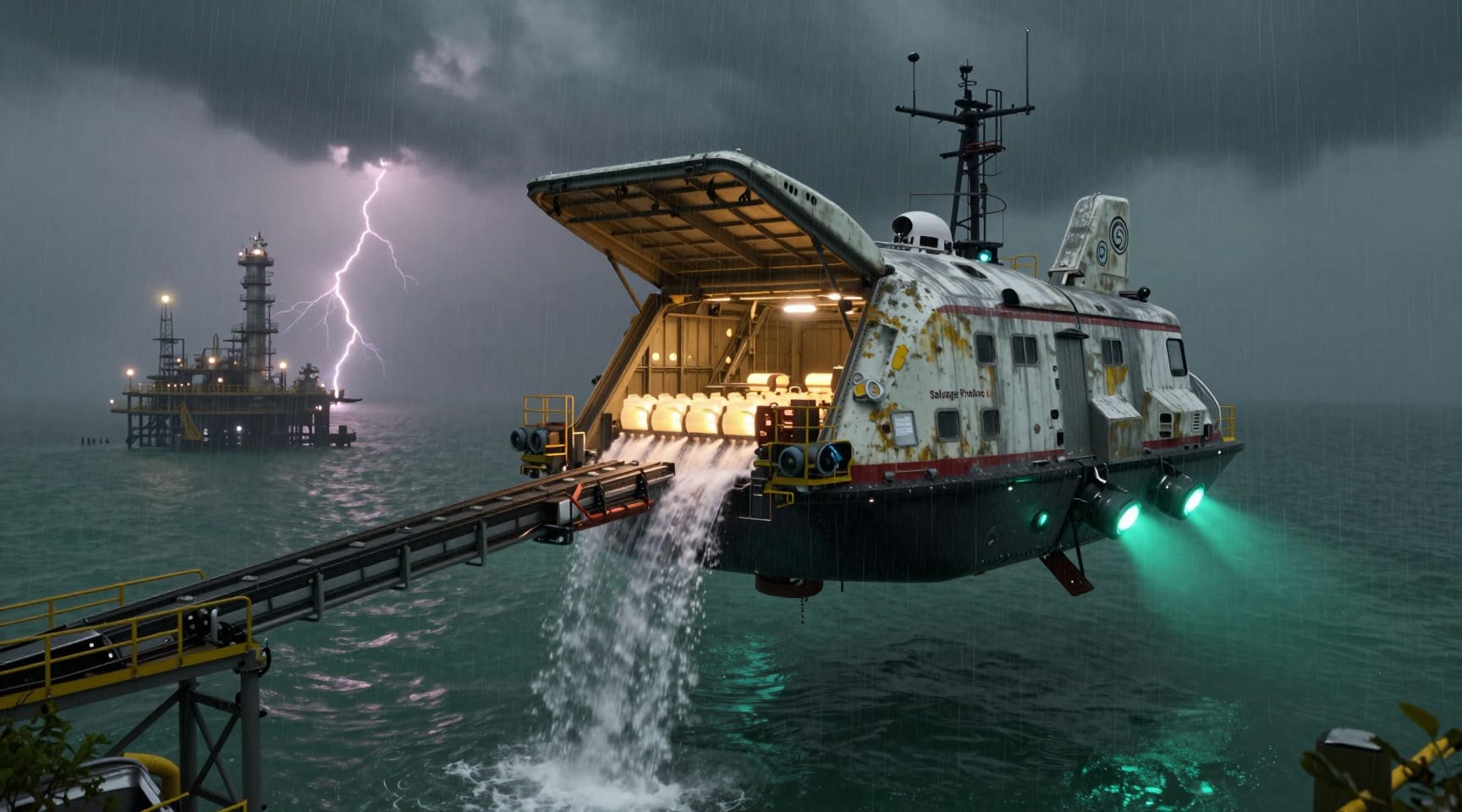
Brazos Cluster sprawled over the drowned refineries near Freeport, a city of scaffolds lashed to the bones of catwalks. Floodlights painted the towers honey gold despite the storm. The settlement’s mayor, a broad-shouldered woman with a shaved head and sea tattoos spiraling down her arms, waited on the highest platform.
“You actually came,” she shouted over the storm.
“Water quotas do not wait for sunshine,” Njeri said. She thumbed the crate seals and let the cascade cells roll down the conveyor toward the mayor’s crew. “You have six hours to spin this grid up before the storm shreds our signal. After that, call the signal buoy and we will vector a second drop.”
The mayor clasped Njeri’s shoulder. “We rigged a new strainer net for the gulf intake. Once the desal line hums, your skimmers get clean feed rates.”
Njeri nodded. The crew hauled the crates into the shelter of the turbine hall. Njeri transmitted a forged ballast log to Geneva that explained the missing mass as storm compensation.
Her slate chimed immediately. Commander Soliman’s identification block filled the screen. She accepted the call before he could escalate.
“You flew two hours late,” he said. “Why does the telemetry show ballast purge over Brazos?”
“The storm threw us off the filed vector,” Njeri answered. Truth, trimmed. “I dumped excess ballast to keep the hull upright. Ward 19 received the critical cargo.”
Soliman remained silent long enough to stretch nerves thin. “The board registered complete delivery. If Brazos received anything, it must have been whatever you purged. Maintain that discretion and I will sign off.”
“We still have a settlement that nearly rationed itself to death,” she said. “Next rotation, send them priority.”
“I schedule flights according to council directives.”
“Then update the council ledger with the riot projections I forwarded this morning,” she said. “Numbers do not care about politics.”
The channel cut. Sipho let out a breath. “That sounded like a win.”
“It sounded like a delay,” Njeri said. “Delays are enough when you stack them.”
Brazos floodlights faded beneath the storm. The grid inside her slate recalculated future drops based on the lie she had fed Geneva. Relief vector lines glowed green toward both settlements. For one rotation, the math honored the people standing in the rain.

Author’s Note: Year 4 Post-Invasion, gulf relief crews ran cascade cells between flooded coastal settlements and inland fever domes while storms shredded every schedule. Njeri’s job is inspired by the real Salvage Protocol loadmasters who keep the western hemisphere alive with spreadsheets and grit.
If you enjoyed this story, you can follow the main story arc in The Exodus Rush, the first book in The Vethrak Requiem series.