


Ayanda Molefe caught the helmet ring with two gloved fingers and turned Lena’s visor into the lock light.
The transfer lock sat between mine air and station air, mag strips on the floor, a bench nobody used. Lena’s boots locked to the strip. The suit still carried 3-Bravo’s dust in every crease. The fines hung in the lock lamps, a gray film that had not learned gravity.
“Pupils.”
Lena opened them. The lock light was too white. She kept them open.
“Oxygen debt.”
“Worked.”
“Ribs.”
“Left side. Bruised. Seals held.”
Ayanda’s slate took the answers without commentary. She pressed two fingers along the left rib line through the suit’s diagnostic window. Lena did not flinch.
“Exposure is inside the twelve-hour band. Joints are clear. Suit integrity is green.” Ayanda checked the cuff, then Lena. “You are not required to go back.”
“I know the route.”
“That is not a medical finding.”
“It is the only one that matters.”
Ayanda keyed the release. The inner door unlatched with the small honest sound of a machine that still worked.
“If the pain changes, you come back through this lock. Not through a side hatch.”
“Copy.”
Lena unlocked her boots and pulled along the rail toward rescue staging.
The board in the staging bay had two columns.
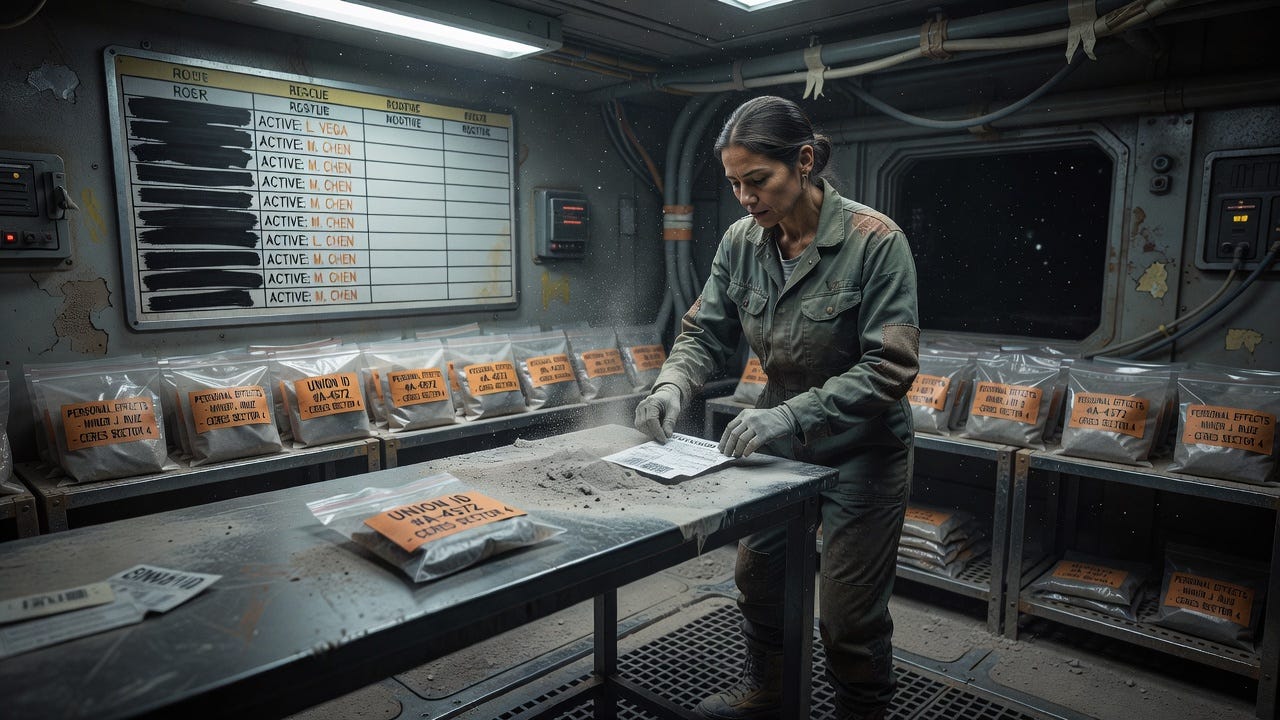
The left column held one entry team, six names, all lit. Active. In the throat. The right column was a roster built for the average incident: three names, two blank slots, a note that read surge call unanswered. The average incident on Ceres was a pinched limb or a failed seal. 3-Bravo was a sheet of rock with the mass of a hull.
The rescue chief stood on the mag strip with both hands on the rail, visor up, eyes on the clock.
“One team in. You wait. Procedure.”
“Air pockets decay on a clock.”
“I know the clock. I also know what a second unanchored team does to a load that has not finished settling. You wait.”
Waiting was procedure. Waiting was also a number that would land later in a column nobody wanted to read. Lena locked her boots at the spare rack and checked her seals again. Collar. Wrists. Boot rings.
The clock over the columns counted minutes the inner refuge bottles would not get back. Four hours if the seal held. Less if the collapse had kissed a fitting. They had already spent part of that clock pulling two living miners through a gap the width of a helmet.
She waited anyway. An unanchored second team was how you turned one collapse into two.
A handheld torque driver hung on the rescue kit, scarred, older than most of the names in the right column. Manual setting. Low. The kind of torque that talked to a pinned brace without asking the rock above it for an opinion.
The active team came back on the emergency band, breath already spent.
“Route is stable to the jam. Inner door still loaded. We need a miner who can read a brace.”
The chief’s jaw worked once.
“Vasquez. You are the miner. You clip to the reel. You do not free-climb. If the load talks, you back out.”
“Copy.”
She locked the torque driver to her belt, clipped the reel hook to her hip ring, and went.
The throat had changed in the hours she had been in the lock. Dust still hung, a gray weather that refused to fall. New lamps marked the surviving rail. Rescue tape webbed the folded frames, orange against charcoal. Her mag boots found the strip. Handhold. Handhold. The reel kept a short leash. In three hundredths of a g, mass still had opinions.
The jammed pressure door sat where she had left it. Ore still hung in the dogs. Beyond it, the inner shift’s dark band occupied her visor.
The pinned brace crossed the gap at a wrong angle, one end still in the wall, the other driven into the door frame. A stretcher could not pass it. The load above it ticked in a register she knew from every cutter she had run: stone finding a new path, not finished.
She set both boots. Short tether. Glove on the brace. The note was high. Tight. Not the collapse pitch. A secondary. The kind that punished haste.
Manual torque. The driver hummed against the pin. She eased a quarter turn, waited for the tick to change, eased another. The brace did not jump. The load above it settled a finger’s width and stopped. Dust drifted in a slow curtain and hung there.
“Clear enough,” she said. “Do not touch the upper frame.”
The entry team fed a cutter into the remaining jam. The door dogs released with a sound too small for the work they had done. The gap widened to a body.
The refuge stencil on the far side was still faded orange. The beacon was dark.
Nobody spoke on the crew channel.
Lena went first because she knew the geometry. Emergency bottles sat in their clips, gauges at zero. Tethers remained clipped to the wall rings, lines still taut. Tools hung where gloves had left them: a hand lamp, a slate, a cutter bit still in its loop. The lamp’s switch was on. The beam had died with the cells.
Stillness did the reporting. Procedure did the rest.
“Recovery,” the team lead said, quiet enough that the word did not bounce. “No living. Seal the count. Effects first. Loads second.”
Lena unlocked a tether from a ring and coiled it. The coil went into the first effects bag, tagged with the tunnel stencil and the shift code. A spare mask followed. A glove. From a chest pocket, a union card still clipped where a miner kept the thing that said they were not alone in vacuum. She slotted the card into the bag’s sleeve and sealed the tag. Faces belonged to Ayanda’s lock. Here the work was objects.
The team moved around her in the slow heavy of Ceres, every motion clipped.
They ran the route twice more for loads, then for the last of the tools. Leaving a cutter bit in a dead refuge was a kind of disrespect the rock would not notice and the living would.
When the chief called the face closed, Lena’s cuff said her oxygen was still inside the band Ayanda had named. The pain in the left ribs had not changed. She came back through the transfer lock, visor dusty, torque driver empty on the belt.
The effects table sat in the staging bay under a hard white strip. Bags in rows. Tags facing the aisle. Kavita Nair stood at the end of the row with her boots locked and her hands empty, which on Ceres meant she had come to talk, not to lift.
Lena set the last bag on the table and aligned the tag.
“I need you on the record,” Kavita said. “What you had in the stone. What Control told you. What the board did not have.”
“I am a miner.”
“You were in the throat. The rest of us have summaries.”
Lena’s glove found the data port on her cuff. Suit telemetry. The pitch change. The order off the face. The dark band. The torque log. Machines did not get asked to be symbols.
“I am not standing in a hall.”
Kavita held out a transfer chip, union-issue, the kind that took a copy and left the original on the suit.
Lena seated it.
“Take the suit log. It doesn’t get tired.”
The chip clicked. Kavita palmed it into an inner pocket and did not thank her. Thanks belonged to speeches. This was a file.
Lena stayed at the table after Kavita left. One bag had come back with a smear of dust across the tag window. She opened the seal. Inside, the union card sat in the correct sleeve, plastic scored by a clip that had done its job.
She lifted the card and cleaned the last of the stone from the letters with the edge of her glove. The dust hung a moment in the bay light, then drifted, still refusing to fall. She put the card back. Sealed the bag. Set it in line.
The board’s right column was still half empty. The left column had gone dark. Recovery complete, the header said, in the same type the system used for a cleared train.
Lena locked her boots, pulled for the lock, and did not look at the header again.
If you enjoyed this story, you can follow the main story arc in The Exodus Rush, the first book in The Vethrak Requiem series.