


The courier was a woman of maybe thirty in a Fleet rain shell that had not been broken in yet. She stood on the cabin’s porch with the inlet behind her and a sealed pad envelope in her hand and the look of a person who had been told this trip was a formality and had discovered, in the four wet kilometers from the floatplane dock, that it was not.
Marcus did not open the door all the way.
“Captain Rivera.” She held the pad up to the gap. “Admiral Chen’s office.”
“I do not take Fleet communications.”
“Sir, I have been instructed to leave it whether you take it or not.”
“Then leave it.”
She set the pad on the worn cedar of the porch boards, two steps from his feet, with the kind of care a person used when setting something down that mattered to someone else. She nodded once. She turned and walked back down the gravel path to the dock, and the door of the cabin closed before she reached the floatplane.
He did not pick up the pad.
He went back to the kitchen. The salmon was on the counter, the fillet half done, the dark side still beaded with the milky residue that came off a fresh fish when the cut had been made an hour ago in good cold water. The knife was where he had set it. The bottle of beer he was not drinking was where he had set that. The window over the sink looked out at the inlet, and the inlet looked back.
He finished the fish.
He rinsed the board. He rinsed the knife. He racked the knife on the magnetic strip he had screwed into the wall in Year 7, the second year of the cabin, the year he had stopped flinching at quiet. He wiped his hands on the dish towel he had stolen from a Fleet officers’ mess in Year 1 and had never replaced because it had outlasted four marriages on the base it came from, including, eventually, his own.
He went to the porch.
The pad was still there.
He brought it inside and set it on the kitchen table and looked at it the way a person looked at a wasp that had walked in under the screen. He sat down across from it. He did not open it.
The inlet light moved on the table.
He opened it at thirteen hundred and read the first paragraph and closed it. He opened it again at thirteen-forty and read the rest.
The language was Helena Chen’s. He knew her sentences. Two declarative paragraphs, no flourish, the offer of command of CV-002 in the third paragraph as if it were a procurement line item. She had not signed it with rank. She had signed it with her name. She had done the same thing eleven years ago on the standing order that had moved him from the Constellation to the Argonaut, the order that had put him in the chair in time to watch the fleet die.
He set the pad face down on the table.
He looked at the bottle. He did not pick it up.
The fleet died on a Tuesday.
Three sentences. He gave it three sentences and no more. The Argonaut‘s bridge in the orange wash of damage-control lighting. The viewer showing the line of human cruisers folding their drives in unison along the L4 axis, and the Vethrak vessel above them doing the thing he had still not, after eleven years, found a word for, the thing that turned a ship’s plasma into a quiet inert glass that hung in vacuum and held its shape. He had given an order. The order had not mattered.
He did not give it a fourth sentence. He had learned, the year after, that fourth sentences became fifth sentences and fifth sentences became nights, and nights became weeks, and weeks were how he had lost his wife and his rank and his sense of which year it was. He had a rule about fourth sentences now. The rule held.
The pad chimed on the table.
It was a personal call routing through the pad’s encrypted channel, and there were two people alive who had that key, and Helena Chen would not call him on the day of the courier.
He picked it up.
“Marcus.”
“David.”
“You did not call.”
“I have not opened it.”
His brother’s silence on the line had a shape he knew, a small dry shape that was David thinking and not letting Marcus hear him think.
“You have not opened it,” David said.
“I opened it.”
“All right.”
A wind moved along the inlet outside and the cabin shifted in the way that cedar shifted, a small voiced settling that was the sound of a building agreeing with the weather.
“What did Helena tell you,” Marcus said.
“That she sent a courier.”
“That all?”
“That I should not call you for three days.”
“And here you are.”
“And here I am.”
Marcus closed his eyes. The shape of David’s office on Earth came up unbidden, the window that did not open, the desk David kept clean the way Marcus had once kept his.
“I am not going to ask you to take it,” David said.
“All right.”
“I am going to say one thing and then I am going to hang up.”
“All right.”
David let a beat go. The beat was Marcus’s to fill. Marcus did not fill it.
“I would want to be there,” David said. “If you say yes. I would want to be there.”
The line clicked off.
Marcus held the pad until it was warm.
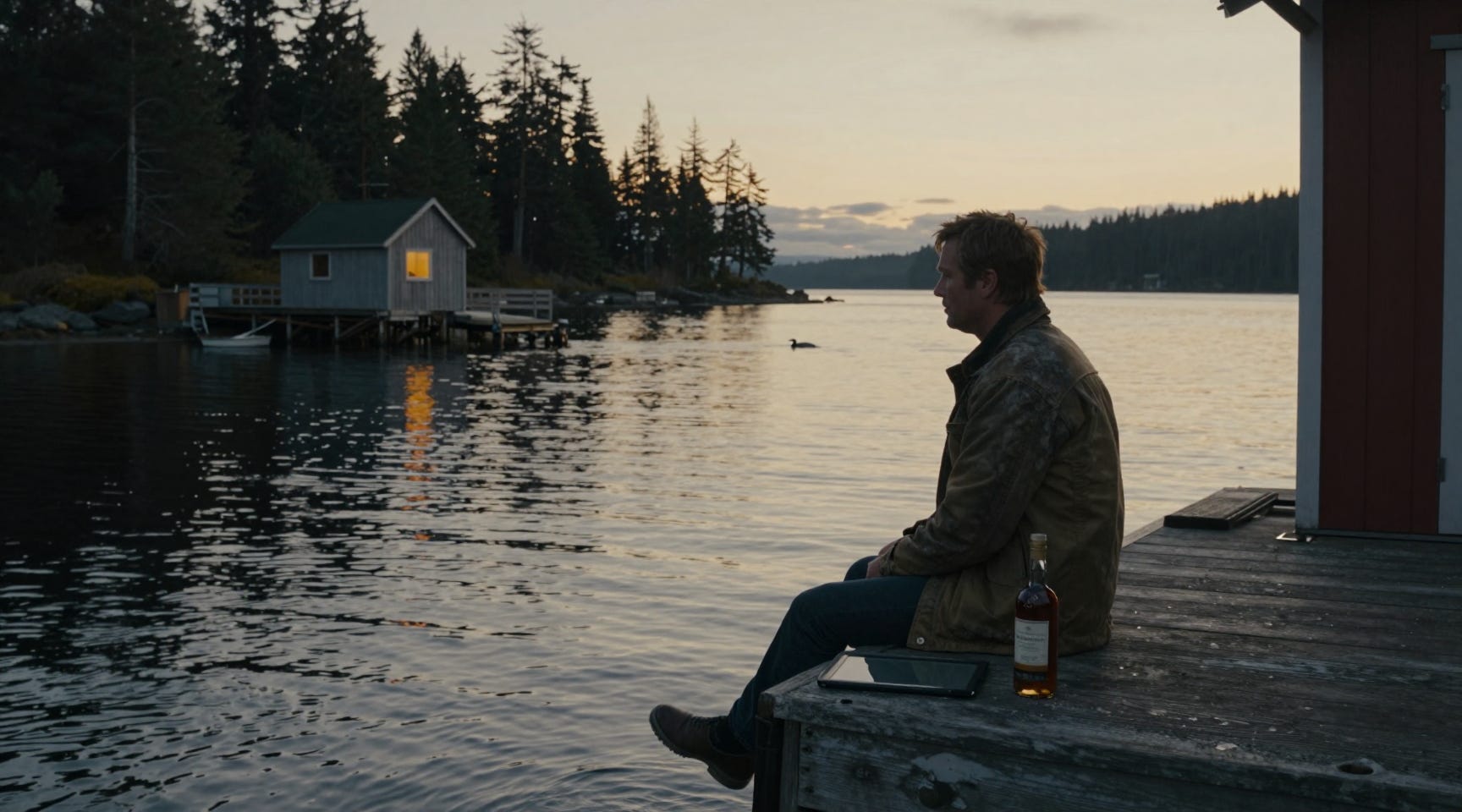
He took the bottle out to the dock at dusk.
He did not open it. He set it on the planks beside him and let his legs hang over the dark water, and the inlet did the thing it did at the hour the gulls quit and the herons started, the surface going to a tarnished silver-gold that was not a color any working light made, the color of a long thin metal warmed by a hand for an hour. The cedars on the far shore went black. A loon called, twice, and stopped.
He held the pad in his lap.
The cabin behind him was eleven years of a life he had built out of refusing the thing the pad was asking him to stop refusing. He looked at the cabin. He looked at the bottle. He looked at the water.
He thought about David at the desk Marcus had not seen in eight years. He thought about Helena Chen signing the offer with her name and not her rank. He thought, with a quietness that surprised him, about a young engineering officer whose name he did not know yet, the kid who was going to be assigned to CV-002 because someone signed off on him, and the question of whether that someone would be a person who understood what an order was costing the people who received it, or whether it would be a person who had never had to find out.
He was not going to say yes tonight. He was not going to say yes this week.
He was going to say yes.
He knew it the way a person knew the tide was turning before the line on the rock moved.
He did not pick up the bottle.
The loon called again, far down the inlet, once.
He sat on the dock until the silver-gold was gone and the inlet was the slate of a thing that did not need to be looked at to be there. Then he stood up. He left the bottle on the planks. He took the pad inside.
He set it on the kitchen table, face up this time.
He did not open it again. He did not need to.
If you enjoyed this story, you can follow the main story arc in The Exodus Rush, the first book in The Vethrak Requiem series.