


The temperature gauge climbed another two degrees. Hiroshi Tanaka marked it in the logbook, his handwriting steady despite the sweat pooling at the base of his spine.
Reactor Three had been running hot for six hours. Not critical. Not yet. The cascade reactor’s containment fields held at ninety-two percent efficiency, three points above emergency shutdown threshold. Three points between controlled power and a cascade failure that would take half the station with it.
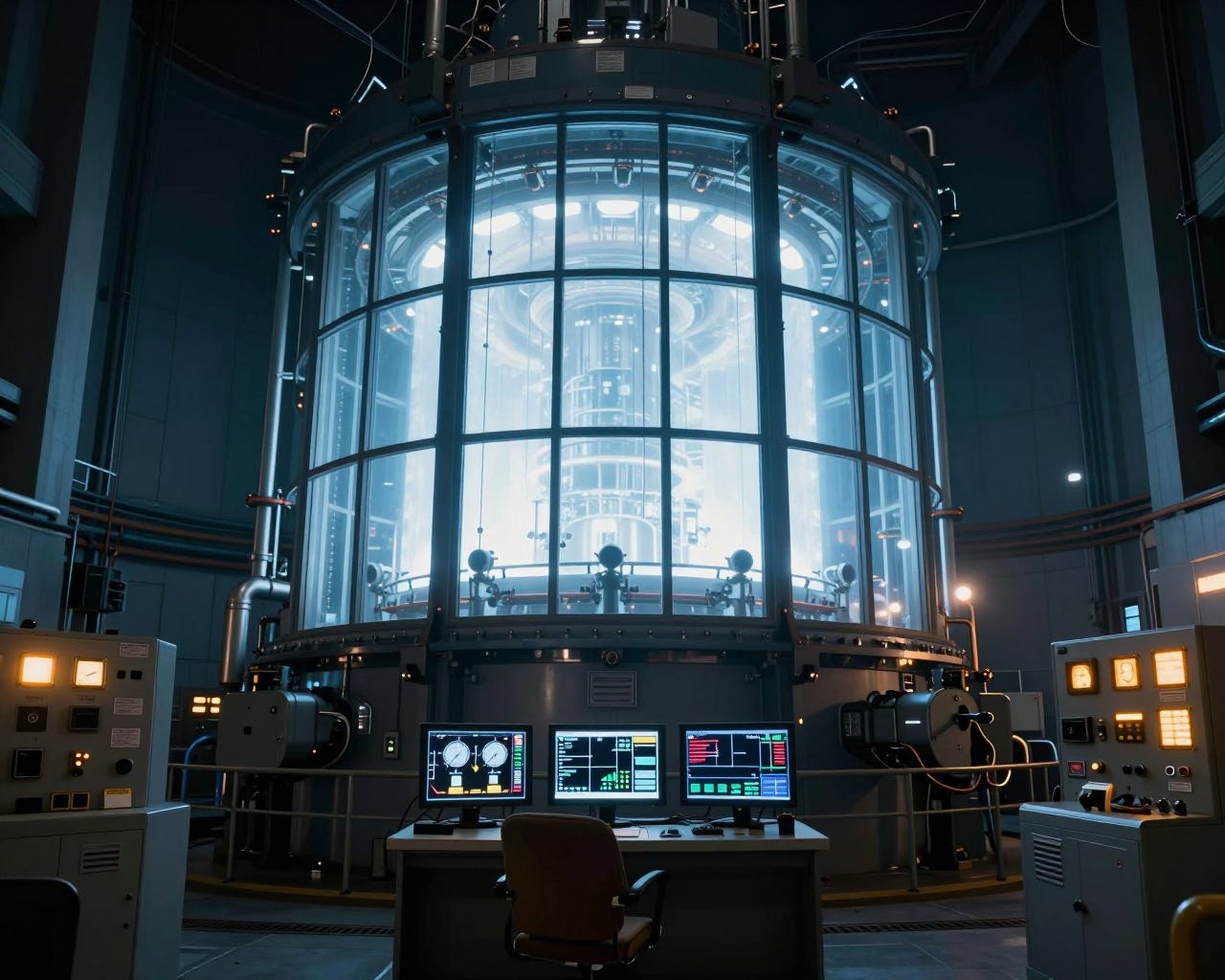
He checked the cooling system readouts again. Pumps one through four showed green. Pump five flickered amber, flow rate down eight percent from optimal. Within tolerances. Barely.
The watch station occupied a small compartment adjacent to the reactor bay, surrounded by two meters of lead-lined steel and enough radiation shielding to survive anything short of a direct breach. Three displays, two control panels, one chair bolted to the deck, one engineer on twelve-hour shifts. The glamorous life of a power tech on Haven Station.
Hiroshi had been pulling reactor duty for three years. Long enough to know when something felt wrong.
The reactor shouldn’t be running this hot. Load demand was normal. Cooling systems operational. Fuel burn steady at point-seven-three cycles per hour, exactly where it should be. Every indicator told him the system was fine.
The temperature gauge said otherwise.
He pulled up the diagnostic subroutine, letting it cycle through the reactor’s subsystems. Containment field generators, power distribution nodes, coolant pressure valves, fuel injection controls. Green across the board. The system reported itself healthy even as it cooked itself from the inside.
His commlink chirped. “Tanaka, this is Ops. We’re showing a temperature alert on Reactor Three.”
“Copy that, Ops. I’m on it.” He kept his voice level. Panic served no one.
“Do we need to evacuate the section?”
“Negative. We’re stable.” The word tasted wrong. They weren’t stable. They were balanced on a knife edge, and he had no idea why.
“Keep us updated.”
“Will do.” He killed the connection and stared at the displays.
Twelve thousand people lived on Haven Station. Mining families, freight handlers, administrative staff. Children learning to read in the education wing three decks above. Doctors treating patients in the med bay. Engineers like him, keeping the lights on and the air flowing.
All of them depending on Reactor Three to keep functioning.
The temperature climbed another degree.
Hiroshi reached for the emergency shutdown protocols, then stopped. Shutting down the reactor would trigger a cascade through the other three units, each one taking on additional load to compensate. Reactors One and Two were already pushing seventy percent capacity. Four was undergoing maintenance. If he scrammed Three, the sudden load shift could destabilize the entire power grid.
They’d survive. Emergency batteries would keep life support running for forty-eight hours. Long enough to bring Reactor Four back online and restart the others.
He hoped.
His hand hovered over the shutdown control.
The temperature held steady. One hundred forty-seven degrees, three above nominal operating range. Hot, concerning, but not catastrophic. The containment fields still showed green. Coolant pressure normal. Nothing in the diagnostic logs indicated imminent failure.
He pulled his hand back.
The reactor hummed through the shielded walls, a deep vibration that lived in his bones after years of standing watch. A steady rhythm, unchanged. Whatever was causing the heat buildup, it wasn’t mechanical stress on the core.
Hiroshi closed his eyes, picturing the reactor schematic in his mind. Containment fields, fuel chambers, coolant loops, power conduits. Thousands of components working in concert, any one of them a potential point of failure.
Then he saw it.
The coolant return line from the secondary heat exchanger. The diagnostic hadn’t flagged it because flow rate was normal. Pressure was normal. Temperature differential between input and output matched expected values.
The sensor calibration was wrong.
He pulled up the maintenance logs, scrolling back three weeks to the last routine inspection. Reactor Three, secondary exchanger, sensor array replacement. Standard procedure. Sign-off from Engineering Chief Ramos, verification from Senior Tech Chen.
They’d installed the new sensors. They’d verified the readings. They’d marked the job complete.
They hadn’t recalibrated the baseline.
The secondary exchanger was running twenty degrees hotter than the system believed. The coolant was absorbing more heat than the computer thought it was dumping, creating a thermal imbalance that crept upward hour by hour.
Hiroshi’s fingers flew across the control panel, pulling manual overrides for the cooling system. He bypassed the automated controls, cranking the secondary exchanger coolant flow to maximum. The pumps spun up, audible even through the shielding.
The temperature gauge hesitated. Held. Began to drop.
One forty-six. One forty-five. One forty-three.
He let out a breath he hadn’t realized he was holding.
The reactor hummed, steady and strong. Twelve thousand people slept, worked, lived, unaware that they’d been twenty degrees from catastrophe.
Hiroshi made a note in the logbook. Secondary exchanger sensor calibration required. Coolant override engaged. Temp stabilized at 1430 hours. His handwriting was still steady.
The commlink chirped. “Ops to Tanaka. Temp alert cleared. Nice work.”
“Thanks, Ops.” He leaned back in the chair, feeling the tension drain from his shoulders. “I’m going to need a maintenance crew down here to recalibrate the sensors.”
“Copy. We’ll have someone there in an hour.”
“Appreciated.”
The displays glowed softly in the dim compartment. Reactor Three purred along at a comfortable one hundred forty-one degrees, containment fields solid, power output steady. Everything exactly as it should be.
Hiroshi marked the temperature reading in the log. Another twelve-hour shift. Another day keeping the lights on.
He settled in to watch the gauges. Somebody had to.
Author’s Note:
This story explores the quiet heroism of the engineers who keep humanity’s scattered outposts running. Haven Station represents one of thousands of settlements holding on in the aftermath of the invasion, each one sustained by people like Hiroshi who stand the watch when no one else is looking.
If you enjoyed this story, you can follow the main story arc in The Exodus Rush, the first book in The Vethrak Requiem series.