


The shrine room smelled of sandalwood incense and dust.
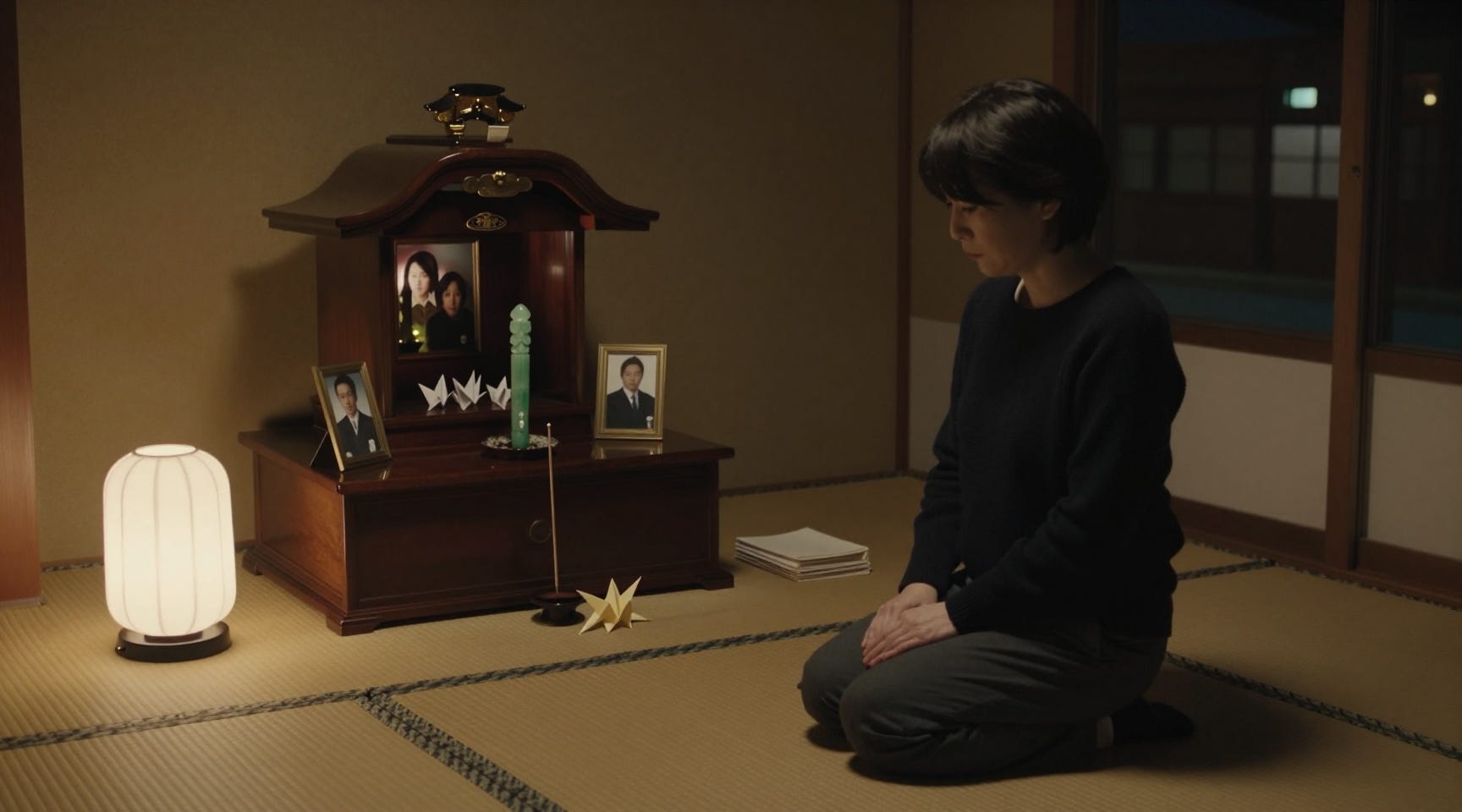
Captain Yuki Tanaka knelt on the tatami before the butsudan, the small household shrine her mother had kept in this apartment for thirty-seven years. Her mother was no longer in it. Neither was her father. Neither was her brother. The photographs in the lacquered cabinet held three faces and the incense holder was dark with decades of ash.
She had lit a single stick of shōkō. The jade-green incense her father preferred, sharp and cool, the same box he had bought in batches from a shop in Asakusa that no longer existed. The shop had burned on Day 2 of the invasion. The box had survived because he had kept it in this apartment. Tanaka had been carrying it from duty station to duty station for twelve years.
The incense thread of smoke rose straight in the still air. The smoke held its shape and did not answer.
The offer had come three weeks ago.
A direct comm from Admiral Chen, voice-only, the audio compressed into the hollow clarity of deep-space relay. Captain Tanaka. We are seeking a commanding officer for the third of the First Three. I expect you will say yes. I would like to hear it from you before I announce it.
Tanaka had said yes inside the same minute.
She had not told anyone on her current ship. A long-haul survey vessel running mineral assays in the outer belt, quiet work, important work, work that had kept her moving for eleven years because moving was easier than standing still in a country that was still burying its dead. The crew would find out when Fleet posted the announcement. She would be at Prometheus Station by then.
The yes had been easy. The yes had taken no thought. The yes had been sitting in her chest for eleven years, since the day Tokyo’s skyline went dark on a live feed from a relay satellite that kept transmitting for forty-seven minutes after the harvest ships reached the surface.
The yes had not been asked. Not then. Not by anyone. She had been a lieutenant commander on an ice-hauler in the Jovian system, too far to help, too useful in a supply chain that was now the only chain left. She had done her job. She had been told afterward that her job had saved lives. She had believed it.
The yes she gave Chen was the yes she had been waiting to give since she was thirty-one years old and standing on the bridge of a ship that was not a warship, with Earth burning on a screen she could not turn off.
The incense had burned down by a third when she spoke.
She did not speak aloud. The conversation was in her head, the way conversations with the dead always were. Formal, quiet, structured by the years of ritual her mother had taught her before Tanaka was old enough to understand that ritual was a language for things too large for words.
Father, she thought. They have asked me to command a warship.
Her father had been a civil engineer. Bridges, water treatment, the unglamorous infrastructure that held a society together. He had spent his career arguing that building was harder than destroying and therefore more worth doing. He had been in the Tokyo metro when the first strike hit. Tanaka had stopped trying to find out which station.
I said yes because I did not want anyone else to say it.
She waited. The dead did not answer. She had learned that lesson at thirty-one and had kept learning it every year since, but she still waited.
Her mother’s photograph was on the left side of the shrine. Younger than Tanaka was now, forty-seven, in a blue kimono with a pattern of small white cranes, the photo taken at Tanaka’s graduation from the Academy. Her mother had not understood the Academy. She had understood that her daughter needed to go and had been proud in a way that did not require understanding.
I will keep them alive if I can, Tanaka thought, looking at her mother’s face. I know that is not what you would have asked of me. I am asking it of myself.
She did not know how many them would be. The Hope‘s crew complement was classified until commissioning. She had seen the preliminary numbers in Chen’s briefing: approximately four hundred officers and crew, across all departments. She had memorized the number and had not let herself think about what it meant to be responsible for four hundred people on a ship built to close with an enemy that had not been seen in eleven years.
The responsibility was not the hard part. She had been responsible for crews before. The hard part was that they would be on a warship, and she had spent her entire career on ships that ran away from danger as a matter of doctrine.
She did not know if she could turn around.
She did not know if she could ask four hundred people to turn around with her.
She had said yes anyway.
Her brother’s photograph was on the right. Kenji, four years younger, a propulsion engineer on the Mars convoy route. He had died in the evacuations of Year 3, when a civilian transport’s drive failed forty-two minutes from the Martian orbital ring and the Vethrak patrol that found it did not bother with a harvest. The wreckage had been identified by a hull plate number. There had been nothing else to identify.
Tanaka had been in the belt when the message came. She had spent the next eight days running mineral surveys on autopilot because nobody else aboard was qualified to run the survey and nothing was going to bring her brother back.
She had not cried. She had not slept. She had done the surveys and she had filed the reports and she had not let anyone see the inside of her quarters for the entire time.
I do not know if this is a good reason, she thought to Kenji’s photograph. I know it is the only reason I have.
The incense burned down. Tanaka let the ash fall where it would.
She reached for the small stack of origami paper beside the shrine. kami, the same brand her grandmother had used, pale ivory squares that softened under the fingers. She had been folding paper since she was eight. Her mother had taught her the crane first, the way everyone learned the crane first, and then the rabbit, the frog, the lotus that required sixteen folds and took her two years to master.
Tonight she folded a simple star. Twelve folds. A shape that held.
She placed the star beside the incense holder and did not explain it. The dead did not need explanations.
The last word was for her mother’s photograph. She did not bow. She was already on her knees, but she inclined her head in the small motion that was the same as a bow when the body was already low.
I am leaving for Prometheus in the morning. I will not be back for a long time.
She stood. Her knees ached from the tatami. She was forty-three years old and her body reminded her of it more often than it used to.
She blew out the incense. The thread of smoke stopped, and the room smelled of sandalwood and dust and the cold of a Kyoto night in autumn.
She stood in the dark of the shrine room for a long moment. The three faces in the cabinet looked out at her from a silence she carried everywhere. She had been carrying it for eleven years. She was about to carry it onto a warship.
I will do this, she thought. I do not know if I can do this. I am going to do it anyway.
She turned on the light and left the room. The origami star stayed on the shrine. The photographs stayed in the cabinet. The woman who had said yes inside the same minute walked out of the apartment and into the kind of quiet that was about to end, and she did not look back, and her hands were steady, and the dead were still dead, and none of that changed what she had decided to become.
If you enjoyed this story, you can follow the main story arc in The Exodus Rush, the first book in The Vethrak Requiem series.