


The beacon’s heartbeat stuttered at 03:12 station time.
Ismael Cruz pushed away from the console and braced his boots against the deck, the grav field barely a whisper under his soles. A warning band crawled across the top of the monitor in steady amber. NAV BEACON 7A. ATTITUDE DRIFT. SPIN RATE OUT OF TOLERANCE. Beneath it, the diagnostic graph sagged, then spiked.
He keyed the comm to the station’s internal channel. “Control, this is Cruz. Beacon 7A is drifting. I am heading out to align the gyro.” He waited a beat, long enough for the fan hum in the life support column to fill the cabin. No reply. The station’s night shift consisted of him and a sleeping medic down the corridor.
He clipped a tether to his suit harness and pushed off the console. The airlock cycled with a tired wheeze, the seals old enough to remember the first evacuation convoys. He checked the pressure readout, then the external cam. The beacon floated in the distance beyond the station’s scaffolding, a cylinder of matte black with its transmitter dome aimed nowhere.
Ismael stepped into the void.
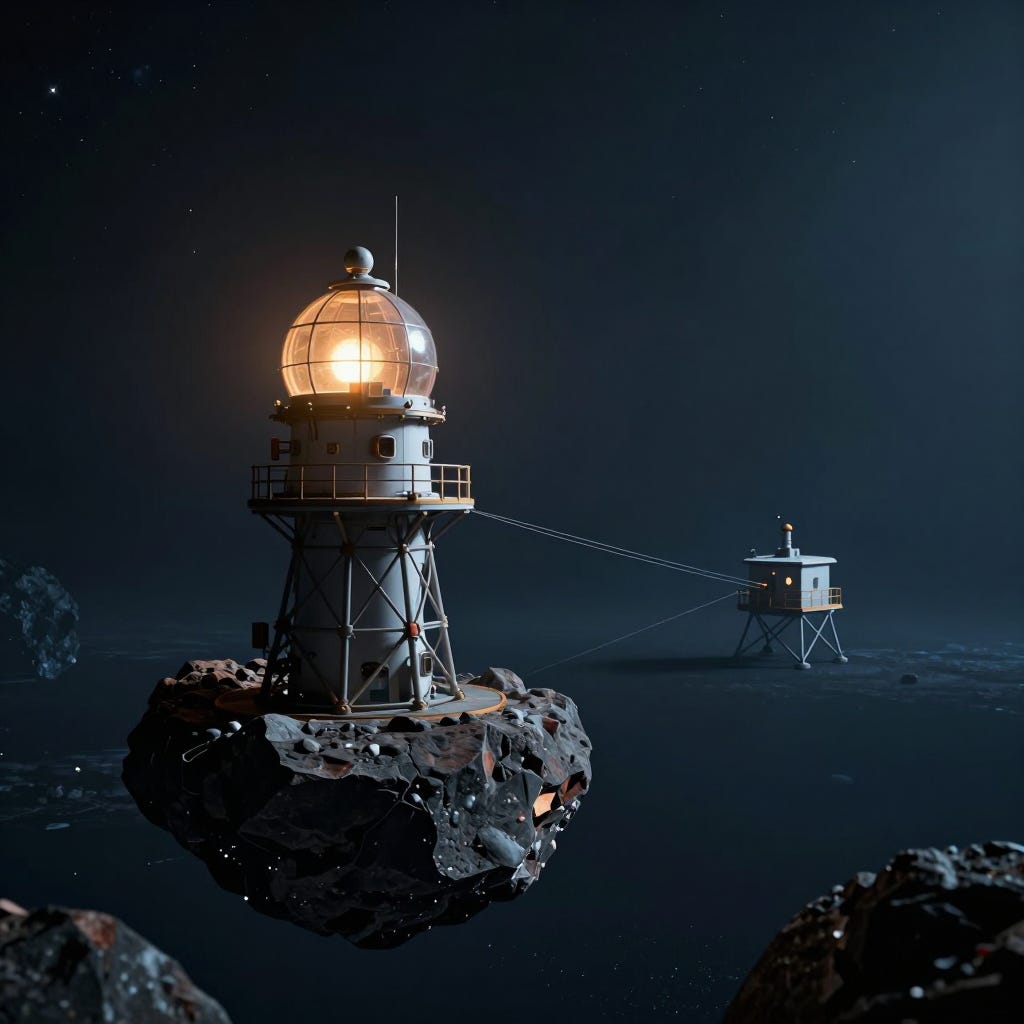
The tether tightened, a slender thread between him and the only oxygen in thirty million kilometers. His gloved hand found the station’s handholds, each one painted yellow and scratched to bare metal. The asteroid field around Relay 7A rolled slowly, a river of stone that never touched him yet refused to let him forget its presence.
He reached the beacon after a slow traverse, boots planting on the outer collar. The transmitter dome had canted twelve degrees off axis. The solar foil on the cylinder’s side had one tear, a pale ribbon fluttering against the black. The gyro housing sat behind a round hatch, its bolts studded with micro-meteoroid scars.
Ismael brought out the torque tool and loosened each bolt in a practiced rhythm. The hatch released with a soft pop, and the cavity inside greeted him with a thin shimmer of frost. The gyro assembly should have spun with a clean, quiet force. It wobbled.
He pulled the manual from his suit sleeve. The update was printed on real paper, the last run before the printers went down during the Year 5 grid failure. The lines were smudged at the fold, the diagrams etched into his memory. The fault log on his wrist display showed a slow bearing grind that no software patch could fix.
Ismael released the assembly and let it float in his grip. The replacement gyro was strapped to his back. He eased it forward, guiding it into place while keeping his movements small. A slip here meant a pinched cable and a relay blind to every ship that trusted it.
The beacon hummed as he sealed the hatch. A soft vibration traveled through his glove and into his arm. The transmitter dome pivoted a fraction, then steadied. The diagnostic light on his wrist blinked green.
He opened the comm to the public channel. “Relay 7A, update. Beacon alignment restored. Drift correction successful.” The words bounced out into a wide empty that cared nothing for them.
The return trip stretched longer. The station’s hull cast a hard shadow that slid across his visor. The void on the far side of the beacon stretched without relief. He followed the tether and kept his breaths slow. Oxygen readout eighty six percent. The station’s airlock light blinked twice, the signal for incoming traffic.
A convoy icon lit on his display. Three freighters and an escort corvette. UEN registry code. The nav line showed a scheduled fold in nine minutes.
Ismael pushed harder, muscles tightening against the tether’s pull. The airlock swallowed him with a gust of recycled air, the pressure rising in a slow climb that always seemed to take a beat too long. He stripped his helmet and wiped the condensation from his forehead with the back of his hand. The medic’s bunk was dark. He was still alone.
The console chimed. Fold corridor locked. Beacon engaged. The freighters would see the pulse, align their jump vectors, and trust the little station that orbited a chunk of stone no one had named.
He opened a secure channel and keyed a prewritten packet. The station’s antenna array flashed as it transmitted, a tight beam aimed at the freight escort. The message carried a warning about the torn solar foil. It carried one more line, appended from habit rather than protocol.
Safe passage.
He leaned back in his chair and pulled up the station’s maintenance logs. Another relay eight hours away was overdue for its weekly sync. Another beacon had a failing capacitor. The list never ended, a chain of problems linked across a hundred light minutes.
A ping sounded. One reply, short and direct. RECEIVED. THANK YOU RELAY 7A. The escort captain’s name was listed below, a human signature in a system that had once held thousands.
Ismael pulled a small tin from the drawer by his console. Inside was a thin wafer of pressed algae, a ration bar cut into four neat pieces. He ate one, then tucked the tin away for the next shift.
The beacon’s heartbeat settled into a steady rhythm, a pulse every thirty seconds that mapped safe paths through the ruin of old space. Ships would pass through this corridor for weeks, maybe months, before a more permanent relay could be built. He would keep the light on until then.
He keyed the comm again. “Relay 7A control log, entry seventy four. Alignment restored. Transit corridor clear.” He paused, then added a line for himself. “Weather in the field is calm. The rocks are quiet tonight.” He saved the entry and let the screens dim.
The station circled the asteroid in slow silence. Ismael stretched his legs and set a timer for the next diagnostic sweep. He closed his eyes with the beacon’s pulse keeping time, a small light that promised the dark could be crossed.
This story takes place in Year 7 (2132), during the Survival Era. Relay 7A was one of the first civilian navigation beacons repurposed for UEN fold corridors after the initial invasion, kept alive by skeleton crews and remote techs who maintained safe passage between scattered colonies.