


Onur Tekin checked the closed query path beside three pale brackets on Article Four. Both records held exactly what he had asked them to hold. The barrel could not leave. The question could not go out.
Across Slip Two’s inspection boundary, removable overlays marked the cracked transitions beneath apparently sound steel. Narrow work lamps picked out the weld ridges. The proof cradle carried the barrel into anchors buried in asteroid rock, its actuators isolated. Somewhere beyond this hidden yard, two pressure-hull sections would wait for the structure meant to join them.
His denial remained attached to the materials request. Five missing process fields for each of two certificate hashes. No source address requested, no route, no destination. The narrow question still led into a retrieval package broader than engineering could receive.
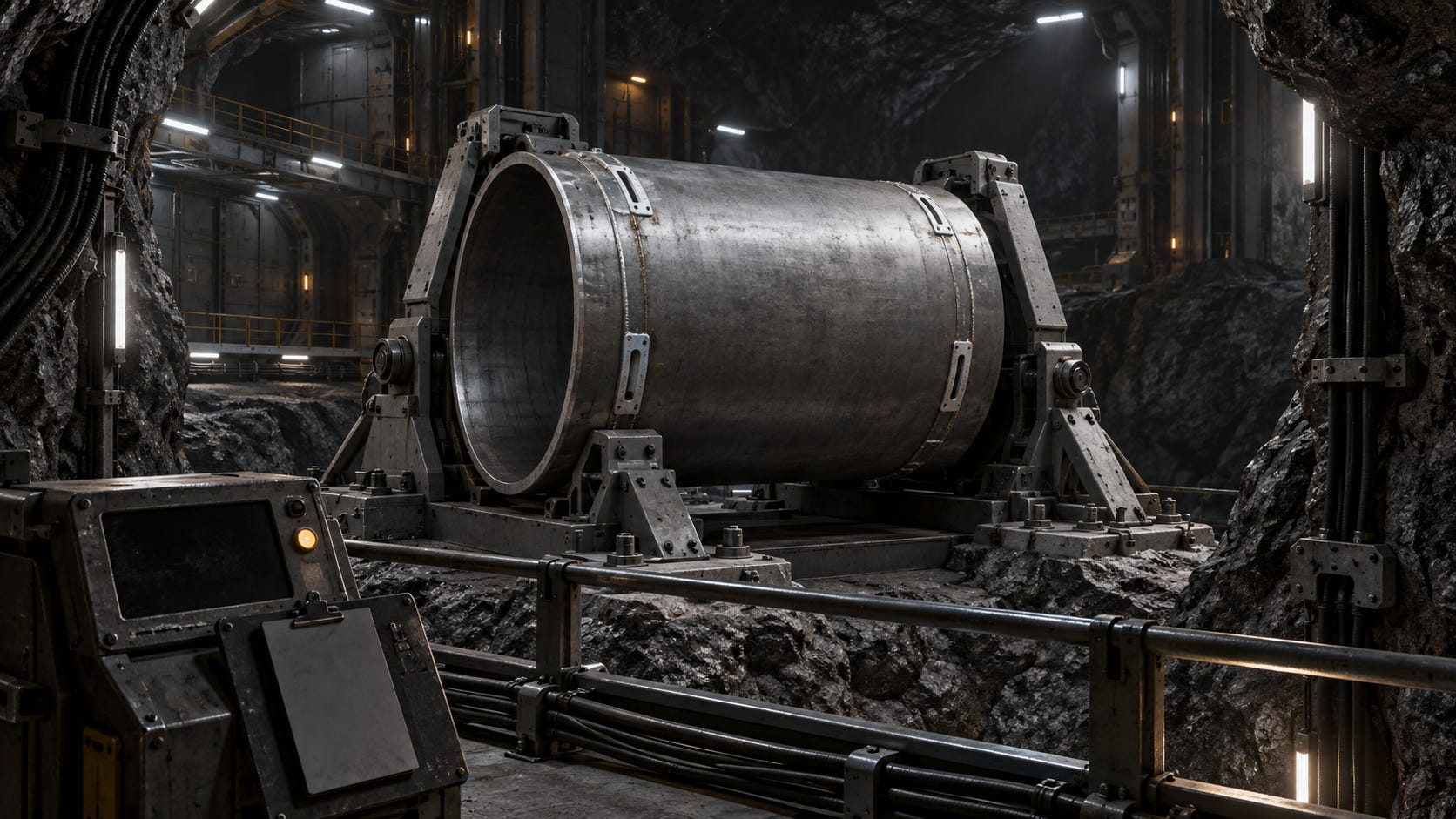
Wanjiku Bett secured a scan packet beneath the station’s retaining bar.
“Anything in the local record?” she asked.
“I’m tracing it.”
“The original, not another receiving summary.”
He brought the two upstream hashes onto his slate. Their long strings matched the local material links. He had checked them before. He had defended their survival as evidence that nothing essential had vanished.
“The identity packet is sealed,” he said.
Wanjiku tapped the three brackets on the map.
“Those aren’t asking who made the plate.”
Onur clipped the slate to his harness. “I know.”
He left the request unanswered rather than changing its status to investigation complete.
The corridor past Bay Three carried only ventilation noise. Onur pulled along its rail beneath reduced lighting, passing the closed access without opening the equipment status. That work had its own retained position. Today’s silence belonged to the scheduled concealment window, not an alarm.
Inside the offline records room, he fitted his boots into the terminal restraints and secured the slate. The external query indicator remained dark. He opened the local receiving schema, its revision history, and the acceptance audit for both hashes.
His first diagram had three boxes. One-time route code. Sealed identity packet. Local material certificate.
He drew the connections before adding the permissions. The route code pointed into custody records retained beyond ordinary engineering scope. The sealed packet preserved the upstream identities and routing links under higher authority. He checked the packet inventory without opening those identities. Their presence had an acknowledgment, a retained checksum, an assigned access authority.
The local certificate carried nominal grade, chemistry band, dimensions, and inspection acceptance. Beneath the merged heading, both upstream hashes survived.
He added a fourth box for the original technical attributes.
No connection reached it.
Onur expanded the acceptance transformation. The software had reduced the incoming attributes to the receiving schema and retained the result. Its local revision record described the merge accurately. The transaction log recorded the removal of the temporary acceptance payload after validation.
Removal had completed without error.
He checked the retention rule, then the retained-object inventory. The identity packet was not a complete copy of the incoming certificate. Its protected fields served custody and concealment. The detailed process fields belonged to the temporary payload, outside that retained selection.
He moved the diagram’s fourth box beyond the local boundary. The hashes could identify certificates upstream. They could not reconstruct words that the yard had chosen not to keep.
His hand stayed against the slate bracket. A neat drawing could make that look inevitable. The receiving program had followed a rule someone could revise. Someone could also defend it until another barrel occupied another cradle.
He reopened the transformation and checked the second hash separately.
The same rule. The same completed deletion.
No forming history emerged. No thermal cycle. Nothing in the local audit supplied the five answers Samrawit needed. The absence was not permission to infer them from the damaged plate.
Samrawit joined him with the reduced examination allocation still open on her slate. He turned the diagram toward her without exposing the protected inventory.
“The origins survive,” he said. “The detailed process attributes don’t survive here. Not behind another permission. They were removed after acceptance.”
She secured her boots in the neighboring restraint.
“Both certificates?”
He showed her the two transformation records and their retained-object lists. She followed each field selection to the same local summary.
“The hashes remain useful,” she said.
“For asking upstream. Not for recovering the contents locally.”
“Keep that distinction in the report.”
He entered it before continuing. His earlier denial remained attached, unchanged. It had correctly refused broad retrieval. It had not established where every excluded technical fact was preserved.
Samrawit touched the empty box outside his boundary.
“Can you retrieve the process fields now?”
“Not during the closure. There isn’t an authorized narrow return path afterward either. This identifies what the path must request. It doesn’t open it.”
She left the question on her slate. No new material disposition replaced it.
Onur brought up the incident classification. A retention gap would fit the menu and conceal the decision that produced it. He selected the broader security-process finding, then wrote the narrower evidence beneath it: required technical history discarded locally while source and route remained recoverable under restricted authority.
His name appeared in the authorship field.
“This will go through security review,” he said.
Samrawit loosened one boot restraint. “It should.”
He had expected a concession about the pressure of concealment. She gave him a field reference he had omitted from the attachment, waited while he checked it, and returned to the examination work.
Onur added the reference. The finding became harder to dismiss and harder to mistake for a demand that every record be opened.
He split the replacement diagram into two records.
The engineering side held forming method, thermal history, procedure compatibility, examination results, authorship, and revisions. No upstream facility name. No route or strategic destination. The compartmentation side held the origin and custody connections under their existing protection.
He gave neither side authority to rewrite the other’s fields. A changed engineering fact would require its own retained revision, not a security operator’s silent substitution. Joining the records would require an engineering-release key and a compartmentation key together.
The first version put the acceptance deletion rule beneath both boxes. He crossed it out and preserved the revision. Separating access would accomplish nothing if the common process could still erase the technical record after receiving it.
Three instructions went into his report: conceal identity, separate access, preserve technical facts.
The current system had concealed identity. It had bundled useful facts with protected ones, then removed the local bundle after reducing it to acceptance. Its success at the first duty had hidden its failure at the other two.
Onur saved the proposed design beside the failure report. Proposed, not implemented. Nobody could use his diagram as an authority to transmit. Article Four’s hold and the closed query path stayed attached.
He read the report once more, leaving his earlier denial visible in its history. His signature belonged on this finding too.
Between the two new records, he drew a wall. In the wall he placed a door, with one key control on either side. Opening it would require a hand from each room. Neither hand could erase what the other room kept.
Author’s note: This story continues the Site Anvil arc in late Year 3, during one bounded dark-state window. Onur Tekin traces what the hidden yard has protected and what its receiving process has failed to preserve.
New to The Vethrak Requiem? Start with The Exodus Rush, Book 1, where humanity fights for survival after an alien invasion using technology it barely understands. These short stories explore the wider universe; the novel begins the main story.