


The tag read clean. Every field populated, every timestamp sequential, every hash verified against the Salvage Protocol’s central registry. Rasmus Botha should have stamped it and moved on. He had forty-three more pieces in the queue, each one waiting for his authentication before it could enter the UEN’s material pipeline and reach the repair yards where ships sat grounded for lack of parts.
He did not stamp it.
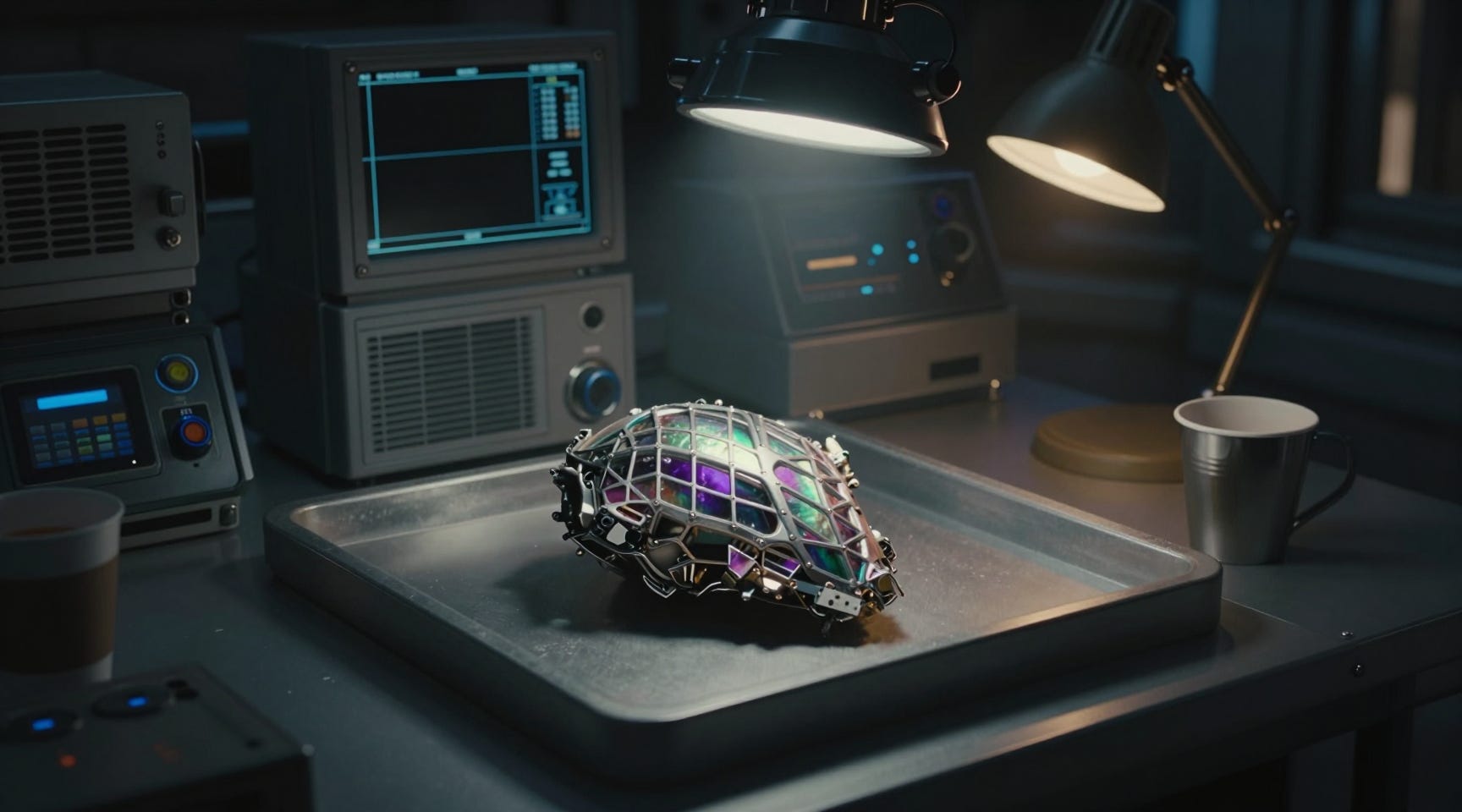
The fragment sat in the inspection tray under his magnification hood, a piece of Vethrak hull composite roughly the size of his palm. Faint iridescence shifted across its surface as the overhead light tracked through its cycle. The material was genuine. He had authenticated enough alien debris over the past fourteen months to recognize the lattice structure without needing his instruments. The fragment was real.
The provenance was not.
Rasmus pulled up the sourcing record on his terminal. Tag 2291-J, sourced from Debris Field 4, Sector 11-Alpha, cataloged during the second UEN sweep of the Mars orbital corridor. The sweep had been thorough. He knew, because he had processed every fragment from Sector 11-Alpha himself, sitting at this same desk on Juno-3, working eighteen-hour shifts while the backlog threatened to bury the entire station’s processing capacity.
Sector 11-Alpha had yielded sixty-one tagged pieces. All sixty-one were already in the pipeline. He had the records. He had his own initials on every authentication stamp.
Tag 2291-J made sixty-two.
Rasmus leaned back in his chair. The authentication bay was quiet during third shift, the overhead ventilation pushing recycled air through ducts that rattled every thirty seconds with a sound like someone tapping a wrench against sheet metal. Two other authenticators worked the far end of the bay, heads down, hoods lit, moving through their own queues. Neither looked up.
He opened the fragment’s physical inspection report. Mass, density, spectral signature, lattice depth. All consistent with genuine Vethrak hull composite. Whoever had prepared this tag had done exceptional work. The sourcing coordinates matched a real debris field. The collection timestamp fell within the window of the actual sweep. The courier chain showed three transfers between collection and his desk, each one logged with proper credentials.
The only problem was that he had already authenticated every piece from that sector. Sixty-one fragments. Not sixty-two.
Someone had duplicated a provenance tag, attached it to a real piece of Vethrak material sourced from somewhere else, and fed it into the legitimate pipeline. The duplicate was good enough to survive automated verification. It would have survived human review, too, if any other authenticator had drawn this piece from the queue. Rasmus only caught it because Sector 11-Alpha was his. He remembered every piece.
He pulled the fragment from the tray and set it on his desk beside his cold coffee. The iridescence caught the light again, faint purples and greens sliding through the lattice like oil on water.
The question was simple. The answer was not.
If he flagged the duplicate, Juno-3’s entire salvage pipeline would lock down for investigation. Standard protocol. A provenance fraud triggered a full audit of every tag processed in the previous ninety days. The audit would take two weeks minimum. During those two weeks, no authenticated material would leave the station. The repair yards at Ceres, already running three months behind schedule, would lose their primary supply line. Ships waiting for hull patches, reactor shielding, and drive components would stay grounded. Crews would stay stranded.
People would die. Not dramatically, not in explosions or combat. They would die the way people died in Year 2: slowly, from systems failing on ships that could not be repaired, from life support degrading in stations that could not get replacement parts, from medical equipment breaking down in clinics that had been promised resupply six weeks ago.
If he stamped the tag and moved on, a piece of Vethrak material with unknown origins would enter the official pipeline. It might be harmless. Salvage crews sometimes recovered fragments outside sanctioned sweeps and needed a way to get them into the system. The UEN’s processing bureaucracy had not kept pace with the volume of debris still orbiting every major body in the solar system. Unofficial recovery happened. Everyone knew it.
It might not be harmless. The material could have been diverted from a research facility, stripped from a classified site, or pulled from wreckage that the UEN had quarantined for reasons he was not cleared to know. Vethrak technology was not passive. Some of it interacted with human systems in ways that the science teams were still mapping. Uncontrolled material entering the supply chain carried risks that no one fully understood.
Rasmus looked at the queue on his terminal. Forty-three pieces. Behind those, another seventy submitted overnight. Behind those, the weekly shipment from the Mars corridor sweep, expected in two days. The backlog grew every shift. It never shrank.
His comm chimed. He opened the channel.
“Botha, you still on third?” The voice belonged to Zainab Ezeh, the shift supervisor. She managed the authentication bay’s throughput metrics, which meant she spent most of her time watching numbers climb in the wrong direction.
“Still here.”
“You’re running slow. Terminal shows you’ve been on the same piece for eleven minutes.”
Eleven minutes. He looked at the fragment on his desk, the iridescence still moving through the lattice. Eleven minutes of staring at something that should have taken ninety seconds.
“Complex lattice structure,” he said. “Needed a second spectral pass.”
“Copy. Pick it up if you can. Ceres is asking about the next batch.”
The channel closed. Rasmus looked at the authentication stamp beside his terminal. A simple tool: a biometric scanner tied to his credentials, a pressure pad that embedded his approval code into the fragment’s tag. One press and the piece moved downstream. One press and forty-three more pieces followed, and then seventy, and then the weekly shipment, and the repair yards got what they needed, and ships flew, and people lived.
One press and he became complicit in a system he could not see the edges of.
He picked up the stamp. The fragment sat on his desk, catching light it had no right to catch, alien material wrapped in human paperwork, waiting for a human decision.
Rasmus thought about Sector 11-Alpha. Sixty-one pieces. He remembered every one. He remembered the lattice patterns, the spectral signatures, the weight of each fragment in the inspection tray. He remembered because remembering was the only thing that separated authentication from rubber-stamping.
He set the fragment back in the inspection tray. He opened the flagging interface on his terminal and began typing his report.
The pipeline would lock. Ceres would wait. Ships would stay grounded. The backlog would grow.
He typed anyway. Because sixty-one was sixty-one, and sixty-two was a lie, and the moment he stopped counting was the moment the entire system stopped meaning anything at all.
Author’s Note: By Year 2 Post-Invasion, humanity’s salvage infrastructure was drowning in volume. The Salvage Protocol, established months earlier, created a framework for cataloging and distributing recovered alien material, but the bureaucracy couldn’t match the pace of recovery. Gray-market operators exploited the gap, feeding undocumented material into legitimate channels through forged provenance tags. Authenticators like Rasmus held the line between a system that worked slowly and one that didn’t work at all. Most of them never knew what happened downstream.
If you enjoyed this story, you can follow the main story arc in The Exodus Rush, the first book in The Vethrak Requiem series.