


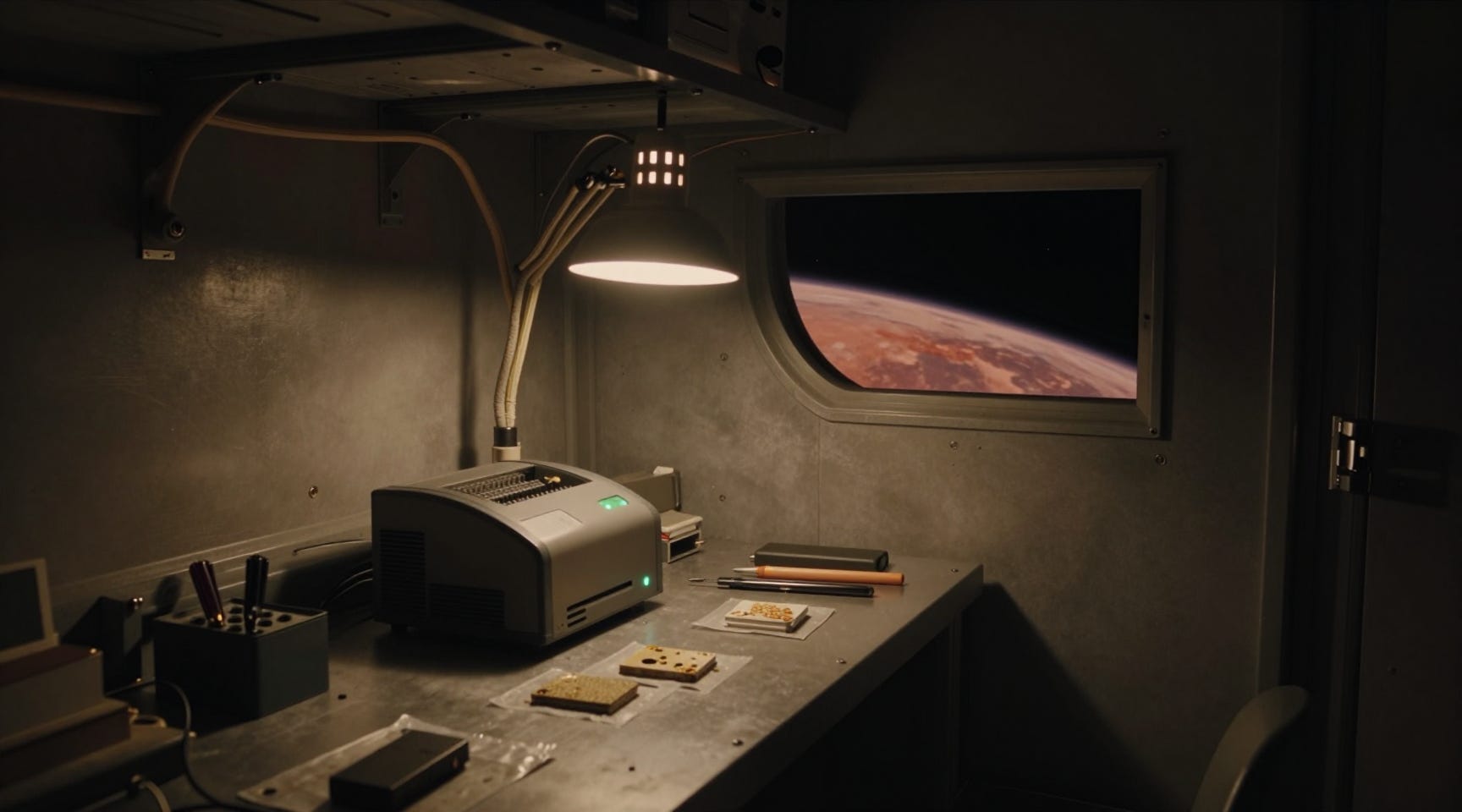
The biometric printer hummed at a frequency Setareh Fontana could identify from three rooms away. A low, stuttering vibration that meant the thermal head was cycling through its calibration sequence. Forty-seven seconds until the chip was ready. She counted them the way her mother had taught her to count heartbeats during the invasion: steady, methodical, without letting the number mean anything.
The chip slid from the printer’s output tray, warm against her fingertips. Standard civilian profile, keyed to a woman named Yelena Maksimova who had died of radiation exposure on Ring Station Fourteen eight months ago. The dead woman’s biometric data, her retinal pattern, her palm geometry, her gait signature, now lived on a ceramic wafer the size of a thumbnail. Tomorrow morning, an unregistered refugee named Daria would press that wafer against the scanner at Ration Distribution Point 6 in Arcadia Sector, and the system would welcome her as Yelena. The system would dispense 1,400 calories and 2.1 liters of water. Daria would eat. Her two children would eat. The dead would feed the living, same as always.
Setareh placed the chip in a static sleeve and set it on the shelf beside eleven others, each one a small resurrection. The Greyline Parish paid her four hundred thermal credits per chip, enough to cover her own atmospheric stipend and the rent on this converted maintenance closet she used as a workshop. The arrangement was clean. She forged. They distributed. Nobody asked questions that would make the answers dangerous.
The knock came at 2300, two hours after her usual cutoff. Three taps, pause, two taps. Greyline cadence. She pulled back the bolt and opened the door to a man she had never worked with before.
He was tall, broad through the shoulders, wearing a cargo handler’s coveralls with the name patch removed. The absence of the patch told her more than any introduction would have. People who removed their name patches either worked for one of the syndicates or wanted her to think they did.
“Kayode Sepulveda,” he said. “Blessing sent me.”
Blessing. The name carried weight in Mars orbital’s underground economy. Blessing Eriksson ran logistics for the Greyline Parish across three sectors, a woman whose organizational precision had kept the forgery network invisible to UEN census audits for almost two years. If Blessing had sent this man, the job was sanctioned.
“Inside.” Setareh stepped back. The corridor beyond was empty, the overhead lights dimmed to nightcycle amber. Kayode entered and she closed the door.
He reached into his coveralls and produced a data stick, matte black, military grade. The housing alone was worth more than her monthly income. Setareh took it and turned it under the work lamp. No manufacturer’s mark. No serial etching. The kind of blank that came off Iron Wake supply lines, stripped and sanitized before reaching civilian hands.
“What am I building?”
“Full biometric key. Retinal, palmar, gait, and voiceprint. Needs to pass mil-spec authentication, not civilian.”
Her hands stopped moving. The data stick sat between her thumb and forefinger, warm from his pocket. Civilian scanners checked three parameters. Military scanners checked seven, including subdermal vein mapping and cardiac rhythm signature. She had never built a mil-spec key. The equipment in this room could not produce one.
“That’s not what I do.”
“Blessing says you can adapt your printer. She says the thermal head resolution is close enough if you run a double pass on the substrate. Two layers instead of one.”
Setareh set the data stick on the workbench. The printer continued its idle hum, a sound that had become as familiar as breathing over the past nineteen months. She had built 643 civilian keys in this room. Each one had fed someone. Each one had given a name back to a person the census had erased.
Military-grade keys opened different doors. Not ration queues. Not water distribution points. Armories. Restricted decks. Command-level access corridors where the decisions that shaped the survival of thousands were made behind pressure-sealed hatches.
“Who is this for?”
“You know better than to ask that.”
She did. The forgery network survived on compartmentalization. She built keys. Other people used them. The gap between those two actions was the only thing protecting everyone involved. Knowing who carried a key and where they carried it made her a liability instead of an asset.
The problem was what the key implied. Someone needed to walk through a military checkpoint as someone else. Not to eat. Not to drink. Not to secure shelter for a family the system refused to count. This was infiltration. This was something that could get people killed, not the slow death of starvation or exposure, but the fast kind that came with armed response teams and sealed corridors.
“The pay is twelve thousand thermal credits,” Kayode said. “Blessing authorized the full amount.”
Twelve thousand. Thirty times her usual rate. Enough to cover her atmospheric stipend for the next two and a half years. Enough to disappear from Mars orbital entirely and start over on one of the outer settlements where the census infrastructure was fragmented and porous. Enough to stop forging keys altogether, if she wanted.
Did she want that?
The printer hummed. The eleven chips on the shelf waited in their static sleeves, eleven people who would eat tomorrow. She thought about Daria’s children, ages four and seven, whose names she was not supposed to know. She thought about the sixty-three unregistered families in Arcadia Sector who depended on Greyline’s distribution network, a network that depended on her keys, keys that depended on her continued willingness to sit in this room and press ceramic wafers against a thermal head.
If she refused this job, Blessing would find another forger. Someone less careful. Someone who might make mistakes that compromised the civilian keys along with the military ones. If the network collapsed, sixty-three families starved.
If she accepted, she became something different. Not a woman who fed people the system forgot. A woman who armed people the system feared.
Setareh picked up the data stick.
“I’ll need eight hours,” she said. “The double-pass substrate cure takes time.”
Kayode nodded. He did not smile. He did not thank her. He left the same way he had entered, three taps confirming his departure.
She plugged the data stick into her diagnostic reader and studied the biometric profile it contained. Seven parameters, each one rendered in enough resolution to fool hardware designed to keep secrets. The identity on the stick belonged to a UEN logistics officer stationed at Deimos Depot, a supply hub that processed ninety percent of the military hardware moving between Mars and the belt.
Ninety percent. The number settled into her like a stone dropped into still water.
She initialized the double-pass calibration sequence. The printer’s hum shifted, climbing half an octave as the thermal head powered to a resolution it had never been asked to reach. Forty-seven seconds until the first substrate layer was ready. She counted them the way her mother had taught her. Steady. Methodical. Without letting the number mean anything.
Outside the maintenance closet, Mars orbital turned in its slow rotation, carrying six hundred thousand registered lives and an unknown number of unregistered ones through the dark. Somewhere in Arcadia Sector, Daria’s children slept. Somewhere on Deimos, a logistics officer whose identity would walk through two doors at once had no idea a woman in a converted closet was building a second version of his life.
The printer hummed. Setareh worked.
Author’s Note: The Greyline Parish operates one of Mars orbital’s most persistent identity forgery networks, producing ceramic biometric keys that allow unregistered refugees to access civilian ration queues using the profiles of deceased residents. The network’s survival depends on compartmentalization: forgers never meet end users, distributors never visit workshops, and payment flows through thermal credit accounts that the UEN’s financial monitoring systems have not yet learned to trace. The Iron Wake supplies the blank data sticks and military-grade components that make advanced forgery possible, taking a percentage of every transaction that passes through Greyline’s infrastructure. By Year 13, an estimated 400 to 600 unregistered residents on Mars orbital depend on Greyline-forged keys for daily survival.
If you enjoyed this story, you can follow the main story arc in The Exodus Rush, the first book in The Vethrak Requiem series.