


Sarah Vance found her niece between two departures.
The transfer corridor curved along Prometheus Station’s residential ring, one wall armored steel and the other reinforced glass. Beyond it, supply shuttles crossed the black in measured bursts. UENS Hope waited free of the station with her running lights bright, while UENS Vanguard remained inside a zero-gravity service framework farther along the industrial core.
Kira stood at the glass with a campaign case in one hand.
Fleet personnel moved around her toward the docking array. Gray uniforms, sealed cargo carts, final manifests. The ring’s spin held everyone at thirty percent of Earth gravity. Experienced station workers leaned into each step. Visitors pushed too hard and caught themselves against the rail.
Kira moved like she belonged here.
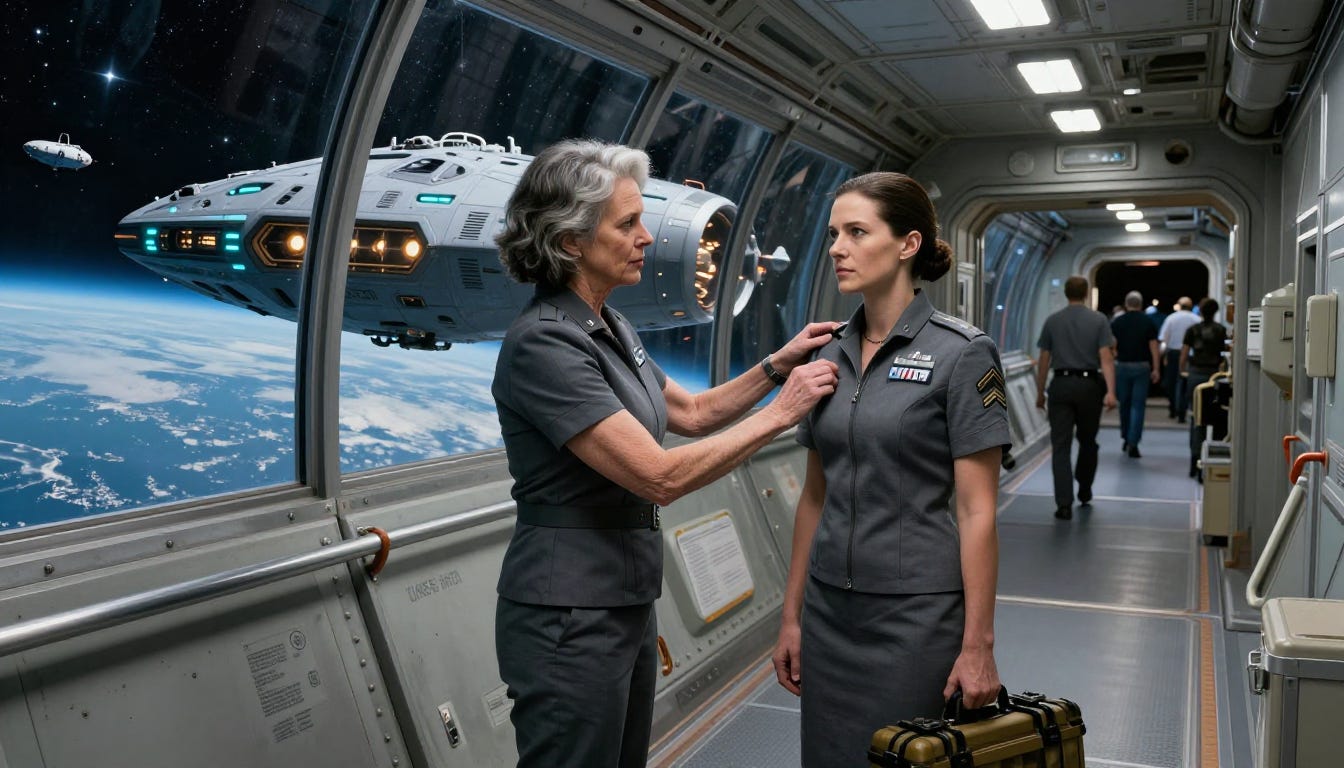
Sarah stopped three meters away. The captain’s insignia still drew her eye first, despite every effort not to let it. Kira had earned the rank through battles Sarah understood mostly as casualty summaries and classified telemetry. Her niece wore command without ceremony. Straight posture. Dark hair secured at the nape. One thumb pressed against the campaign case latch, checking a seal already checked.
The four-year-old in the yellow dress had done the same thing with the clasp on her telescope case.
“You’re difficult to find,” Sarah said.
Kira turned. The tension around her eyes eased by a fraction. “You found me.”
“I had intelligence support.”
“Vasquez?”
“Your mother.”
A small smile crossed Kira’s face. “That qualifies.”
Sarah joined her at the viewport. Hope’s matte armor cut a dark shape against Earth, broad enough to cover part of the Mediterranean from this angle. Work pods withdrew from the fuselage one by one. A transfer shuttle approached the aft port under maneuvering thrusters.
The departure board above the corridor showed four hours, twelve minutes.
Neither woman looked at it for long.
“Are you ready?” Sarah asked.
No tactical questions. No request for target coordinates, reserve windows, or casualty projections. Sarah had read the campaign assessment. She had helped build it from depot records and fourteen years of Vethrak operational patterns. Those answers belonged to intelligence rooms and command briefings.
This answer belonged here.
“Yes,” Kira said.
Sarah studied the hand around the campaign case. Steady. No white pressure at the knuckles. Kira’s shoulders carried fatigue, not hesitation. The answer contained no performance and no comfort offered for an aunt’s benefit.
They had never lied to each other. Silence, yes. Classified omissions, too many. Grief hidden until there was space to open it. Never lies.
“Good,” Sarah said.
Kira’s gaze returned to Hope. “You don’t sound relieved.”
“Readiness and relief have little overlap.”
“That sounds like something you learned on Sanctuary.”
The station’s ventilation carried ozone and fresh sealant through the corridor. Eleven years inside an asteroid had taught Sarah the language of failing systems: a fan bearing half a tone too low, scrubber cycles separated by the wrong number of seconds, a pump shivering through the deck before its pressure dropped. Prometheus sounded healthy. Busy. Built for another century.
Sanctuary had sounded alive by negotiation.
“The weight doesn’t get lighter,” Sarah said. “You learn to carry it without letting it change your stride.”
Kira’s reflection hovered over the stars. “You taught me that.”
“I know.”
The words came sharper than Sarah intended. Pride had spent years disguised as instruction, correction, and impossible expectations. Naming it stripped away the protection of useful language.
She turned from the viewport.
“I am proud of you.”
Kira remained still.
Sarah had addressed seventeen thousand people while life support failed behind sealed walls. She had read death lists aloud. She had explained ration cuts to parents and burial limits to families who had no ground for graves. None of it had required the courage of this sentence.
“Not for the victories,” Sarah continued. “Not for the rank. I am proud of the way you carry people with you. The ones aboard Hope. The ones who came home. The ones who didn’t. You never turn them into numbers, even when numbers are the only tool the work gives you.”
Kira lowered the campaign case to the deck. In the station’s light gravity, it settled with a muted tap.
“Sometimes numbers are easier.”
“Easier is useful for about ten minutes. Then the names come back.”
“Do they ever stop?”
Sarah considered the question. Kira deserved an answer without polish.
“No.”
A maintenance crew passed behind them, boots finding the station rhythm. One worker carried a coil of fiber line across both shoulders. Another guided a tool cart with two fingers. Their conversation faded toward the industrial core.
Kira nodded once. “Good.”
Pride tightened beneath Sarah’s ribs. Of course that was her answer. Not because the names brought comfort. They did not. The names proved command had not hollowed her into a machine built from decisions.
An overhead tone marked a docking change. Hope’s transfer shuttle aligned with the station port, its attitude jets flashing white against the dark.
“My embarkation window moved forward,” Kira said. “Shaw needs the outer lane clear for Vanguard’s final launch test.”
“How long?”
“Seven minutes.”
“Then I used six.”
“You planned this conversation?”
“I plan all conversations.”
“You always said planning a conversation was another way to avoid having it.”
“Age has made me a hypocrite.”
Kira lifted the campaign case. “No. Sanctuary did.”
The corridor traffic opened around them. Thirty meters ahead, an illuminated junction marked the route to the docking array. Beyond it waited the shuttle, Hope, and a campaign whose casualty models Sarah had helped calculate.
No advice would improve what Kira already knew. No blessing could reduce a plasma strike or stabilize a fold transition. Be careful would ask a captain to choose caution over the mission. Good luck would surrender the outcome to chance.
Sarah stepped close and straightened the edge of Kira’s collar. The gesture belonged to another life, one with birthday dresses and telescope cases and a moon rock never brought home.
“Come home,” Sarah said.
Kira’s breath stopped for one count.
She did not promise. Promises built against war became debts collected from whoever survived. Sarah had spent too many years paying those debts for the dead.
Kira nodded.
Enough.
Sarah dropped her hand. Kira picked up her pace toward the docking junction, each step controlled in the weak gravity. Fleet personnel moved aside before she reached them. Some saluted. Others carried loads too awkward for ceremony and gave her a brief nod instead.
At the junction, Kira looked back.
Sarah held her place beside the glass.
The look lasted one second. Family, captain, intelligence advisor, niece. Every role present. None of them large enough for what passed between the two women.
Kira turned toward the docking array.
Sarah remained at the viewport until the corridor swallowed her. The girl she had helped raise was gone. The captain she respected walked on, her stride unchanged beneath the weight.
If you enjoyed this story, you can follow the main story arc in The Exodus Rush, the first book in The Vethrak Requiem series.