


The line never ended.
Mara Iqbal sat behind a narrow desk bolted to the deck, a tablet in her left hand and a stylus in her right. The processing hall stretched the length of Prometheus Station’s lower ring, a corridor widened into a cavern by rows of temporary partitions and portable medical bays. Grav plating kept everyone steady, even the children who had grown up with almost no pull at all. Overhead, duct fans pushed recycled air with the faint metallic tang of new sealant.
She keyed in another name, another date of birth, another place that no longer existed on any official chart. Sanctuary Colony. Year 12. Evacuation manifest serial 38-17.
“Next,” she said.
A man stepped forward, thin and sun-browned despite the artificial light. His hands were rough, marked by cuts that had never fully healed. A badge hung from his neck, scratched through so many times that its original logo was impossible to make out.
“Name,” Mara said.
“Jalen Okoro.” His voice carried the cadence of someone who had spent years speaking over industrial machinery. “Occupation: maintenance, atmospheric processors. I can keep your scrubbers running.” He lifted his chin, pride tucked under the fatigue.
Mara glanced at his work permits and transfer notes. The medical team had cleared him for general housing. No contagion flags, no neural disruption exposure, no nanite contraindications. The station needed technicians. Prometheus needed everyone.
She assigned him to a bunk in Sector D, four levels up, and marked him for an interview with Prometheus Technologies. He thanked her, then moved on without looking back. The line absorbed him, and Mara faced the next pair of eyes.
A girl, maybe ten. Tight braids. Oversized jacket that had seen too many repairs. She clutched a glass jar against her chest with both hands, knuckles white. Inside the jar was a swirl of reddish soil and a tiny plant that had barely pushed through.
“Name,” Mara said.
“Nina,” the girl said. “Nina Bale.” She held out a paper wristband, the kind Sanctuary used when their power grid failed. The paper was stained with condensation and grime.
“Where are your guardians?”
The girl gestured over her shoulder. A woman stood a few meters back, her face turned toward the medical bay where another child lay under a scanner. The woman gave a small nod, a question without words.
Mara held the jar up to the light. Soil meant bacteria. Soil meant unknown pathogens. The quarantine protocol was clear.
“I need to take that for inspection,” Mara said. “You will get it back after sterilization. I promise.”
Nina’s eyes narrowed. “It is from our garden. It is all we have left.”
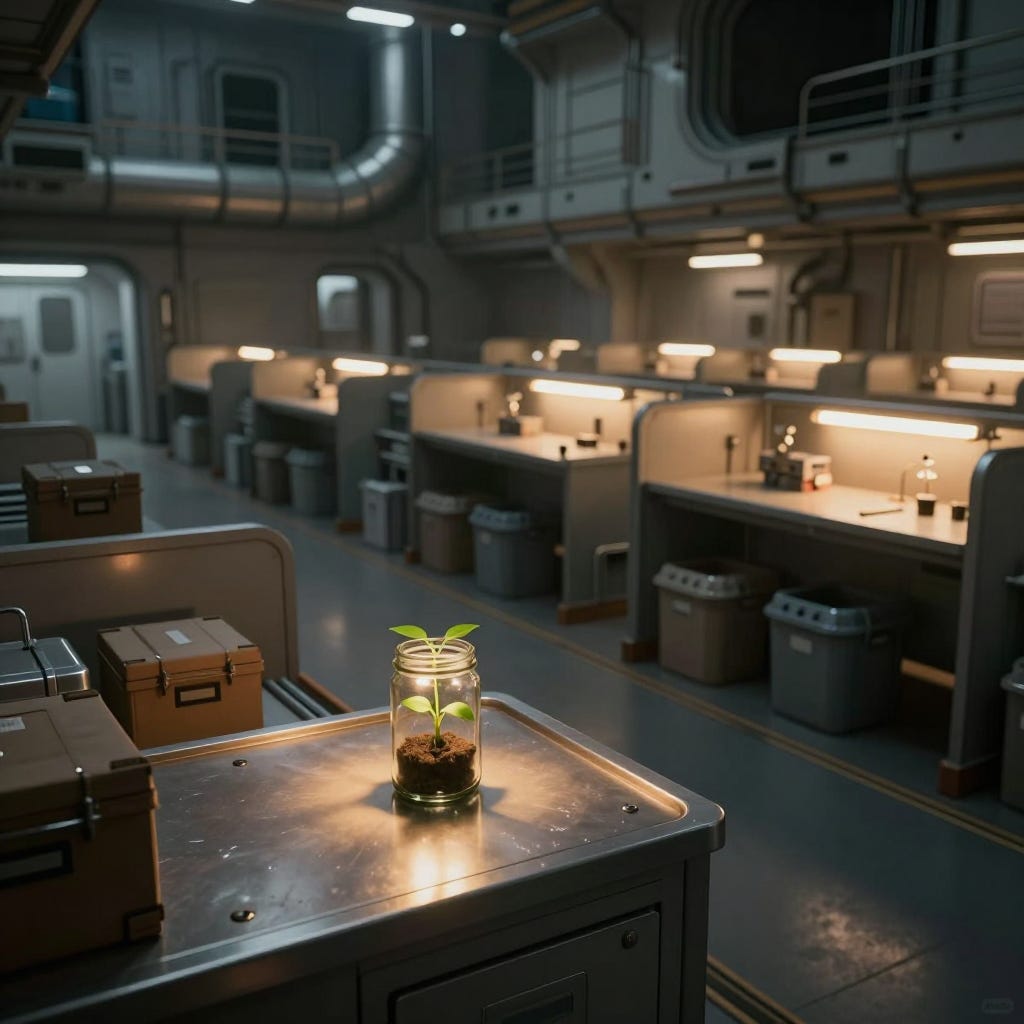
The line pressed forward behind her. An old man gripped the arm of a teenage boy. A pregnant woman wiped sweat from her forehead with the back of her hand. The processing hall hummed with tired breathing and distant machinery.
Mara tapped a code into her tablet and lifted a small seal pouch from her drawer. The pouch was clear crysteel, used for evidence and biohazards. She set it on the desk.
“Put the jar in here,” she said. “I will label it myself. It will go to Atmospherics for sterilization. You can watch me write your name.”
Nina hesitated. The jar shook once, then settled as she placed it into the pouch. Mara sealed it with a thumbprint, then wrote Nina’s name in block letters across the top.
“Sector D, family housing,” Mara said. “Your mother and brother will join you after medical screening.”
Nina nodded, then moved on. The woman at the medical bay released a slow breath when the scanner chimed green. She lifted her sleeping child and joined the line.
Mara set the jar in the quarantine bin beside her desk. The plant inside angled toward the overhead lights, seeking the closest thing to a sun.
Hours passed. The station’s artificial day cycle shifted from white to warm amber. The processing hall filled with new arrivals, then emptied, then filled again. Mara’s hand cramped around the stylus. Her tablet’s battery hit ten percent and a runner swapped it for a charged unit.
By the end of the shift she had processed three hundred and twelve people. The number meant nothing next to the full tally. Seventeen thousand in the halls, seventeen thousand in her head. The count crept upward with every tap.
She logged out and stood, knees stiff. The grav plating held her with the gentle insistence of Earth gravity, heavier than the low pull she had lived with on Luna Station Alpha before transferring to Prometheus. The weight of it settled in her bones, an anchor she welcomed after years of drifting through grief.
Mara walked the corridor toward Sector D. She did not go off shift, not yet. She needed to check the quarantine locker, to make sure the jar had not been discarded by a tired tech who could not afford a mistake.
The locker was at the end of a narrow maintenance passage, far from the processing hall’s hum. A single light strip flickered overhead. Mara keyed in her clearance and pulled the drawer open. The jar sat inside the pouch, Nina’s name still sharp in black marker. The tiny plant leaned toward the light like a question.
Her comm buzzed. A text, not a call. Her sister’s name glowed on the screen. Kesi. Earth side, Nairobi Recovery Zone.
Mara opened the message.
We got water today. The river pumps are running again. Tell me you ate something that was not powdered.
A smile pulled at one corner of Mara’s mouth. She typed back with her thumb.
Synthetic noodles, extra salt.
She slid the phone back into her pocket and lifted the jar from the drawer. The protocol said quarantine held for twenty four hours. The protocol also said nothing about a plant, or the child who would wait for it.
Mara carried the jar to the Atmospherics lab. A technician met her at the door and took it without questions. The station ran on routines and trust. She watched as the jar disappeared into a sealed chamber lined with UV strips and sterilization coils.
“When will it be cleared?” Mara asked.
“Tomorrow morning,” the technician said. “If it survives.”
Mara nodded and turned back toward Sector D. She made a detour to the family housing cluster and found Nina sitting on a bunk, knees pulled to her chest. Her mother spoke in a low voice to a housing officer across the corridor. The sleeping boy lay under a thin blanket, chest rising and falling in even rhythms.
“It will be back tomorrow,” Mara said. “I wrote your name on it. Nobody can take it now.”
Nina’s posture loosened. “Promise?”
“Promise.” Mara left before the gratitude could settle into her face. She did not want to make this about her.
The corridor outside Sector D opened into an observation alcove. Through the thick glass, Earth hung in the distance, blue and scarred, cloud bands turning slow against the curve. Prometheus Station drifted over the terminator, night giving way to the fragile gold of dawn.
Mara rested her palm against the glass. Her breath fogged it for a moment, then cleared. The planet looked small from here, smaller than the memories that had once haunted her. She thought of the jar in the sterilization chamber, of a plant that had grown in soil no one had expected to survive. She thought of seventeen thousand people moving through the halls, each one carrying a world in their hands.
The line would continue tomorrow. The tally would climb. The station would keep turning.
Mara let her hand fall. She returned to the processing hall and took her seat for the night shift.
This story takes place in Year 12 (2137), immediately after the Sanctuary Colony evacuation described in Book 1. Prometheus Station’s processing centers operated around the clock to integrate 17,312 colonists into Earth orbit society, pairing Salvage Protocol resources with civilian housing and medical teams. The atmospheric processor specialists from Sanctuary later formed the core of Prometheus Station’s life support division.