


The monitoring station at the edge of the Tau Ceti system was not built for comfort. It was built for function: a compact pressure vessel bolted to a rock fragment that had been drifting through the outer system for longer than Keraneth civilization had records for. The station’s interior was arranged around a single primary chamber, its walls lined with sensor analysis interfaces that displayed the system’s steady-state data in layered streams. The station had been operating for seven hundred and ninety years without interruption. It had never detected anything its protocols classified as anomalous.
Frequency-Keeper sat at the primary analysis station. The shift was deep into the watch cycle – the hour when the previous operator had left and the next had not yet arrived. The station was certified for dual occupancy, but the rotations had stretched during the current maintenance cycle. Frequency-Keeper was alone.
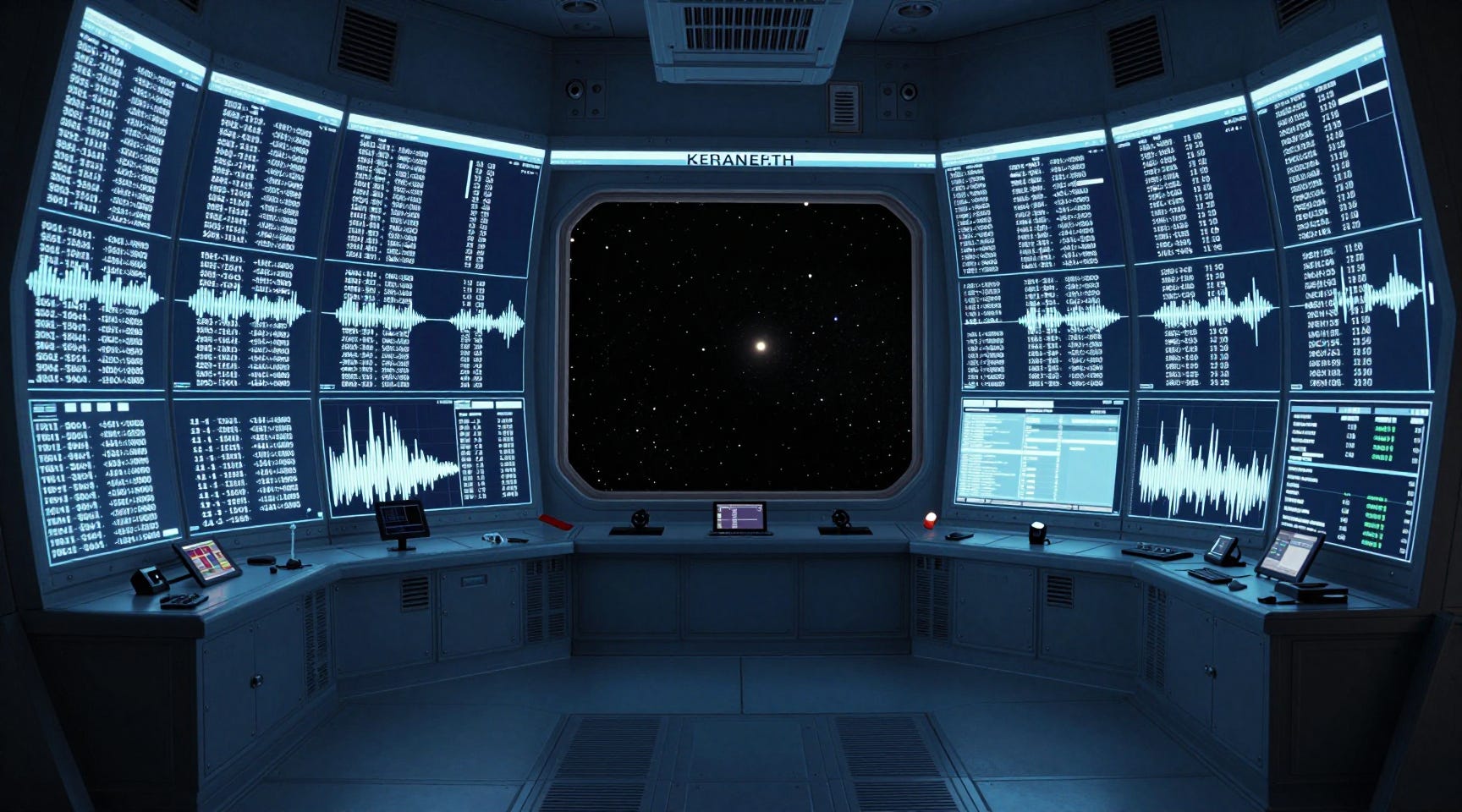
The displays cycled through their standard patterns. The system’s outer boundary registered as a clean gradient: stellar radiation, gravitational distortion from the star’s influence, the faint background noise of fold-space. Everything was nominal. The same data Frequency-Keeper had observed for the duration of their assignment. The same data the operators before them had observed. The same data stretching back to the station’s activation, seven hundred and ninety years earlier.
Frequency-Keeper was not assigned to active monitoring. The station’s primary function was passive data collection. The sensor arrays recorded everything within their range, and the analysis systems flagged anomalies for secondary review. No anomalies had been flagged during Frequency-Keeper’s tenure. The previous operator’s logs did not record any. The watch logs for the station’s entire operational history showed no entries beyond the routine calibration reports.
Frequency-Keeper had a habit that was not part of the operational protocol. During the quiet hours, when the displays showed nothing that required attention, Frequency-Keeper reviewed historical log data. Not the summary reports – the raw sensor logs, accumulated over decades, stored in the station’s archival buffers. The habit had started as idle curiosity, a way to pass the slow hours. It had become a practice: tracing the data profile of known objects through years of accumulated readings, observing how the system’s steady state shifted over cycles, learning the pattern of the solar system the way a technician learned a machine’s rhythm.
The historical review was satisfying in a way the active monitoring was not. The station’s primary function was to detect the unexpected. The historical review revealed the shape of the expected. Frequency-Keeper found comfort in the repetition, the predictability, the knowledge that the system had a steady state and that Frequency-Keeper could read it.
The anomaly appeared in the sensor log from thirty-seven years prior.
Frequency-Keeper did not notice it immediately. The historical review was a slow process, scrolling through archived data streams in the background while the active displays cycled through their standardized outputs. The anomaly registered as a deviation in a frequency band the station’s analysis protocols did not actively monitor: four hundred and eighty terahertz, classified as stellar emission. The classification was standard. The frequency was within the range of natural radiation output for a star of Tau Ceti’s type.
The anomaly was too regular.
Stellar emission was not periodic at the granularity the archived logs preserved. The background radiation fluctuated with the star’s activity cycle, which operated on a scale of decades, not seconds. The signal Frequency-Keeper’s attention had caught was a repeating pulse at an interval of precisely twelve point seven seconds. Twelve point seven. The same interval in every instance Frequency-Keeper reviewed. The signal had been present in the archived logs from thirty-seven years ago. It was present in the logs from seventy years ago. It was present in the logs from the station’s first year of operation.
Frequency-Keeper flagged the data for secondary analysis. The analysis ran automatically, comparing the flagged signal against the station’s reference library of known stellar emissions. The analysis returned a result Frequency-Keeper had not expected: no match. The signal did not correspond to any documented stellar emission profile. The signal’s periodicity was artificial.
Frequency-Keeper ran the analysis again, adjusting the parameters. The result was the same. The signal at four hundred and eighty terahertz, pulsing at an interval of twelve point seven seconds, had been present in the Tau Ceti system continuously for seven hundred and ninety years. The station’s own analysis systems had never flagged it, because the frequency was outside the active monitoring range. The protocol classified the frequency as stellar emission. The protocol did not require analysis of stellar emission. The protocol therefore did not detect the signal, because the protocol was not looking for it.
The protocol had never been looking for it.
Frequency-Keeper’s bioluminescent display surfaces shifted without conscious control. The station’s monitoring chamber filled with Warning-Tone, sharp blue-white, saturating the interior with the color of sudden danger. Frequency-Keeper’s conscious mind was still processing the data streams, still running through alternative explanations, still trying to find a scenario in which the signal was natural. The body had already reached the conclusion. The body had known before the mind was ready to accept it.
A Vethrak surveillance probe had been in the Tau Ceti system since the attack. It had been transmitting the entire time. The Keraneth had never detected it.
Frequency-Keeper sat in the Warning-Tone saturation, the light of the station’s emergency register reflecting off the display surfaces. The active monitoring displays continued their standard cycling. The system’s outer boundary registered as a clean gradient. Everything was nominal. The solar system looked exactly as it had before Frequency-Keeper discovered the signal. The station’s protocols did not know that anything had changed.
Frequency-Keeper opened the priority channel to fleet command. The message was concise: a reference to the flagged frequency, the analysis result, the transmission duration. Frequency-Keeper attached the historical log data. The transmission was brief. The implications were not.
Frequency-Keeper remained at the station after the message was sent. The displays continued their cycles. The solar system continued its rotation around the star. The signal at four hundred and eighty terahertz continued its pulse at twelve point seven second intervals, as it had done for seven hundred and ninety years, as it would continue to do until someone arrived to silence it.
Frequency-Keeper knew that if there was one probe, there were more. The certainty was not based on evidence – the station’s data showed only the single signal. But the logic was inescapable. A species that placed one surveillance asset would not stop at one. The signal that had been missed for seven hundred and ninety years was the first of many that the Keraneth had never seen.
The station’s displays continued their standard cycling. The solar system looked the same. But Frequency-Keeper perceived it differently now. The quiet outer system, the steady background noise, the familiar shape of the Tau Ceti system on the sensor displays – none of it was what it had appeared to be. The Vethrak had been monitoring Tau Ceti the entire time. The Keraneth had been observed for seven hundred and ninety years without knowing it. One curious technician, alone on a slow shift, reviewing logs that no one else had reviewed, had identified what a civilization’s entire sensor architecture had failed to see.
Frequency-Keeper waited for the response from fleet command. The signal continued its pulse in the archived data. The system continued its silent rotation. And the first Keraneth to know that they had never been unwatched sat alone at the edge of the system, carrying a knowledge that would change everything.
If you enjoyed this story, you can follow the main story arc in The Exodus Rush, the first book in The Vethrak Requiem series.