


The chair straps cut into Elif Demir’s shoulders. Relay Station Tern kept a thin, lazy spin for stability, never enough to stop a body from drifting at the wrong moment.
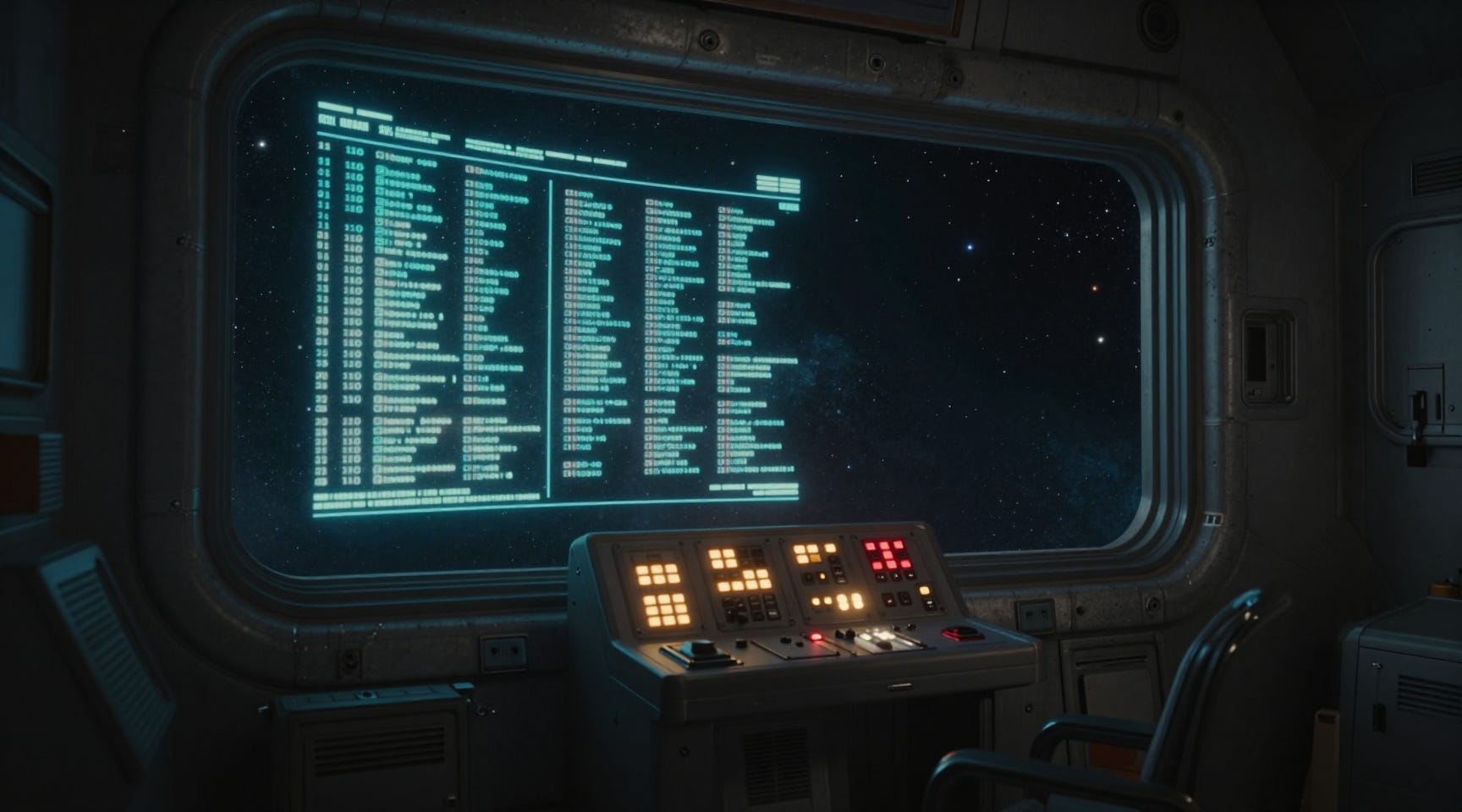
The comms queue stacked itself across the wall display in clean rectangles. Green for civilian traffic. Blue for UEN administrative. Red for military.
Red meant the station belonged to someone else.
A thin amber line blinked at the bottom of the stack.
Unclassified. Narrowband. Legacy format.
Elif tapped it open.
A CSV transponder signature, stripped down to bare identity fields. No registry. No flight plan. Oxygen reserve estimate embedded in the header, crude and honest.
Six hours.
The clock read Year 7, Day 119, 05:00. Tern sat between routes, a relay node that existed because distance still killed.
A new block slammed into the top of the queue.
Fleet directive. Full bandwidth. Immediate.
Jules Mercier floated into the aisle behind her, one hand hooked around the overhead rail. His collar sat crooked, like he had dressed in the dark.
“You have that look,” he said.
“Elif has a distress beacon in legacy format,” Elif said. “No registry. Six hours of oxygen.”
Jules leaned over her shoulder. The wall display reflected in his eyes, tiny rectangles of human need.
“Directive arrived,” he said.
“It did.”
“Send it.”
The order landed with the weight of policy. Fleet traffic outranked everything. Fleet traffic kept convoys alive.
Elif pulled up the directive payload. Updated fold corridor restrictions. Vethrak activity in the outer arcs. A reroute for a civilian convoy, three jumps out.
People she would never meet, alive or dead based on clean timing.
Elif brought the distress beacon details back up. Coordinates relative to Tern.
Too close.
The external camera feed offered nothing except deep black, a slash of the station’s own hull plating, and distant stars that did not care about oxygen.
Jules’ voice softened. “Beacon has no registry. No authentication. Someone could be spoofing traffic to pull rescue assets off the lanes.”
The invasion had taught every survivor the same lesson. Trust was a luxury item.
The amber line blinked again.
Elif expanded the payload. Legacy packets carried a small free text field at the end, a relic from earlier protocols.
One word sat there.
Mariam.
No surname. No rank. No ship name.
Heat rose behind Elif’s eyes. Mariam had been her mother’s name. A common name. A meaningless coincidence.
Her fingers hovered over the allocation panel. The fold array opened one window in the next two minutes. Tern could push one full burst in that window. A second transmission would wait.
Forty minutes until the next opening.
Six hours of oxygen.
Jules watched her hand pause. “Do not get creative.”
“Five percent timing jitter,” Elif said. “If the directive tolerates it, the distress packet can ride under the burst.”
“It will not tolerate it. Operations will flag the directive as tampered.”
“Tern has relay authority,” Elif said, eyes on the keychain field. “The cache holds a signing key for reroutes and traffic shaping.”
“The cache exists for emergencies. Fleet emergencies.”
The station intercom chimed. Automated, calm. “Fold window opens in one hundred twenty seconds.”
Elif opened the directive’s error correction layers. Three tiers of redundancy, built for noisy space and hostile hands. Tern’s fold lane had been stable for nine days. Sensor logs showed no interference.
One layer could go.
The system flashed a warning.
RED TRAFFIC INTEGRITY RISK.
Jules grabbed the rail hard enough to whiten his knuckles. “Stop.”
Elif’s mouth dried. The decision lived in her bones now, not in her head.
The beacon blinked again.
Someone out there still had power. Someone still spent it on a pulse into the void.
Elif marked one redundancy layer for removal. The freed bandwidth bar grew by a thin sliver.
Ten milliseconds.
Enough.
She carved out a timing slice and placed the distress packet inside it like a folded note.
Jules’ jaw worked. A small tremor ran through his cheek.
“If Fleet Integrity runs a diff, you will lose your clearance,” he said.
“Elif will lose her clearance,” Elif said.
The intercom chimed again. “Fold window opens in sixty seconds.”
Jules let go of the rail. His shoulders dropped, a reluctant release.
“Do it clean,” he said.
Elif sealed the directive with a new checksum and signature, chained to the same key the fleet used. Tern’s software verified the trust path.
Green confirmation.
The fold array drew power. The station lights dipped, then steadied. The Cascade Reactor’s hum deepened, a controlled strain.
Elif launched the burst.
No glowing ring appeared on the camera feed. Tern’s array sat inside the hull, invisible. Reality still twisted for a heartbeat, a faint warping at the edge of the star field.
Transmission complete.
The red block vanished from the queue.
The amber line vanished with it.
Jules exhaled. “Now we wait.”
Waiting tasted like copper.
Elif switched to the inbound buffer. Replies would come through the next window or the one after, routed across a chain of relays that survived by redundancy and stubbornness.
The queue rebuilt itself. Green shipments. Blue admin reports. Nothing red.
Minutes crawled.
A new amber line appeared.
Not a ping.
A response.
Elif anchored her boots under the console frame. The chair straps bit harder as her spine straightened.
The packet header carried an external relay stamp, then a second stamp. Someone had received the distress and bounced it back through the network.
A blue tagged packet followed it.
UEN Rescue Coordination.
Elif opened it.
Coordinates matched, refined. Estimated intercept time: three hours.
A message field sat at the bottom.
RESCUE ASSET DIVERTED. HOLD BEACON ACTIVE. YOU ARE RECEIVED.
Air moved through the vents, indifferent. The burn behind Elif’s eyes sharpened into something steadier.
She forwarded the coordination packet to Jules.
His reply arrived a moment later.
Good.
One word. Human.
The amber line blinked once more, then held steady.
Mariam.
A transmitter out there kept pulsing, a small candle of battery life and stubborn breath.
Someone answered.
Author’s Note: Relay stations like Tern sit between routes, invisible until the moment they matter. In the Survival Era, the network carried orders, warnings, and the smaller messages that kept people believing the species still listened.
If you enjoyed this story, you can follow the main story arc in The Exodus Rush, the first book in The Vethrak Requiem series.