


Emeka Bonnet’s workspace occupied a converted storage locker on Deck 9 of Meridian Station, three meters by two, barely enough room for the modified biometric scanner, the chip encoder, and the single chair where his clients sat. The ventilation duct above leaked a constant whisper of recycled air that smelled of copper and machine oil.
He preferred it to the corridors. The corridors smelled human.
The scanner was a medical-grade biometric reader, originally built for triage identification during mass casualty events. Emeka had acquired it from an Iron Wake salvage broker eight months ago, traded for information about a cargo manifest gap on the station’s Deck 4 supply corridor. In its original configuration, the scanner read fingerprints, retinal patterns, and vascular maps, then matched them against the UEN’s population registry. In Emeka’s configuration, it did the same thing, then wrote the data onto blank ration chips with a new identity number.
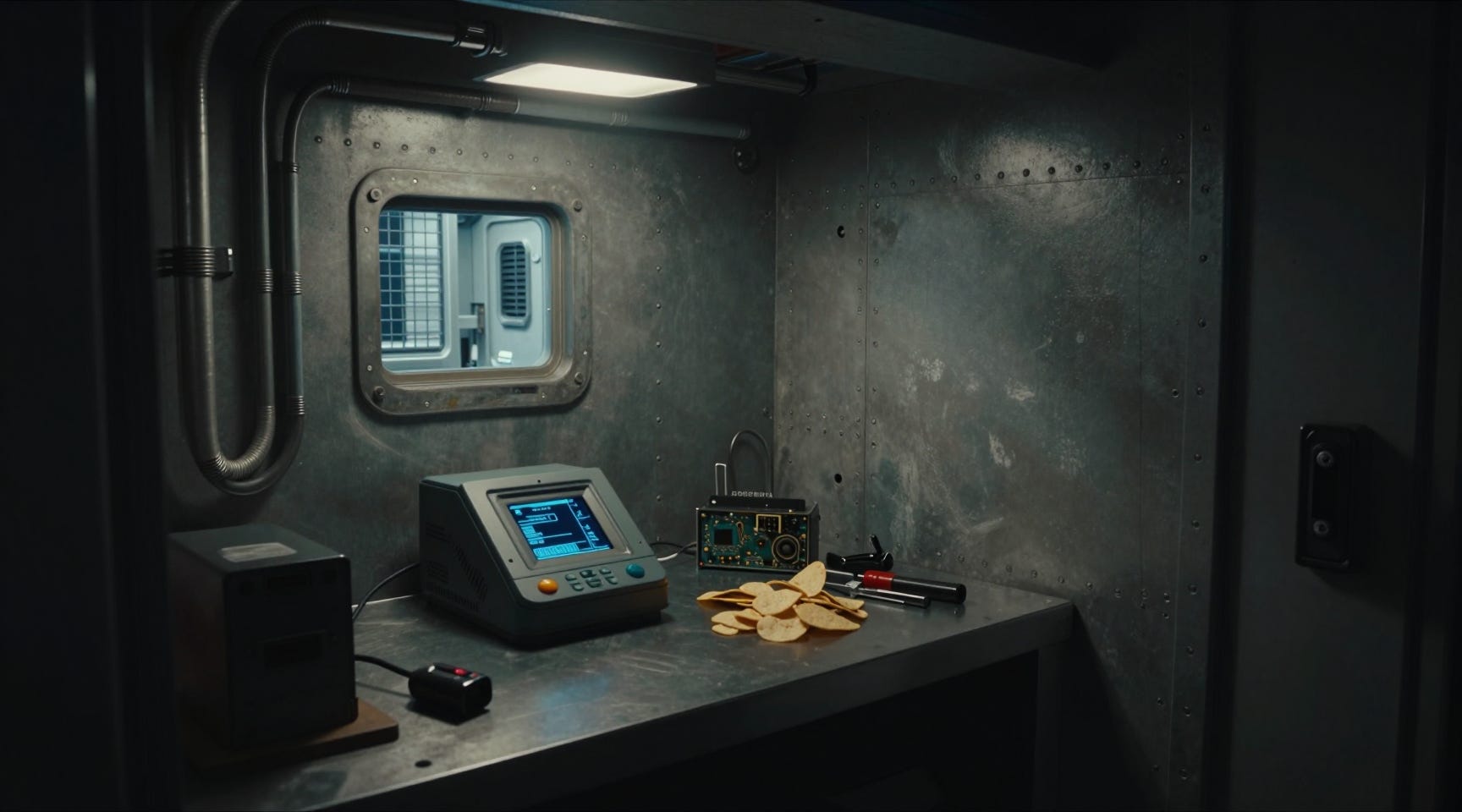
One scan. One chip. One ghost in the system, drawing rations at a distribution point on a different station while the original person collected their legitimate share here on Meridian.
The mathematics were straightforward. Every duplicate chip diluted the total allocation by a fraction too small for station administrators to distinguish from standard accounting variance. At current volume, Emeka’s operation produced twelve chips per week. Twelve ghosts eating meals that existed on paper, paid for by a system stretched too thin to notice the shortfall.
His fee was ten percent of the ration value drawn by each chip for the first three months. After that, the chip belonged to the client. Fair. Sustainable. The kind of arrangement that let everyone pretend the moral math worked out.
The woman in the chair did not match his usual client profile.
His regulars were salvage workers, dock handlers, maintenance crews. People whose labor kept the station functional and whose UEN tier-three allocations kept them perpetually short of adequate nutrition. They needed a second ration draw to bridge the gap between what the system provided and what their bodies required. They were practical. They knew the risks. They paid on time.
Frida Persson was none of those things. She was thin in the specific way that meant long-term caloric deficit, her cheekbones sharp beneath skin that held a grayish undertone. Her hands, folded in her lap, trembled with a fine vibration she could not control.
“Two chips,” she said. “Different identities.”
“Standard service. I’ll need biometric scans for both end users.” He kept his voice professional. The clinical language helped. End users instead of people. Service instead of crime.
“They can’t come here.”
“I don’t do remote enrollment. The scanner requires direct contact.”
“They’re children.”
The word landed in the small room like a dropped tool. Emeka’s hands paused over the scanner.
“Ages?”
“Three and five. The older one was born on the transport from Earth. The younger was born here, on Meridian.”
He understood. The UEN population registry had frozen during the evacuation chaos of Year Zero. New births were supposed to be enrolled through the Vital Records Office at the receiving station. The backlog for enrollment on Meridian was eleven months. Eleven months of bureaucratic processing while two children existed outside the system, drawing no rations, assigned no medical priority, occupying no line in any database.
Ghost children. Real ones.
“Bring them tomorrow,” he said. “Same time. The scan takes forty seconds per person. The children need to hold still.”
“The three-year-old won’t understand.”
“Hold her hand on the plate. The scan reads through contact. It doesn’t require cooperation.”
Frida nodded. Her hands still trembled.
“The fee,” she said.
“Standard. Ten percent of draw value, first three months.”
“I can’t pay ten percent. We’re eating at sixty percent of minimum now. Ten percent of the new draw puts us at the same deficit.”
The arithmetic was immediate. Two children at tier-three allocation would draw approximately eight hundred calories per day each in ration value. Ten percent was eighty calories per child per day. One hundred sixty calories she could not spare.
Emeka leaned back. The storage locker’s walls pressed close. The ventilation whispered.
His operation ran on margin. Every chip he produced carried risk: discovery, prosecution, disconnection from the station’s life-support allocation as punishment. The ten percent fee compensated for that risk across his entire client base. Reducing it for one client set a precedent that eroded the model. Other clients would learn. They always learned.
“Five percent,” he said. “Three months. After that, the chips are yours.”
“Thank you.”
He did not want her gratitude. Gratitude complicated the transaction, transformed it from commerce into something that carried weight. He was a technician. He modified hardware, wrote data, produced chips. The hunger those chips addressed was not his problem. The children those chips would feed were not his children.
Frida stood. She paused at the door, one hand on the frame.
“The five-year-old,” she said. “His name is Anders. He asks every morning if today is the day we become real.”
The door closed. The ventilation duct whispered. Emeka powered down the scanner and sat in the silence of his converted locker, surrounded by the tools of a trade that existed in the space between a system too damaged to function and people too desperate to wait for it.
Twelve chips per week. Twelve ghosts drawing meals from a pool that shrank with every phantom mouth. The system lost calories with each new ghost in the registry. The math was clean, distributed, invisible.
Tomorrow there would be fourteen chips. Two of them would belong to children who ate real food with real hunger and asked questions their mother could not answer.
Five percent. Three months. The numbers balanced. The ledger closed.
The question Anders asked each morning would not.
Author’s Note: In the early years after the invasion, the UEN’s population registry became both lifeline and cage. Registration meant rations, medical access, and a place in the system. The unregistered, including thousands of children born during the evacuation and its aftermath, occupied a bureaucratic void that informal networks were quick to fill. Biometric forgery operations like Emeka’s existed on every major station by Year Five, producing duplicate identities that diluted the official ration pool while feeding people the system had not yet acknowledged. The Iron Wake network supplied much of the hardware, moving modified medical scanners through the same channels that carried stolen Fold Drive components and black-market reactor parts. The children who grew up in that gap carried the experience into adulthood, shaping a generation’s relationship with authority, identity, and the cost of being counted.
If you enjoyed this story, you can follow the main story arc in The Exodus Rush, the first book in The Vethrak Requiem series.