


Lena Vasquez clipped to the face rail and reached for a cutter sequence that stayed amber.
Yesterday’s replacement anchor held beneath its new witness line. Her boots caught the deck strip after one short push. Beside the shift authorization, the independent Ceres safety authority’s seal occupied a place production control could not cover with another window. The rescue roster sat beside it, names matched to checked equipment and the few tunnels cleared for this shift.
The first full day after the strike had brought back the train clock.
It counted down above the feed rate. Forty-six minutes until the first ore cars needed to leave for processing. The cutter had not turned.
“Sequence paused,” Ji-woo Han said over the engineering channel. “Brace sensor four is reporting behind the reference clock. Keep the feed locked.”
Her image occupied a small corner of Lena’s cuff. Han sat restrained at the control alcove, still on limited instrument duty. An environmental lead stood beside the transfer panel. Nothing on the new authorization put Han back under a loaded brace.
Lena kept her hand on the cold casing. The sensor trace looked flat. Yesterday she might have taken comfort from that. Today its timestamp made the flatness useless.
“How far behind?”
“Enough to put the last sample before your proof check.”
The train clock lost another minute.
A technician came along the rail with a secured test case. He checked the clock fault under the independent reviewer’s instructions, replaced the failed synchronization connection, and ran the comparison again. Han placed the old and corrected traces beside one another. The reviewer checked current samples against the reference and signed the release.
The first stop entry remained at the top. Its failed reading stayed attached.
Lena keyed the cutter. The pitch rose through her glove, rough at first, then steady beneath the reduced feed limit. Chips struck the dust skirt and traveled into the enclosed belt. Fine powder hung in the work light until the extraction flow drew it away.
The train would be late. The rock did not become easier because the number above it changed.
The maintenance block arrived with a half-filled car still beneath the loading gate.
Lena stopped the feed and waited for the cutter to coast down. Power isolation followed. A maintenance technician locked his own control before opening the coolant housing. His tools rode on short restraints, each close enough to recover without reaching across the machine.
Production control opened a channel to Sigrid Hedlund.
“We lost the inspection interval. Twenty minutes from this block puts the last car inside the cargo window.”
Lena held the face rail beside the motionless cutter. Twenty minutes would fill the car. The first shipment after twenty-one strike days should have gone out full. Her crew had already done the waiting.
The thought had the same shape as one final cycle.
Sigrid’s answer came through the open shift channel.
“The block stays. Cargo control recalculates the load.”
“The work can finish next shift.”
“This work is due now. There is no safety concurrence to convert it.”
The technician kept his lock in place. He drew the coolant strainer into a secured tray. Gray fines filled the mesh where coolant should have passed.
Lena leaned close without loading the housing. The next twenty minutes would have asked the old machine to cut with that still inside it.
Sigrid entered the cargo revision request under her own authorization. The original production request remained beside her refusal.
No one asked Lena to vote again.
She clipped her handover slate to the rail and transferred the face to relief under the posted limit. Her shift ended at its assigned time, with the maintenance lock still engaged.
At the rescue staging bay, two entry teams answered the readiness check. Every required position had a person present. Anchor reels held current resistance-test marks. Suits showed sealed inspection tags, cutting tools their load checks. Medical packs sat latched in their brackets. Charged emergency-air units filled the assigned cradles.
The reserve team remained at the rack while the first team checked its route. Nobody borrowed a responder to help make up the missing car.
Lena ran a gloved finger over the second rack’s closed clamps. During 3-Bravo recovery, an empty place had been called a surge provision. These places contained weight, seals, and people who answered.
“Coverage holds,” the rescue chief said.
Lena continued toward processing.
The car from her face reached the plant behind its scheduled slot.
Through the inspection partition, its load passed into the enclosed mill. The processing board carried the same lot reference through screening, separation, and grading. Other inspected faces fed the batch. No display pretended the rock Lena had cut was already a hull.
Lena took the memorial spur before following the lot into the cargo spine.
The names occupied their own display. No tonnage ran beneath them. The dark trace of 3-Bravo remained on the adjoining panel, closed pending independent investigation and corrective review.
She stopped with both boots engaged and put her glove on the rail beneath the names.
The rail had carried recovery equipment once. Her hand remembered the tension of a loaded strap better than any sentence from the settlement. Nothing departing today would reach back through the sealed throat.
She let each line stand, then released one boot and continued toward loading.
Mateusz Zieliński met her at the cargo-spine rail after the plant released the graded material. He caught his next handhold before freeing his boots. His slate carried a smaller row of sealed modules than the dispatch plan above the loading portal.
“Cargo control can keep the window,” he said. “With this load.”
A receiving-office voice answered from his slate. “An extended extraction shift could complete the balance.”
Lena’s shoulder tightened against her tether. The stopped car returned as a sentence from farther away.
Mateusz opened the maintenance and shift records beside the receiving requirement.
“No extension. Authorize the reduced load. Send the balance as a separate assignment after it is available.”
“The forming schedule will lose time.”
“Record the loss.”
He entered Fleet Construction’s revised cargo priority. He signed no mine clearance and changed no worker’s shift. Cargo control confirmed the sealed load and the tug’s acceptance.
The public manifest listed iron and nickel tonnage, lot references, and custody marks. Every figure belonged to material already weighed. The destination field held a classified routing code.
Lena followed the reference from her car to the batch and then to a sealed module. A handling arm drew it along the restrained loading track, past a pressure door that closed before the outer portal opened. The module joined the smaller train waiting on the vacuum side.
The cargo board recorded departure readiness without declaring the station repaired. Temporary scrubbers remained on the environmental page. The damaged air branch stayed isolated. Normal load still had no clearance.
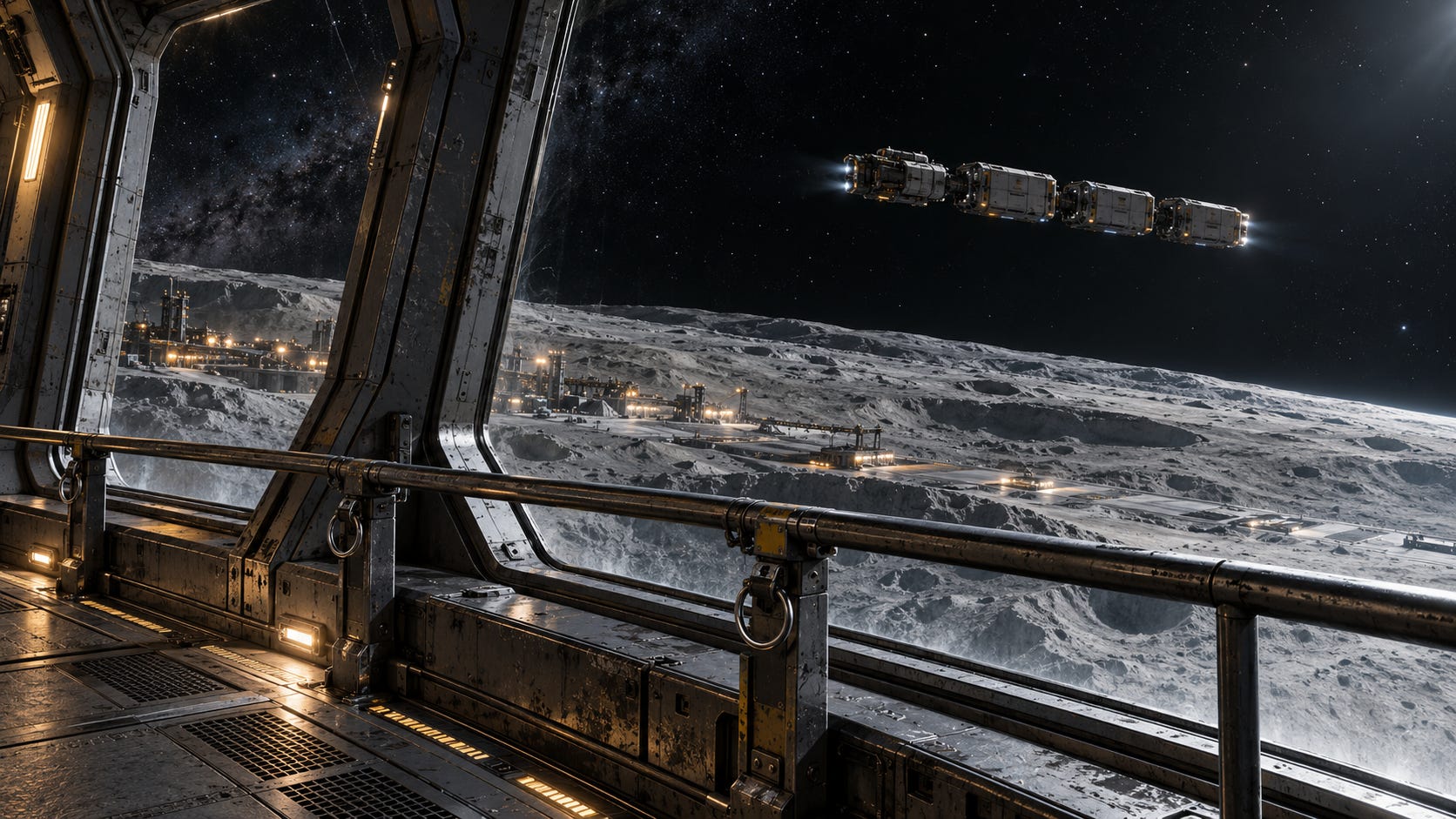
The observation blister projected beyond the surface housing, its pressure panes divided by thick ribs. Lena clipped to the inner rail. Ceres filled the lower edge of the glass, pale rock crossed by loading lights.
The tug drew away slowly. Secured cargo modules followed its motion, the smaller train holding its spacing as the loading frame released it. No sound crossed the vacuum. The station carried a faint working vibration into Lena’s glove.
Mateusz secured himself beside her.
“Which yard?” she asked.
“I am not cleared to give you its name.”
She left the question there.
Someone would receive the iron. Someone would check a plate, replace a seal, or ask for time a construction schedule did not contain. Lena knew nothing of their yard. She knew the shape of the request.
The tug’s drive lights diminished beyond the loading glare.
She had cut that rock. Han had kept the failed reading. A technician had cleaned the mesh. The rescue teams had stayed ready. Sigrid had left the maintenance lock alone, and Mateusz had sent fewer tons.
The ships were meant to save people. These people belonged inside the count before any ship existed to carry them.
Beyond Ceres, the convoy became one moving point. Lena kept her glove against the observation rail while the station’s working vibration continued beneath her hand.
New to The Vethrak Requiem? Start with The Exodus Rush, Book 1, where humanity fights for survival after an alien invasion using technology it barely understands. These short stories explore the wider universe; the novel begins the main story.