


The transfer pushed the badge back across Onur Tekin’s desk before he could release it.
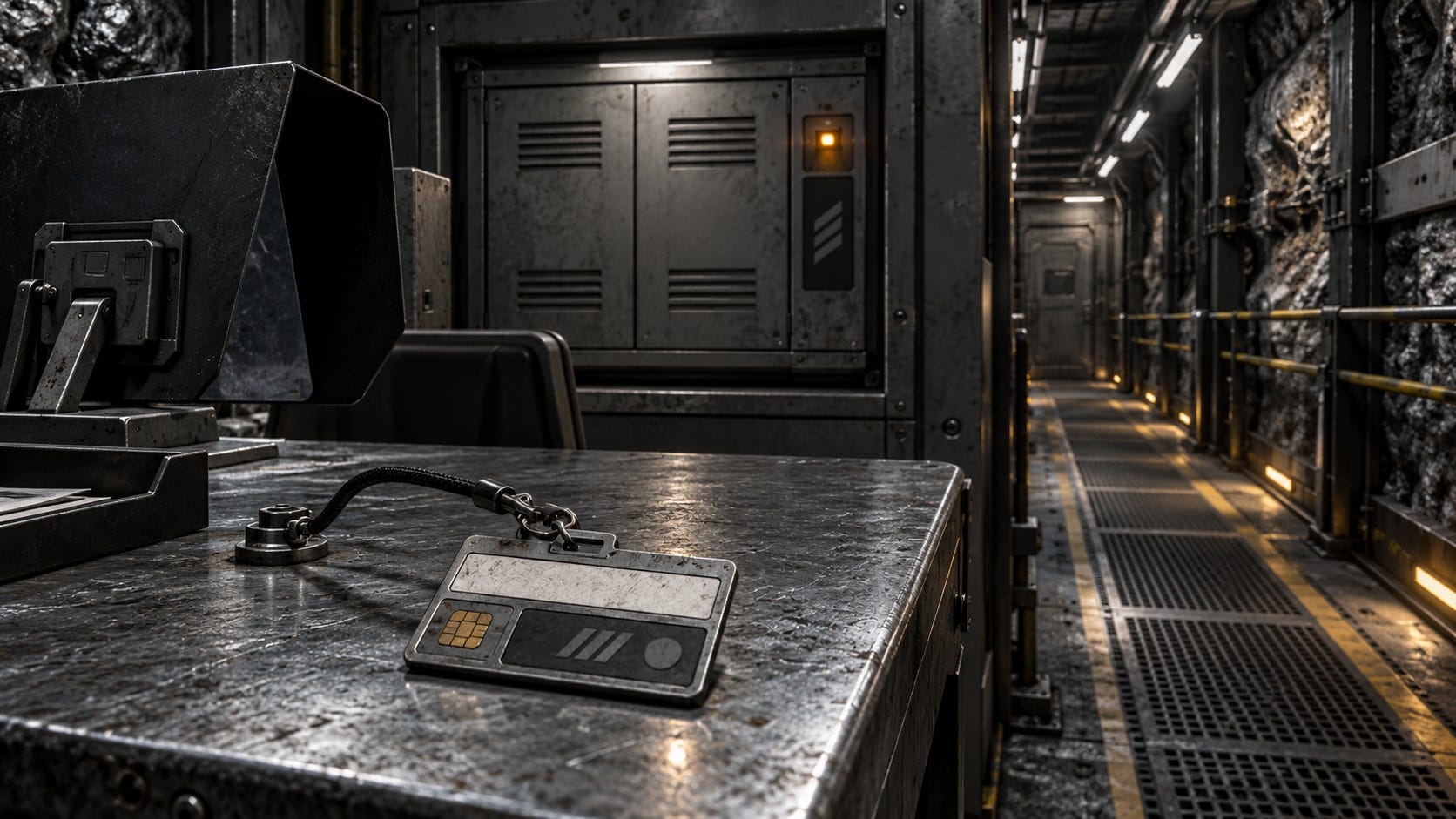
Its retaining cord drew tight. The card stopped between them, blank except for a shift designation, a rigging role, and the block of an access token.
“There is no name.”
“There won’t be one on the shop roster either.”
Onur kept his thumb off the release control. Beyond the identity alcove, a trolley latched to the corridor rail with two hard clicks. The transfer turned toward the sound, one hand gripping the visitor loop. He had brought no loose bag through the hatch. His gloves remained clipped together at his chest.
“The qualification record has my name.”
“The protected record does. This badge gives the door what it needs.”
He turned the desk screen toward himself and checked the assignment again. Temporary test rigger. Article Four, Slip Two. A barrel of structural plate would eventually go into a vessel elsewhere; here, its test fixture needed rigging hands who understood loads even when nothing weighed anything.
The transfer’s qualification covered restraint rigging and the reaction loads of an anchored proof cradle. The certificate matched its issuing authority’s verification. The required practical assessment remained current. Health clearance passed for the assigned work, with a medical contact available behind separate authority. Onur had no reason to open the man’s treatment history.
Prior employers and residential addresses sat behind another closed tab. He left it closed. A passed assessment gave the foreman a usable rigger. A list of places the man had slept gave strangers a route toward him.
“Your access ends with the assignment,” Onur said. “Slip Two’s rigging area and the corridor to it. Medical access follows its own authorization. No other construction bay.”
“Will this let me operate the test?”
“Rigging only. The test order and operator authorization are separate.”
The man checked the badge again. Onur waited for him to take it.
“The medical form asks for an emergency contact.”
“Yes.”
“What do I tell her I’m doing?”
The ventilation grille rattled behind the desk. Onur pressed its loose corner into the retaining clip until the rattle stopped.
“Use the contact instructions already cleared for your transfer. Don’t add a site or an assignment.”
“She already knows I won’t say where I am.”
The man’s finger rested against the empty strip where a name would have fitted.
“Who tells her if I die here?”
Onur withdrew his thumb from the release control entirely.
The records partition stood beyond the alcove’s inner door. Onur released his desk restraint, clipped his slate to his belt, and guided himself along the rail. The transfer followed on the visitor tether, stopping at the marked hold point while Onur opened the restricted terminal.
No construction roster appeared here.
Onur confirmed his authority and called up the medical intake acknowledgment. The transfer entered his own confirmation before Onur angled the shielded screen toward him. His legal identity occupied the first line. Beneath it sat the emergency contact and the instructions he had provided for reaching her.
“Check those,” Onur said.
The man used the restraint bar to steady himself. He read slowly, then corrected one digit in the contact field. Onur required a second confirmation of the changed entry. The acknowledgment returned with the revision attached.
A wrong number could remain protected as faithfully as a right one.
“Who can open it?” the transfer asked.
“The authorized medical officer. Compartmentation under the stated conditions. Every opening leaves an access record. Your shift controller gets the clearance, not this screen.”
Onur selected the notification instructions. An authorized referral went from the medical record into a sealed notification channel. Its recipient acknowledgment was current. He exposed the status and the assigned authority without exposing the route.
“The path is sealed,” he said. “It is not absent.”
“Will she be told what happened?”
The easy answer waited within reach. An accident report. A person at her door. Enough truth to make the rest bearable.
He could promise none of it.
“I cannot promise what the released explanation will contain.”
The man’s jaw tightened. “This yard can’t appear on a death certificate.”
“I cannot give you a document now and promise how they will complete it. I can show you who has the duty to notify, and that your instructions have reached them.”
“That isn’t the same thing.”
“No.”
The transfer released the restraint bar and checked the visitor tether before pushing toward the door. Onur let the silence remain. The hidden yards existed because the visible ones could burn. That did not give him the right to borrow a family’s trust against a procedure he did not control.
“Keep the correction,” the man said. “She changed numbers.”
“It is retained.”
Onur closed the notification view. The identity remained protected on the terminal while he guided the transfer back through the door. A rigging escort waited at the corridor junction, harness clipped to the rail.
Onur released the badge from its desk cord and handed it over. The man fastened it to his chest.
“Temporary rigger,” the escort said, reading it. “Slip Two.”
He answered to the role. Their tethers moved along the corridor, one checked clip at a time.
Article Four’s material request waited when Onur returned to the desk.
Samrawit Assefa’s technical question remained attached to two complete upstream certificate hashes. Both plate groups met receiving limits. Their hardness readings separated within those limits. Engineering needed to establish whether the proposed mixed joint treated them as interchangeable when they were not.
The referral sought access to the origin partition.
Onur opened the request fields, not the partition. Source facility. Origin identity. Route history. Those answers could connect a shipment to the yard. None, by itself, told an engineer what heat and pressure had done to a plate.
He entered the denial against the requested scope. Receiving compliance and an unresolved compatibility question did not justify opening a complete route. He retained the technical question with the denial; a closed door did not make the question answered.
His finger moved toward the field selector. He wanted to return a narrower request for forming history, stripped of names and locations.
The selector offered no such field.
He expanded the schema. Nominal category, chemistry band, dimensions, inspection status. The sealed fields described where material came from and how it traveled. The engineering-visible record had never kept a separate forming-history entry for the request to address.
Samrawit had asked what happened to the plates. His form could ask where they had been.
Onur recorded the missing category in his disposition and left the referral unresolved. He could identify the gap. He could not fill it with a certificate the system had not supplied.
The transfer’s intake worksheet still occupied the other half of the screen. Onur cleared the temporary copies after checking the protected receipt. Unrelated biography would not circulate with the assignment. Qualifications, access scope, medical clearance, and the sealed identity link remained where their duties required them.
He returned to the records partition and verified the corrected contact acknowledgment once more. Then he locked the identity view.
The final roster preview opened under his thumb. In the restricted confirmation pane, the legal name gave way to the operational entry.
Temporary test rigger. Slip Two. Current shift.
The assignment was accurate. The access was narrow. Somewhere down the corridor, a man carrying both could be trusted with a load that might crush him.
Onur released the roster. The empty name strip stayed empty.
Author’s note: This story continues the Site Anvil arc in late Year 3, during Article Four’s intake week. The yard’s protected personnel records preserve truths that its operational roster cannot display.
New to The Vethrak Requiem? Start with The Exodus Rush, Book 1, where humanity fights for survival after an alien invasion using technology it barely understands. These short stories explore the wider universe; the novel begins the main story.