


The medical wing of Prometheus Station occupied a dedicated deck between the administrative levels and the drydock bays. The signage was institutional green. The lighting was the same cool fluorescent that bathed every corridor on the station, though someone had put a plant near the reception desk. A real plant. David did not know who had smuggled dirt onto a military installation, but the plant was there, small and green and inexplicable.
He stood outside examination room four with his hands at his sides. The door was closed. The status indicator glowed a steady blue, the color that meant evaluation in progress, please do not enter. He had been standing there for two minutes.
The walk from Defiant’s docking berth to the medical wing had taken eleven minutes. He had taken nine. He was walking faster than normal. He arrived at the medical wing early and had to wait.
The door opened. A doctor in station whites stepped out, a datapad tucked under her arm. Her expression was professional. David had learned to read professional expressions the way he had learned to read tactical displays. This one said the news was not bad. It did not say the news was good.
“Commander Rivera. He is waiting for you.”
David nodded. The doctor did not elaborate. She moved past him down the corridor, the soles of her shoes making the soft sound that station shoes made on station decking.
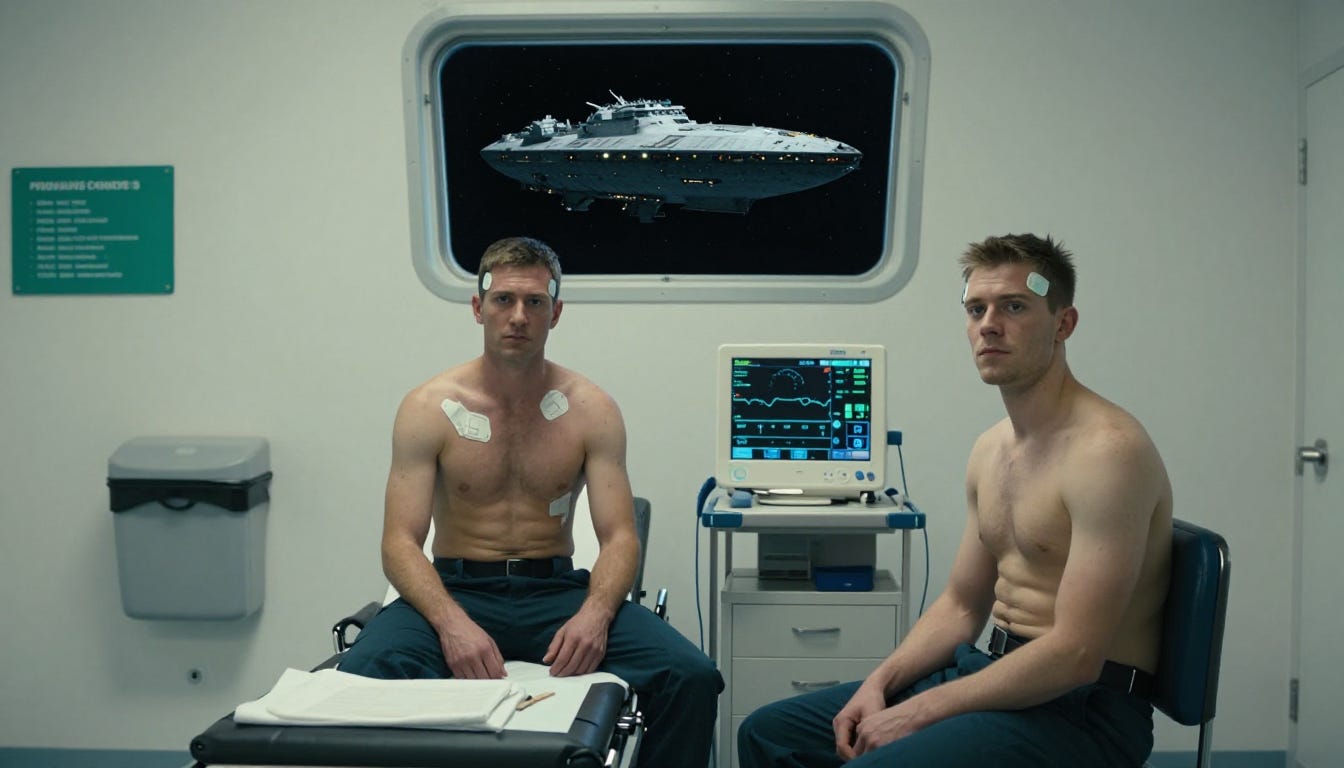
The examination room was small. A bed. A display wall currently dark. A chair next to the bed. Marcus sat on the edge of the bed with his shirt off, the medical sensors still attached to his chest and temples. The adhesive patches were white against his skin. The readout on the bedside monitor showed the kind of data that medical professionals found meaningful and David found insufficient. Heart rate. Neural activity. Stress markers. Marcus looked at him.
“I’m still here,” Marcus said.
“I know,” David said. “I read the report.”
The report. Three pages of medical terminology that boiled down to a single finding: Marcus Rivera was healing. His physical recovery was ahead of projections. The nerve damage in his left arm was responding to the regenerative protocols that Dr. Vasquez had adapted from captured Vethrak medical supplies. His cognitive function was sharper. His decision-making scores in simulation were within acceptable parameters.
The report also said something else. David had read the section twice.
“I saw the latency finding,” he said.
Marcus did not look away. “Processing latency in high-stress decision scenarios. Six-point-four percent deviation from pre-injury baseline.”
“That is what it said.”
“That is what I tested at.”
David sat down in the chair next to the bed. The chair was the kind of chair that existed in every medical facility in human space. Uncomfortable by design. A chair meant for visitors to sit in briefly and leave. He did not intend to leave briefly.
“They said it might improve,” Marcus said. “Or it might not. They do not know. The neural pathways are healing. The speed of healing is not the speed of processing. The two are related but not identical. The body can be ahead of the brain while the brain catches up. Or it cannot.”
He delivered the assessment the way he had once delivered tactical briefings. No evasion. No self-deception. The same precision he had used in command.
His brother had given a hundred briefings. David had been there for most of them. His brother had broken down Vethrak formations into component parts and assigned each part a counter. His brother had calculated approach vectors that other captains would not attempt. This was not a briefing. This was a man reporting on his own damage with the same dispassionate clarity he had once reserved for enemy ships.
“The doctor said you did not argue,” David said.
“What would I argue with? The numbers are the numbers.”
“They are numbers about you.”
“The numbers are me,” Marcus said. He reached up and began removing the sensor pads from his chest. His movements were careful but not hesitant. The left hand was slower than the right. A fraction of a second. The hesitation was there. Marcus knew it was visible. “The latency is part of me now. It might go away. It might not. I do not get to choose which parts of this war I keep.”
David sat with that. The silence between them was not uncomfortable. It was the silence of two people who had spent years learning how to be in a room together after the universe had tried to prevent exactly that.
“Are you okay with this,” David said.
It was not a question. It was the question. The one he had been walking down this corridor to ask since the report landed on his datapad that morning.
Marcus was quiet for a long moment. The sensor pads lay on the bedside table now, white adhesive circles that had measured his brain and found it wanting. He looked at them. Then he looked at David.
“I do not have to be okay with it,” Marcus said. “I have to be honest about it.”
Another pause. Longer this time. The station hummed at a frequency that was different from Defiant’s reactor thrum. Higher. Cleaner. A station did not push matter-antimatter annihilation through its veins.
“You are doing well,” Marcus said. “I have been watching the reports.”
David had not known Marcus was reading the reports. He should have known. Of course he was reading them. He was Marcus.
“I learned from the best,” David said.
“No.” Marcus shook his head, a small movement. “You learned from me. That is different from being me.”
The distinction landed in David’s chest and stayed there.
“It is better,” Marcus said. “You are better. I have been watching. I am not saying this to make you feel something. I am saying it because it is true.”
The chair was uncomfortable. The lighting was institutional. The plant at the reception desk was still there, small and green and inexplicable. David did not know what to do with his hands.
“Defiant needs a permanent captain,” he said. “Not an acting one.”
“Defiant has one,” Marcus said.
The words were simple. The weight behind them was not.
David stood. He did not know why he stood. The motion was something his body needed to do while his mind caught up. He crossed to the small viewport set high on the medical wing’s outer bulkhead. Through the armored glass, Prometheus Station’s shipyard was visible. A Vanguard-class cruiser. Vanguard herself. Shaw’s ship. The cruiser sat in her construction framework, work pods drifting around her hull in the slow dance of repair. The running lights were dark. The reactor was cold. A warship at rest.
“The chair fits you,” Marcus said from behind him. “It fit me once. It does not fit me anymore. That is not a failure. That is what happens when a war lasts long enough that the people who started it are not the people who finish it.”
David turned from the viewport. His brother was still sitting on the edge of the medical bed, shirt still off, the sensor pads still on the table. He looked tired. He also looked like himself, in a way David had not seen in years. Not the exhaustion of someone hiding from his own damage. The exhaustion of someone who had stopped hiding.
“I am not finished,” Marcus said. “I am not retiring to an asteroid to grow vegetables. Tanaka wants me to build a curriculum. Training. Simulation design. A program for the next generation of officers that does not require them to learn everything they know by losing ships. I said yes.”
“You said yes.”
“It is not command. It is not Defiant. It is something.” He met David’s eyes. “I spent fourteen years trying to be the person who survived the invasion. I am trying to be something else. I do not know what it is yet. But I am trying.”
David walked back to the chair. He did not sit. He stood next to it with his hand on the back, the plastic backrest cool under his palm.
“When does the program start,” he said.
“Next week. Tanaka has already requisitioned a simulation bay. She did not ask permission. She does not ask permission.”
“That sounds like Tanaka.”
“It is Tanaka.” A pause. A ghost of something that was not quite a smile. “She visited me yesterday. She told me to stop feeling sorry for myself. She said it in the tone of voice she used to use for tactical corrections. I told her I was not feeling sorry for myself. She said I was too good an officer to waste on self-pity and she needed someone who could design a scenario that would actually challenge cadets instead of scaring them. She said scaring them was easy. Teaching them was hard.”
“What did you say?”
“I said yes,” Marcus said. “It turns out I say yes to Tanaka the same way everyone else does.”
David nodded. He understood. Tanaka had a way of making yes feel like the only possible answer. It was one of the things he had learned from her.
He looked at his brother. Marcus looked back. The latency finding was still in the report. The left hand was still a fraction of a second slower than the right. The sensor pads were still on the table. None of that mattered. Or all of it mattered. David was not sure which. Both things could be true at once. That was something else he had learned, somewhere in the years between the invasion and this room.
“I should let you get dressed,” David said.
“In a minute.” Marcus did not reach for his shirt. He sat with his hands on his knees, the posture of someone who had been examined and found to be both damaged and capable, both slower and still fast enough. “The evaluation is done. I have been sitting in this room for an hour while people measured me. I think I am entitled to a minute where nobody measures me.”
David pulled the chair closer to the bed. He sat down. The chair was still uncomfortable. The lighting was still institutional. The plant at the reception desk was still there, doing what plants did, proving that green things could grow in metal places.
“Take two minutes,” David said.
Marcus closed his eyes. The station hummed around them, that clean frequency that was not a reactor thrum, that was not the sound of a warship pushing toward combat. The sound of a place that was still standing.
David waited.
His brother was still his brother. The war had taken fourteen years of speed and given back a fraction of hesitation. The war had taken the man who would have commanded Defiant into the next campaign and given back a man who was going to teach cadets how to survive one. The war had taken and taken and taken. It had also left this. Two brothers in a medical room on a station built from salvaged bones, neither of them gone, both of them still present, the silence between them full of the things they did not have to say because they had already said them.
After two minutes, David reached over and picked up the sensor pads from the bedside table. He placed them in the disposal unit mounted on the wall next to the monitor. The unit accepted them with a soft click.
Marcus opened his eyes. He looked at the empty table. He looked at David. He did not say thank you. He did not have to.
“I have Defiant’s post-repair trials tomorrow,” David said. “Shakedown run. Twenty-four hours. Engineering wants to test the new coolant manifold. The Skarreth one.”
“The one Thomas adapted?”
“The one Thomas adapted.”
“Tell him the torque tolerance on the secondary junction is three percent higher than his calculation,” Marcus said. “The Skarreth alloy expands under load. I saw it in the specs.”
“I will tell him.”
Marcus nodded. He reached for his shirt. The movement of his left arm was practiced, the motion of someone who had learned exactly how far he could extend before the nerve damage objected. He put the shirt on. He stood up. He looked at the monitor on the wall. The one that had displayed his latency. His deviation from baseline. The numbers that were him.
“I am going to the mess hall,” he said. “The coffee is terrible.”
“I know,” David said. “I have been living on this station for three days. The coffee is universally terrible. Every mess hall. Every deck. I have checked.”
“Then why go?”
“Because the people are there.” Marcus walked to the door. His stride was even. His shoulders were level. He looked like a man who had been measured and found to be healing. Not healed. Healing. “Are you coming?”
David looked at the room. The empty bed. The dark display wall. The chair where he had sat and heard his brother say the words that redefined what it meant to be Marcus Rivera. The disposal unit that now held the sensor pads, white adhesive circles that had done their job and been discarded.
“Yeah,” he said. “I’m coming.”
The corridor outside the medical wing was the same institutional green as the corridor inside. The plant at the reception desk was still there. David walked next to his brother, matching his pace without thinking about it.
They did not talk on the way to the mess hall. They did not need to. The silence between them was full of the things they had already said and the things they would say later, when there was time, when the redefinition was complete. The war had taken fourteen years. It had not taken this.
If you enjoyed this story, you can follow the main story arc in The Exodus Rush, the first book in The Vethrak Requiem series.