


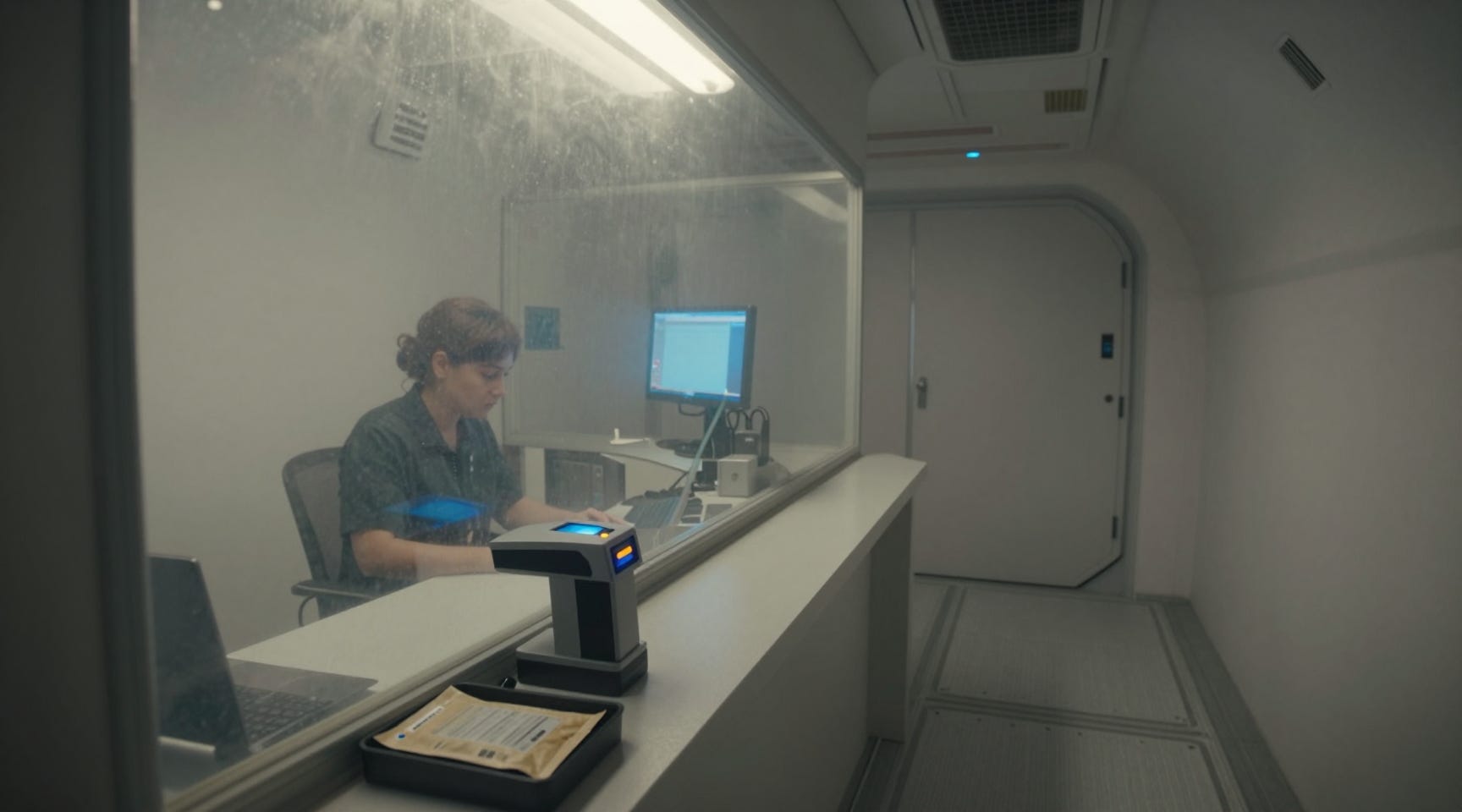
The red diamond was small, wedged in the lower corner of the intake screen, easy to miss if you weren’t looking for it.
Phuong Ramsey was always looking for it. Four years at the southern intake window had given her a particular relationship with anomaly flags: she caught them early, ran the secondary confirm, coded the misalignments and let the legitimate escalations rise. It took discipline. Most clerks developed shortcuts over time, pattern-matching their way through shifts, trusting the rhythms that rarely broke. Phuong didn’t trust rhythms. She trusted procedure.
She ran the secondary confirm.
The result came back in under two seconds. Profile on file: Household 4-Delta-Seven, three adults, two dependents under twelve, Standard Relief allocation. The biometric chip she’d scanned had also been scanned six hours earlier at the northern intake window, twelve sectors across the habitat ring. Same chip. Same biometric signature. Two scans on the same day, twelve hours apart, one at each end of a pressurized cylinder that no resident exited without logging a transit pass.
Physical impossibility.
She sat with that for a moment. Her screen showed the household’s relief record going back eleven months: regular pickups, unremarkable timing, no prior flags. Eleven months of clean double-collection, which meant whoever had produced the duplicate chip was skilled. The northern intake reader had accepted both scans as valid every time. The only thing that had caught this was the algorithmic parity check, an automated routine that ran every sixth scan cycle, comparing biometric access logs across the ring for geographic inconsistencies.
Escalation had a shape she knew well. Two prior cases in four years, both crude forgeries. She’d filed the reports, triggered the investigation holds, watched the freezes run their course. An investigation took fourteen to forty days. During that window, the household had no official allocation pathway. Some households found informal sources. The ones with children mostly found something.
Two dependents under twelve.
The procedure manual didn’t have a section on that.
A knock on the partition glass brought her back up. The intake window had a thick polymer partition, a narrow speaker grille, a document tray at the bottom for chip and packet exchange. The man who had stepped to the window was in his forties, unremarkable build, civilian work coveralls with a Level Three maintenance classification badge. He placed a biometric chip in the tray and slid it through.
She scanned it. The read came back clean: Hernán Bergeron, Level Three residential, industrial maintenance. His ration pickup was current and unencumbered.
“Morning,” he said through the grille.
She was already turning to pull his allocation packet from the rack behind her.
“Three-alpha-seven,” Bergeron said. His voice was conversational, the tone of someone commenting on corridor traffic. “That closes it as a misalignment artifact. No investigation trigger. No hold.”
Her hands stopped on the rack.
“The household does good work for a lot of people in this ring,” he continued. “Your northern colleague thought it was sensor drift every time. Twelve sectors is the outer edge of the reader’s geographic tolerance. Easy to call it drift.”
The northern colleague had rotated out eight weeks ago. Reassigned to Sector Eleven processing, no explanation given. She had not thought about why until this moment.
“What do I get.” She said it without turning around.
He didn’t frame it in credits. Credits were traceable, auditable, the kind of thing an investigation could reconstruct. He described a ration supplement: two pre-loaded household packages per month, delivered, no pickup required. She had been in the official supplement request queue for seven months. The estimated wait was fourteen to sixteen months, assuming no further redistribution adjustments.
The open ticket waited on her screen. The red diamond. Household 4-Delta-Seven, eleven months clean, two children.
Bergeron’s allocation packet sat in her hand.
Three-alpha-seven was eight keystrokes. It appeared in the procedure manual under misalignment artifacts, section four, a valid code for a documented category of reader error. Nothing about entering it here would appear irregular in an audit log. Misalignment artifacts happened. They were not rare.
She entered the code.
The flag closed. The ticket generated a sensor artifact entry, no hold triggered, no investigation window opened.
Bergeron accepted his packet when she passed it through the tray. He didn’t say anything further. The arrangement didn’t carry that kind of courtesy. The network’s name had reached her once, passed between two transit workers in the queue behind her station, spoken the way people spoke about infrastructure: a fact of the environment, not a choice. The Crossline. It moved through four Mars settlements the way a utility service moved, visible only in the small places where the official system failed to reach.
The shift ran four more hours. When it ended, Phuong logged her scan counts, shut down her station, and walked out through the clerk transit corridor that connected intake to the residential approach. She told herself what she would keep telling herself on the walk home: the family got to eat. Nobody was hurt. The parity algorithm had flagged a geographic tolerance edge case, and she had used a valid code to resolve a legitimate artifact type. The supplements would start arriving. Her household’s position improved. The relief queue had simply been corrected through an efficient channel.
The supplements arrived two days later. Pre-loaded, exactly the described amounts, left in the transit pass slot outside her unit with no sender identification.
She told herself that confirmed it. She had made the right call. The system had rewarded a reasonable judgment.
The second flag appeared on her intake screen the following Tuesday.
This one was not a duplicate chip. This one was a cascade-reactor component serial number embedded in a Standard Relief ration code, invisible to routine processing, readable only by the specific parity algorithm that her shift had been running more frequently than the northern window’s rotation. Someone had arranged for her to catch it. Someone had been watching her shift cadence for a while.
The red diamond sat in the corner of her screen, and Phuong Ramsey already knew the code she was going to enter.
Author’s Note: This story takes place in Year 13, at one of Mars’s pressurized habitat rings during the post-invasion resource crisis. The criminal networks that have embedded themselves into relief infrastructure operate by creating obligation rather than by force: each quiet accommodation, each closed ticket, each practical kindness becomes a link in a chain the worker never agreed to wear. Phuong’s story is about the moment that chain becomes visible, and by then it has already been worn for a while.
If you enjoyed this story, you can follow the main story arc in The Exodus Rush, the first book in The Vethrak Requiem series.