


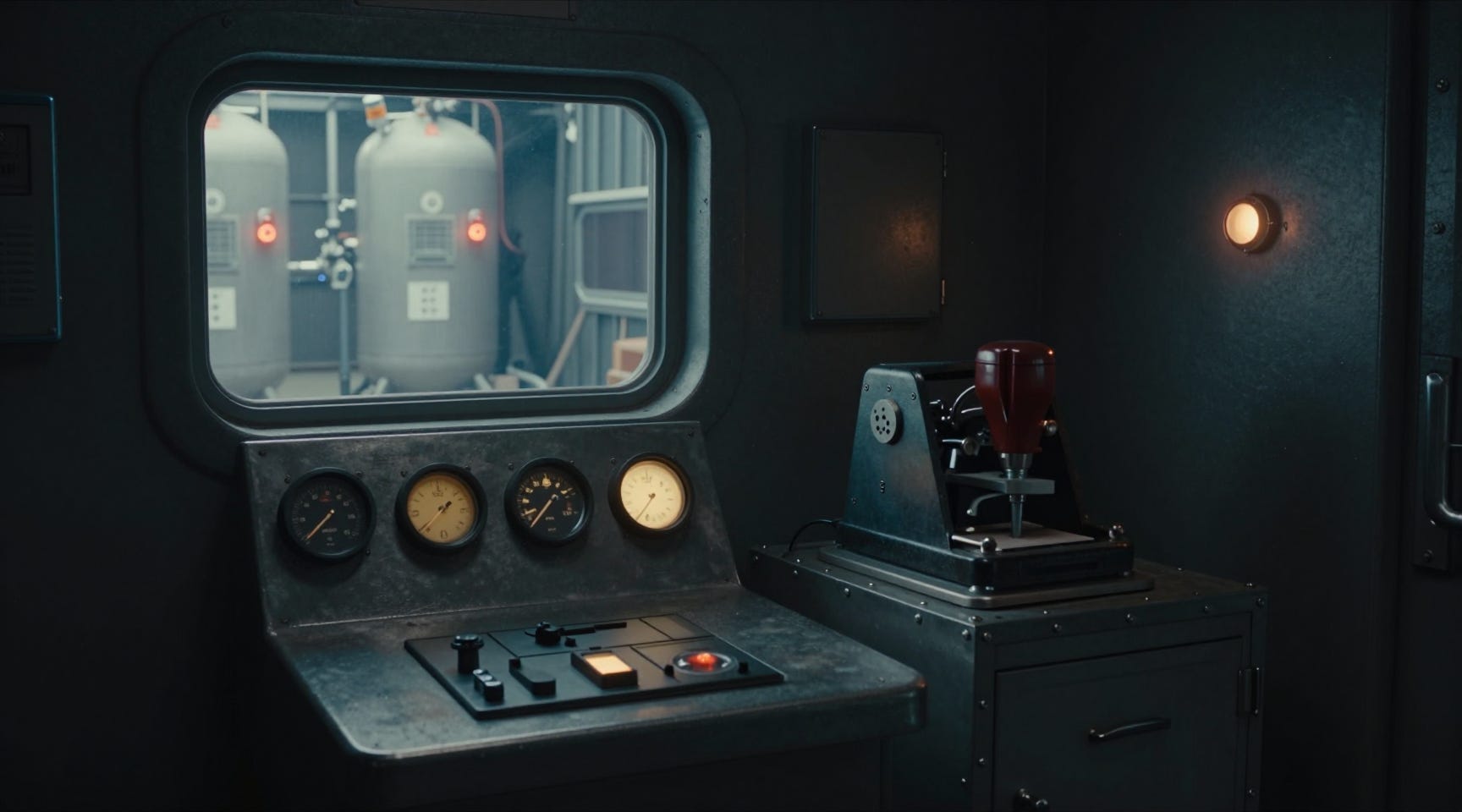
The stamp machine lived in a steel cabinet bolted to the wall beside the atmosphere console. Ink rollers. A dull lever. A tray for paper chits.
Harriet Sinclair kept it clean anyway.
Her shift started at 0500, when most of Gannet Habitat still slept in recycled warmth. The corridor outside Atmosphere Control carried the station’s usual blend of hot insulation and sanitizer. The air tasted a fraction drier than it should.
Dryness meant drift.
The console agreed.
O2 partial pressure: 19.2 kPa.
Target: 19.8.
Six tenths did not trigger alarms. Six tenths still scraped at the back of her throat.
Her wristband chirped with the morning ledger. Two requests, one red.
MEDBAY: supplemental oxygen authorization, six hours, Ward C.
HYDROPONICS: supplemental oxygen authorization, two hours, Section Two.
Hydroponics never asked for oxygen. Plants did not file paperwork unless something had gone wrong.
Harriet pulled the Medbay chit from the tray and held it under the cabinet light. Plain fiber, UEN watermark ghosting across the corner. A thin rectangle of authority, as fragile as everything else.
She brought up Tank Farm status. Eight pressure vessels nested behind bulkhead fifteen, old Earth-made steel with patch plates welded over patch plates.
Reserve Tank 3 read lower than last shift.
Not low enough to scream.
Low enough to explain the dry taste.
Harriet keyed the comm. “Atmosphere Control to Maintenance. Harriet Sinclair. Walk-by on Tank 3. Priority two. Bring leak gel if you have it.”
A tired voice answered. “Copy.”
The stamp machine waited. The lever did not move on its own.
Ward C would not wait either.
Harriet pressed the lever down. Ink kissed paper. APPROVED: 6 HRS. O2 SUPPLEMENT.
Her signature followed, steady enough to pass as confidence.
A soft tone from the console cut through the quiet.
CO2 scrub efficiency: 93%.
Scrubbers ran at ninety-nine on a good day. Ninety-three meant a clogged filter or a fan dying a slow death.
Harriet switched views. Scrubber bank B, Fan 2.
Power draw high. Airflow low.
The station had a talent for asking for repairs in the same hour.
The comm chirped. “Maintenance to Atmosphere. We’re at Tank 3. You should come down.”
Harriet locked the console, grabbed a handheld meter, and headed for bulkhead fifteen.
Two decks down, Tank Farm smelled of cold metal and old sealant. Reserve Tank 3 wore a wet streak along its lower seam, too clean to be condensation.
Maintenance crouched beside it. The tech’s coveralls were marked with green grease and a name patch that read only CHIEF.
Chief touched the seam with a gloved finger and drew it back. The glove shone.
“Pin leak,” he said. “Seam fatigue.”
Harriet’s throat tightened. Oxygen leaks did not look like much. They stole the habitat one breath at a time, then invited fire to finish the job.
“How bad?” The question came out flat.
Chief tapped an ultrasonic probe against the tank. The device chirped.
“Slow. Maybe point four percent of reserve an hour. Gel might cut it in half.”
Harriet did the math without enjoying it. Ten percent buffer gone in a day. A station ran out of buffer long before it ran out of air.
“Isolation valve?” she asked.
Chief shook his head. “Handle snapped.”
Of course it had.
Chief held up a tube of leak gel. “Good kind. Last one.” He waited, letting her own the decision.
A choice settled in her gut.
“Vent the segment,” Harriet said.
Chief blinked. “That drops main pressure.”
“Controlled drop.” Harriet pointed at the manifold. “Depressurize, seal hot, bring it back slow. Less pooling. Less ignition risk.”
Chief’s jaw tightened. “People will complain.”
“People complain when they can breathe.” Harriet kept her voice steady. “Do it.”
Chief moved with grim efficiency, cracking the bypass and bleeding oxygen through a capture filter. The habitat’s pressure ticked down. Dryness sharpened.
Harriet opened the station notification channel.
ATMOS NOTICE: minor pressure adjustment for maintenance. Expect dry air for one hour. Hydrate as able.
Annoyance beat panic.
Chief applied gel along the seam in a smooth bead, then cinched a wrap band over it. The gel glistened, then dulled as it cured.
Harriet watched her meter. O2 concentration in the room stayed safe.
Her wristband buzzed. A Medbay message, shorter than courtesy.
WARD C DESAT EPISODES INCREASING. NEED O2 NOW.
Hydroponics followed a moment later.
POLLINATION FAILURE RISK. REQUEST URGENT.
Harriet stared at the tank until the numbers blurred. A stamp machine waited upstairs. Ink and paper deciding who got a little more air than everyone else.
Chief nodded toward the ladder. “Go. The gel’s set.”
Harriet climbed fast, lungs working in air that only pretended to be thinner. Habit usually kept her from wasting breath on exertion. Habit lost the argument.
Atmosphere Control greeted her with the steady glow of readouts.
O2 partial pressure: 19.0 kPa.
Not dangerous.
Not kind.
She fed the updated leak rate into the model. The curve flattened. The gel held, at least for the next hours.
Medbay’s chit had already been approved. The tube system would deliver it in minutes.
Hydroponics still waited.
Two hours of supplemental oxygen in Section Two could salvage a harvest. Two hours also cut into buffer she no longer trusted.
Ward C meant someone’s lungs were already losing.
Harriet printed the Hydroponics chit and set it beside the stamp.
Her fingers hovered.
Protein paste kept people alive. Fresh food kept people human.
Her hand came down on the lever. APPROVED: 2 HRS.
Her signature followed, smaller this time.
She sent both chits through the tube system. Medbay first. Hydroponics second.
The console chimed.
Tank 3 leak rate: stable.
Scrubber bank B power draw: stable.
O2 partial pressure: rising.
Not much. Enough.
Chief’s voice crackled over the comm. “Wrap held. No pooling.”
Harriet exhaled slow, then checked the queue for incoming requests.
One sat at the top, marked in gray.
SCHOOL DECK: event variance, thirty minutes.
A memorial would not burn less grief with extra oxygen. A memorial with candles could burn the habitat.
Harriet denied the request with a clean tap.
A blank chit waited in the drawer below her desk, the kind that made ration officers nervous. Harriet pulled it out anyway.
She fed it into the stamp machine and pressed the lever.
APPROVED: 15 MIN. O2 SUPPLEMENT.
She wrote a location.
NURSERY.
No request. No form. No argument.
A fifteen-minute bump would not fix Tank 3. It might keep one infant from waking up coughing in dry air.
Harriet folded the chit and slipped it into her pocket. Delivery could be personal.
The station remained a sealed can with too many failure points.
Her lungs worked anyway.
Author’s Note: Gannet Habitat sits in the long middle years after the Invasion, when survival becomes routine and routine becomes its own kind of battle. Harriet’s job is not heroic on paper. It keeps everyone alive.
If you enjoyed this story, you can follow the main story arc in The Exodus Rush, the first book in The Vethrak Requiem series.