


The skiff signature in her sensor scope was the wrong shape.
Anya Rask read it twice before she let herself believe it. The Underweight’s passive array had been pinging the field for forty minutes on approach, building the picture slowly, the way Maren liked, the way that did not advertise their intent across an open band. The picture had come together in pieces. Vethrak hull mass, twin clusters, two main bodies and a halo of fragments. A dense field. A profitable field.
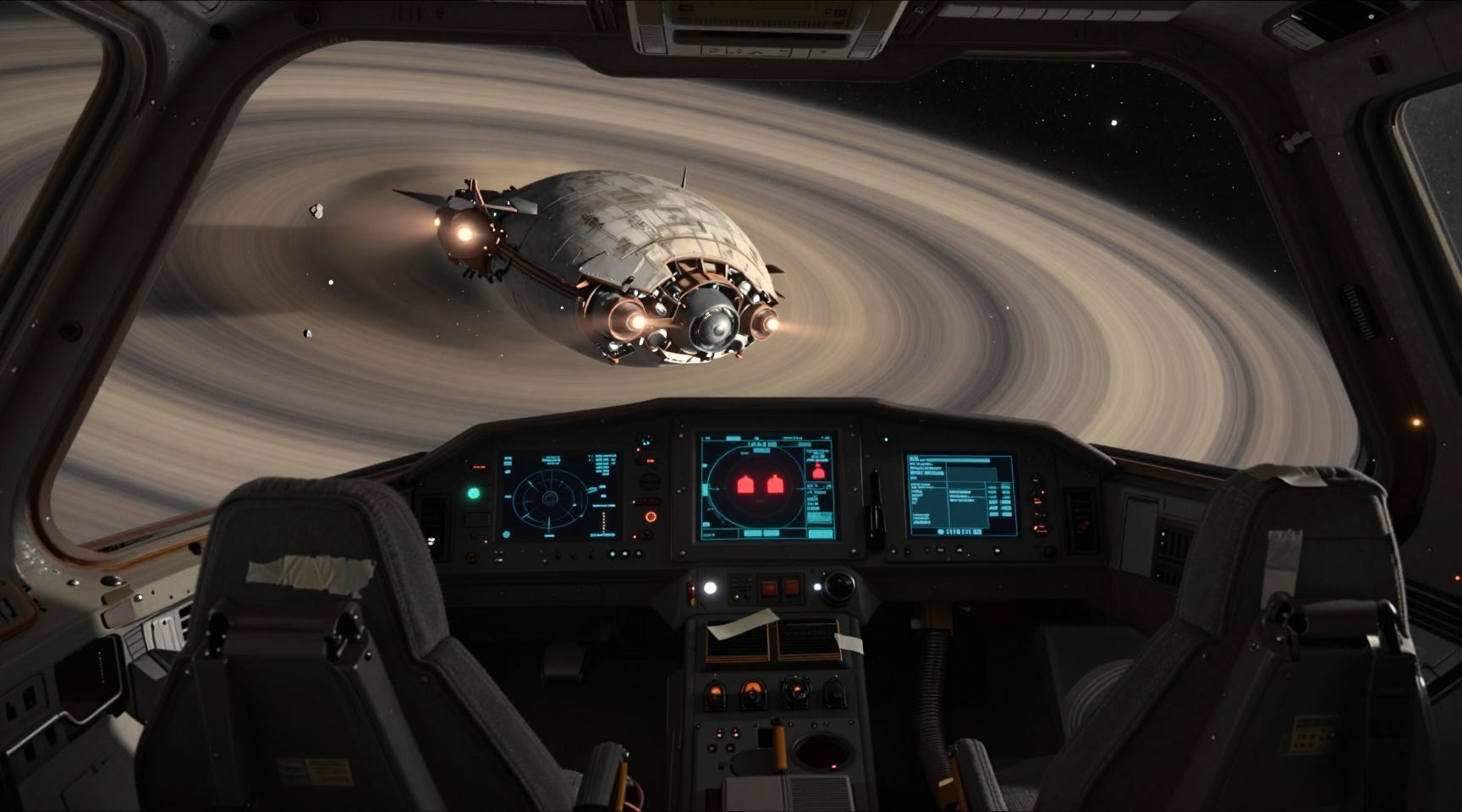
A field with another skiff already inside it.
“Maren.” She kept the voice channel to the cabin only.
“Got it.” The pilot’s seat shifted behind her. Maren’s gloved hand came across the console and tagged the contact in red. “Two skiffs. One small EVA tender. Drone or two. They’re working.”
“How long.”
“Three hours. Maybe four. They’ve got a recovery line strung between the main mass and the tender. They’re hauling.”
The math ran cold and clean through Anya’s head. Two skiffs meant four people minimum, six if they ran a full cargo team. Both skiffs would be armed. Salvager gun mounts were standard now, eight months into the gutted-fleet years; the UEN had stopped pretending it could patrol the rings, and the rings had remembered what they had always been. The Underweight carried a single forward-mount plasma lance and a pair of point-defense turrets refitted from an old Pallas mining rig. Adequate against a single hostile. Adequate against two only if the two did not coordinate, which two skiffs working a recovery line by definition did.
She had registered this field. She had logged it with the Salvage Protocol office on Mimas eight days ago. She had paid the registration fee in thermal credits she could not afford. The yellow-pip courtesy that was supposed to cover situations like this was a thumbprint of felt-ink that no one enforced, because the office that would have enforced it had three people and four hundred fields to track.
The other crew did not know she had registered. The other crew might not have registered themselves. The field would go to whoever held it.
She did not want to hold a field at gun-mount range against four people.
“Open channel,” she said.
Maren’s voice was flat. “You sure.”
“Open channel.”
The hiss of an unencrypted band came through the cabin speakers. Anya keyed her mic.
“Salvage skiff in field grid four-seven-alpha, this is the Underweight. Call sign Rask. Confirm receiving.”
The response came inside three seconds, which meant the other captain had been monitoring the band already and waiting for someone to talk first. A man’s voice, ring-belt cadence, the kind of measured evenness people used when they had practiced it.
“Underweight, this is the Riftpick. Captain Górski. Receiving you. Go ahead.”
Two ships pinged back on the Riftpick’s tag now. Her board was confirming what Maren’s contact had already shown. Two skiffs, one tender. Coordinated.
“Captain Górski. This field is registered. Salvage Protocol, Mimas office, registration date plus eight standard days. Underweight, Rask, certification number A-three-three-one-nine.”
The pause on the other end was not silence. It was the quiet of a man checking his own paperwork.
“Underweight. We have first-contact on this field, recorded by our drone array on approach four hours ago. We have not been informed of any prior registration.”
“You can be informed now.”
“You can transmit your registration.”
Maren’s hand came across her arm. One word, in her helmet, the inside-channel frequency that the Riftpick would not be on.
“Logs.”
Anya keyed the open band. “Transmitting field-registration logs across channel.”
The data packet went out. It carried the Mimas office’s seal, the date stamp, the certification chain, the Iso Pruvit countersignature that Anya had stood at a counter to obtain. The packet would land on the Riftpick’s console and Captain Górski would read it the way captains read paperwork in the year that paperwork had begun to mean something again.
The pause was longer this time.
It was the pause that mattered.
The two skiffs in the field had stopped moving. The recovery line between the main mass and the tender hung in the void without tension, the small backwash of EVA thruster work no longer visible on her scope. Whatever Górski’s crew had been pulling out was sitting still while their captain made a decision.
She watched the pause stretch and counted what it would cost to lose this field if the man on the other end chose the other answer. Two months of registered work. The credits she had advanced to Maren for the EVA refit. The first three pulls toward the Underweight’s cell-bank replacement. The thermal-credit float she had begun routing through Davit Kade and could not now stop without explaining to him why she had stopped. The pause held the shape of all of it.
Then Górski’s voice came back across the open band.
“Underweight. We have your logs. Your field. We’ll find another.”
She did not let her shoulders drop. They would drop later.
“Riftpick. Acknowledged. Safe burn.”
“Safe burn.”
Maren’s hand tightened on her arm and let go.
The Riftpick’s tender began to retract its line. Slow, careful, unhurried, the way professionals worked. The two skiffs realigned along their thrust vectors and began a coordinated burn out toward the next field on whatever grid map Górski had been working off. The drones pulled in. The recovery rigging dropped off the main mass and went into the tender’s cargo bay. The whole operation came apart the way it had come together, in pieces, methodical, expert.
Maren had moved to the secondary console and begun the field workup. Her voice came across the cabin, lower than it had been, the way it got when she was thinking.
“He read those logs fast.”
“Yes.”
“He had his own ready to send if yours weren’t there.”
“Yes.”
“What does that tell you.”
Anya kept her eye on the Riftpick’s drift signature as it pulled out of the field. The two skiffs were already organizing back into their formation. The recovery line had retracted clean. Górski had not said his certification number on the open band, but he had a certification number, somewhere, and he had been ready to transmit it.
The next field he found, he would log first. The next captain he met across a debris cluster, he would push his logs first, and the other captain would have to push back, and somewhere a station office that did not exist yet would begin to mean something because the people working the rings had begun to mean it.
The Mimas office had three people and four hundred fields. That arithmetic would not hold. Something else would hold.
She watched the Riftpick’s thruster glow shrink against the curve of Saturn’s outer ring until the scope lost it in the field’s dust halo.
“Next time,” she said, “it won’t be that easy.”
Maren did not answer.
The Underweight’s passive array kept pinging. The field sat where it had always sat. It was hers tonight. It would be hers tomorrow. It would not be hers forever, because nothing in the rings stayed anyone’s forever, and the man in the Riftpick was already drafting whatever rule the next standoff would test.
She reached for the recovery rig controls.
The work was the same.
The line that was going to organize the work was not yet a line. It was a pause on an open channel, and a packet of logs, and a captain on the other end of the band who had read them and chosen the answer that did not start a fight.
The field belonged to her tonight.
She began the burn.
Author’s note: Day Five of the Iron Wake Origins arc. Anya Rask and Maren Holvaag arrive at a registered debris field in Saturn’s outer ring and find another crew already inside it. The Riftpick and her captain, Jakub Górski, hold first-contact. The Underweight holds a paid Salvage Protocol registration. There is no arbitration body. There is no enforcement. There are gun mounts on every salvager ship in the rings, and there is a single open comm channel between two captains who do not want to use them. The exchange that resolves the standoff is the seed of an institution. Year 1, Month 8. Two months from now, the Bonecrack Field will fail this same test, and people will die. Today nobody does. A captain on the other end of the band reads a paper trail, and the paper trail wins, because both captains have decided in the same heartbeat to let it.
If you enjoyed this story, you can follow the main story arc in The Exodus Rush, the first book in The Vethrak Requiem series.