


The cautery pen traced its line. Smoke rose from the wound in a thin spiral, carrying the smell of burned protein into the recycled air of Operating Theater Four. Ravi held the tissue retractor steady with his left hand and sealed another bleeder with his right. The monitors behind him beeped at their intervals. The ventilator hissed. The room held its permanent chill, climate set to eighteen degrees to keep the surgeon’s hands dry inside the gloves.
“Suction.”
Meera cleared the field. The teenager’s abdominal cavity lay open under the surgical lights, intestine packed away behind moist gauze, the lacerated spleen already removed, the liver repair holding. Three hours in. A delivery scooter had hit the boy on Linking Road at speed. The impact had done its work on the boy’s abdomen; now Ravi was doing his.
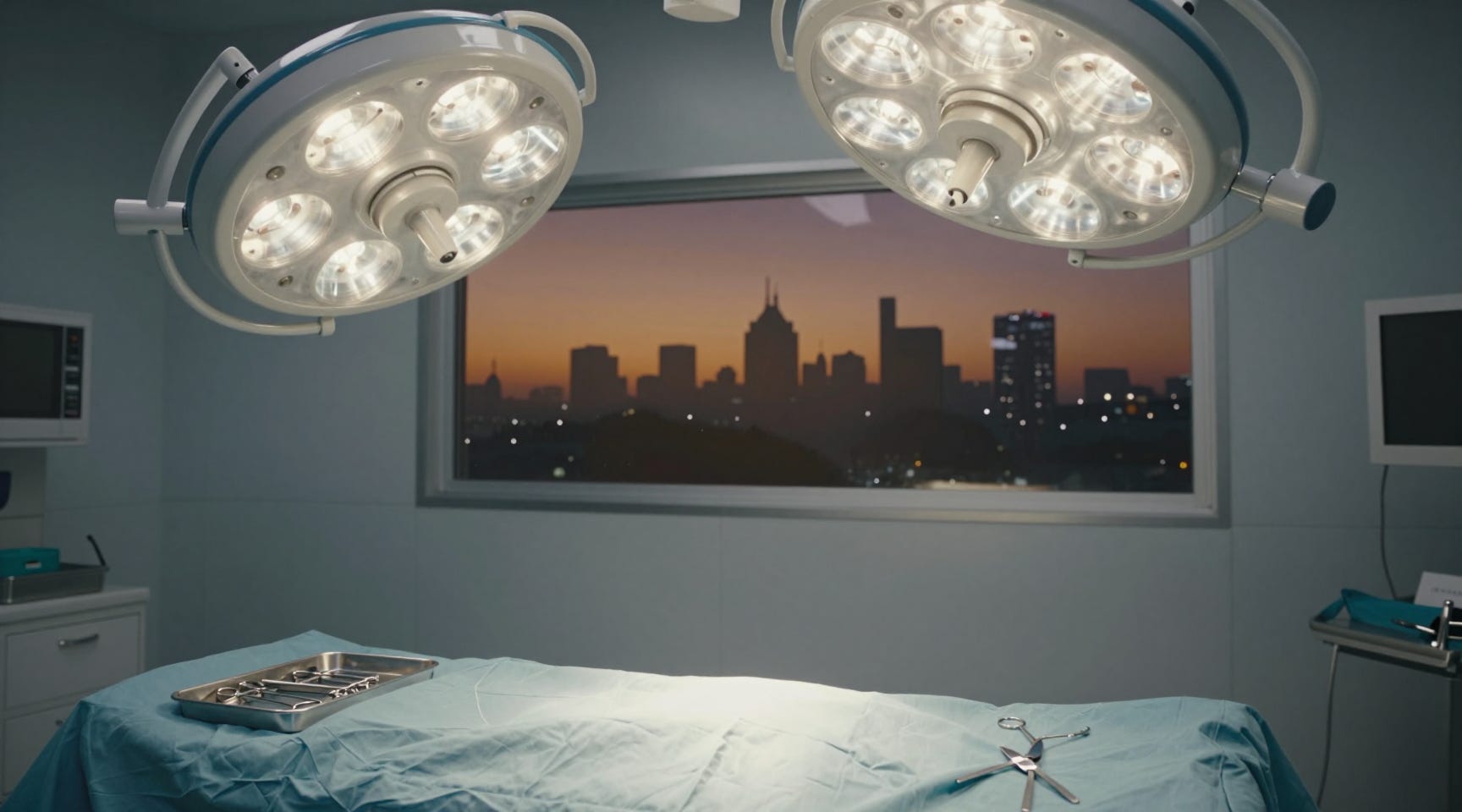
His hands moved. They had been moving for twenty years in rooms like this one, at tables like this one, under lights that turned everything the same flat white. The lights did not care what day it was. Neither did the wound.
“BP stable at 108 over 72,” the anesthesiologist said from behind his screen.
Ravi nodded without looking up. Peritoneal lavage next. Clean the cavity, check for missed injury, close in layers. The procedure had its sequence. He followed it the way a river follows its bed: not by choice, but by the accumulated shape of years.
The OR doors stayed shut during a procedure. This was protocol. The corridor belonged to the corridor; the table belonged to the table. When Meera leaned close and whispered, he registered the break in rhythm before the words.
“Dr. Subramanian. Something is happening outside. They’re saying…”
“Later.”
His forceps found the next bleeder. He clamped. He cauterized. The smoke rose.
The lavage began. Warm saline, poured in liters, filled the open cavity and suctioned out clear. No bile staining. No enteric contents. The bowel was intact. The repair was holding. He checked the liver edge one final time. The suture line was dry.
Meera leaned in again. Closer. The antiseptic on her mask sharp at this distance.
“Doctor. The United Nations has called an emergency session. They are saying something has been detected. In space. Multiple objects.”
“Is this patient coding?”
“No.”
“Then later.”
He irrigated the left paracolic gutter. Clear. He irrigated the pelvis. Clear. He swept the right subdiaphragmatic space with a folded sponge and inspected it under the light. Clean. The body on this table was a problem he could solve, and he was solving it.
The anesthesiologist leaned forward. Not Meera this time. The man’s voice had changed. Not louder. Tighter. The voice of someone holding a thing in his throat that would not stay down.
“Ravi. The broadcasts have confirmed it. Objects approaching the inner system. Not human. Every channel.”
Ravi’s hands did not pause. He positioned the first layer of fascial closure, the needle driver clicking through peritoneum in even, measured bites. One centimeter apart. One centimeter from the edge. The rules of closure did not change because the rules of everything else had.
Lakshmi would have laughed at this.
The thought arrived the way all thoughts of her arrived: without permission, carrying its full weight. His wife, dead fourteen months. The way she had laughed when he missed their anniversary dinner for a ruptured aorta. The low sound of it, her chin tipped back, the gold chain at her throat catching the kitchen light. The way she had said, the morning of her own diagnosis, standing at the stove with tea in her hand: You will not cancel your surgeries for this. I married a surgeon, not a worrier. She would have looked at him now, hands inside a teenager’s abdomen while the world learned it was not alone, and she would have said something small and precise and devastating. Something like: Of course you stayed. What else would you do?
He placed another suture. Tied it down. Cut.
The fascial layer closed. No tension. Good tissue approximation. The muscle layer followed. His hands knew this work the way his lungs knew air: automatic, earned, the memory of ten thousand closures pressed into his fingers.
The skin stapler fired in quick, even intervals. Twenty-three staples. The wound sealed. The dressing went on. The drapes came off.
“Vitals?”
“Stable. 112 over 74. Sats 98 on room air.”
The boy would live. The scooter had opened him on a Tuesday afternoon in Mumbai, and Ravi had closed him, and the closure was clean. The patient, a seventeen-year-old whose name Ravi had read on the chart three hours ago and filed in the part of his mind that would hold it permanently, lay breathing under the lights.
Ravi stepped back from the table.
The OR staff were standing wrong. He could read it the way he read a wound that would not heal: from the posture, from the quality of the silence, from the set of their shoulders. Meera had both hands pressed flat against her thighs. The circulating nurse stood by the door with her phone glowing in her palm. The anesthesiologist had pulled his mask down and was staring at the wall-mounted screen, which someone had switched to a news feed. Hindi and English text scrolled across the bottom of the frame. An anchor spoke in the measured cadence of controlled alarm. Ravi did not read the text.
He did not need to. He could see it in the room.
He walked to the scrub-out sink. The faucet ran cold, then warm. He peeled his gloves off one finger at a time and dropped them in the bin. His hands emerged: brown, lined, dry at the knuckles. The hands of a man who had washed them ten thousand times under lights like these.
He pressed the soap dispenser. Lathered. Scrubbed. The water ran off his fingers and circled the drain. From behind him, the anchor’s voice carried fragments he would learn in full later: gravitational anomaly… multiple objects… decelerating… unknown origin. The words belonged to the corridor now. The corridor would carry them.
He looked at his hands under the stream. The hands that had held Lakshmi’s in the oncology ward, her grip still strong at two in the morning, her breathing already thin. The hands his son Karthik had seized crossing Marine Drive, small fingers locked around his index finger, absolute trust. The hands that had, for the last three hours and eleven minutes, done the only work they knew how to do while the sky above Mumbai became something other than the sky.
I did the work in front of me. That is what is asked.
He turned off the tap. Dried his hands on a sterile towel. Folded the towel with the precise edges his father had taught him, aligned and square, and set it on the counter.
Then he walked through the double doors and into the world.
Author’s Note: This story is part of the Day Zero Anthology, a mosaic of perspectives from the day humanity first learned it was not alone. Dr. Subramanian’s quiet discipline in Operating Theater Four represents one of the less visible truths of that day: while the sky changed, the work in front of people did not. Across Mumbai, across the world, hands kept moving. The operation continued.
If you enjoyed this story, you can follow the main story arc in The Exodus Rush, the first book in The Vethrak Requiem series.