


The kettle whistled. Hannah lifted it from the burner with the small wince that had become automatic, a movement her hand had learned to make without consulting her. The apartment was warm. The east-facing window had taken sun all day and gave it back slowly through the night, like an old animal sharing heat.
The television in the corner was on. She had turned it on at six for the news, as she always did. The anchor’s face was different now from the woman who usually read the evening segment. The set behind her was different. The graphics along the bottom of the frame moved in a way Hannah did not recognize. She lowered her tea bag into the cup and watched the steam rise.
“…repeat. The Security Council has confirmed the detection. Multiple objects. Decelerating from outside the heliopause. Coordination with international partners is ongoing. Citizens are advised to remain in their homes and await further…”
She turned the burner off. The blue ring of flame folded inward and disappeared. She poured the water.
The phone on the small table by the door began to ring. The landline. Miriam’s number. Hannah set the cup down on the counter, walked the eight steps to the table, and lifted the receiver. The cord was the original copper, replaced once, decades ago. It had a small kink near the base she had never bothered to straighten.
“Ima.”
Miriam’s voice was already broken. The word Ima, mother, pulled tight at the end. Hannah listened. Her daughter’s breathing came thin through the line. Behind it, the same channel played in Miriam’s apartment one floor up, the anchor’s voice doubled in faint delay through the phone.
“Ima, are you watching? Are you seeing this?”
“I am seeing it.”
“I do not know what to…” A breath. “I do not know what we…”
“Bring Yael down. Bring yourself. We will eat together.”
“Ima.”
“I have soup. I have bread. Bring Yael.”
The line went quiet. Then: “Ten minutes.”
“Ten minutes.”
Hannah set the receiver down. She returned to the kitchen. She took the lentil soup from the refrigerator and set it on the lowest flame. She cut bread with the wooden-handled knife Yehuda had bought the year they married. She set out three plates and three spoons and the small ceramic dish Esther had thrown in pottery class decades ago, the one she used now for olives because the dish was the right size and because Esther was alive in the dish in a way she was not alive in the photograph on the bookshelf.
They came down at 21:14. Miriam first, Yael holding her hand. The girl was four. The girl had a stuffed rabbit, gray and worn at the ears, that she had not been separated from for eighteen months. The rabbit’s name was Bumi. Bumi was held now by one paw, which was the way Yael held her when she was tired.
“Saba-Saba,” the girl said. Great-grandmother.
Hannah bent. The knee complained. She kissed the small face, the warm cheek, the smell of strawberry shampoo from the bath earlier that evening.
“Come, Yael-leh. Come sit. I have soup.”
Miriam stood at the door with both hands at her sides. Her eyes were wet. She had not yet stopped trembling. Hannah straightened, walked to her, took her face in both her hands. Hannah’s hands were cool from the counter. Miriam’s face was hot.
“Mami, breathe.”
“Ima, what is…”
“Breathe. Now. With me. In.”
Miriam breathed in. Hannah breathed in.
“And out.”
They breathed out together. Three times. Miriam’s shoulders dropped a centimeter. Hannah let her hands fall.
“Now we eat. Then we will think.”
The soup was good. The bread was a day old, the way bread should be for soup. Yael ate three spoonfuls and then occupied herself feeding Bumi imagined olives from the ceramic dish. Miriam ate without tasting. Hannah ate slowly, watching them.
The kitchen TV she had turned to face the wall. Yael did not need to see it. Miriam did not need to see it either, though her eyes drifted to the corner every few seconds, looking for the screen the way a tongue looks for a missing tooth.
“Have they said,” Miriam asked, “what they think it…”
“They have said what they have said. Eat your soup.”
“Ima, you have to…”
“I do not have to. Neither do you. Tonight we eat. Tomorrow there will be more news. Tomorrow we will think about the news.”
“How are you so…”
Hannah looked at her daughter across the table. Sixty-nine years old. Gray in her hair. The same brow as her father. The same long hands.
“Eat your soup, Mami. The soup is good.”
Miriam ate her soup.
They stayed an hour. Yael fell asleep in Hannah’s reading chair with Bumi against her chest. Miriam carried her up at 22:30, the girl heavy with the heaviness of a sleeping child, the rabbit trailing from one slack hand. Hannah kissed them both at the door.
“Lock your door. Do not turn on the news again tonight.”
“Ima.”
“Tomorrow. There is enough tomorrow for it. Sleep.”
She closed the door behind them. She washed three plates. She washed three spoons. She returned the ceramic dish to its shelf. The kitchen settled.
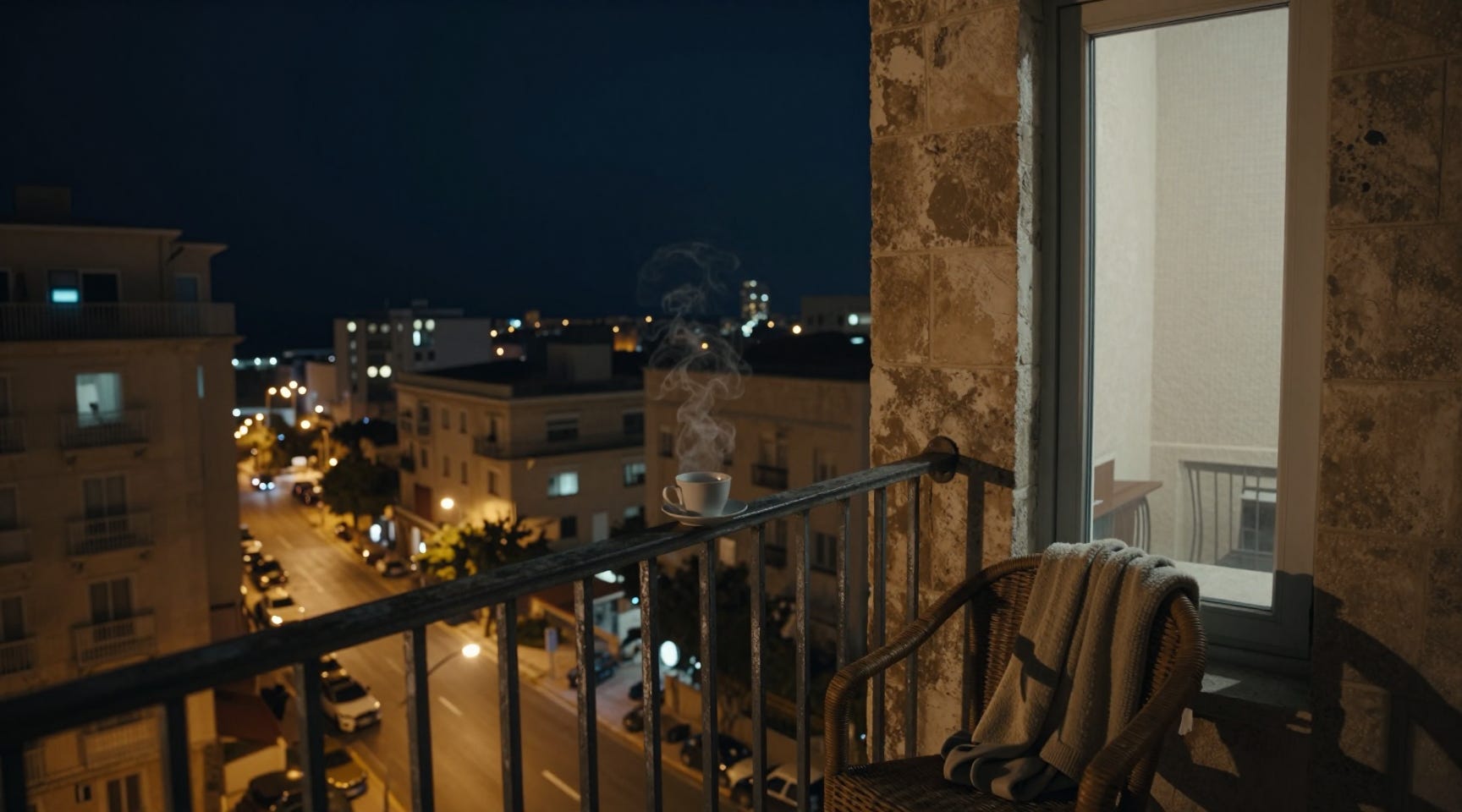
She made fresh tea. She took it to the balcony.
Florentin at 23:00 was wrong. The streetlights were still on. The cars were not. Sirens moved south, then east, then nowhere. A man walked past on the sidewalk below talking to the air in a voice that was either prayer or the other thing. Lights had come on in apartments that should be dark. Other lights, in apartments that should be bright, were out. The city was rearranging itself, the way a forest rearranges itself before a storm.
She set her tea on the railing. She wrapped the cardigan tighter.
She pressed her thumb against the wedding ring on her finger. Yehuda’s ring. The gold had thinned along the inside curve from seventy years of the same press of thumb to ring. The pressure was an old habit. The pressure helped.
She thought about the camp. She did not think about it the way other people thought about it, with the violence rising in the throat. She thought about it the way a craftsman thinks about a tool. She thought about how she had eaten when there was no food: small, slowly, the same slow chewing repeated until the body believed something was happening. She thought about how she had slept when there was no sleep: by holding still, by counting the beams of the bunk above her, by the discipline of the body lying down even when the mind would not. She thought about how she had stayed alive when staying alive was a discipline and not a given. The technique. The technique she had built at fourteen and refined through the rest of her life, applied since to the death of a husband and the death of a daughter and the slow leaving of a body that had decided it was ninety-six.
The technique was: do the next thing. Eat the soup. Wash the spoon. Lock the door. Drink the tea.
She drank the tea.
The sky above Tel Aviv was the same sky. She knew this would not be true tomorrow. Tonight she would let it be the same sky.
She thought about Yael. The small warm cheek. The strawberry shampoo. The rabbit named Bumi. The girl would grow up in whatever world was being made tonight. The girl would have to learn, faster than any child should learn, what Hannah had learned at fourteen: that the world was capable of ending and that the only question was what one did in the part of it that was still happening.
The girl would need someone who knew.
Hannah finished her tea. She set the cup on the railing. A neighbor’s window opened and a woman leaned out and made a small private sound, half laughter, half not.
Hannah went inside. She closed the balcony door. She turned off the kitchen light.
I am still here, she thought. They will need someone who knows. I am still here.
She went to bed.
Author’s Note: This story is part of the Day Zero Anthology, a mosaic of perspectives from the day humanity first learned it was not alone. Hannah Gluckmann is the one woman in her building who is not afraid. She has done this kind of thinking before. The discipline she built at fourteen, in a place she does not name aloud, is the discipline she will need now. She represents a truth the anthology insists on: somewhere in every disaster, there is the person who has seen the shape of it before and who can teach the rest of us what to do with our hands.
If you enjoyed this story, you can follow the main story arc in The Exodus Rush, the first book in The Vethrak Requiem series.