


Sigrid Hedlund laid four concessions across the arbitration table before the room seal finished cycling.
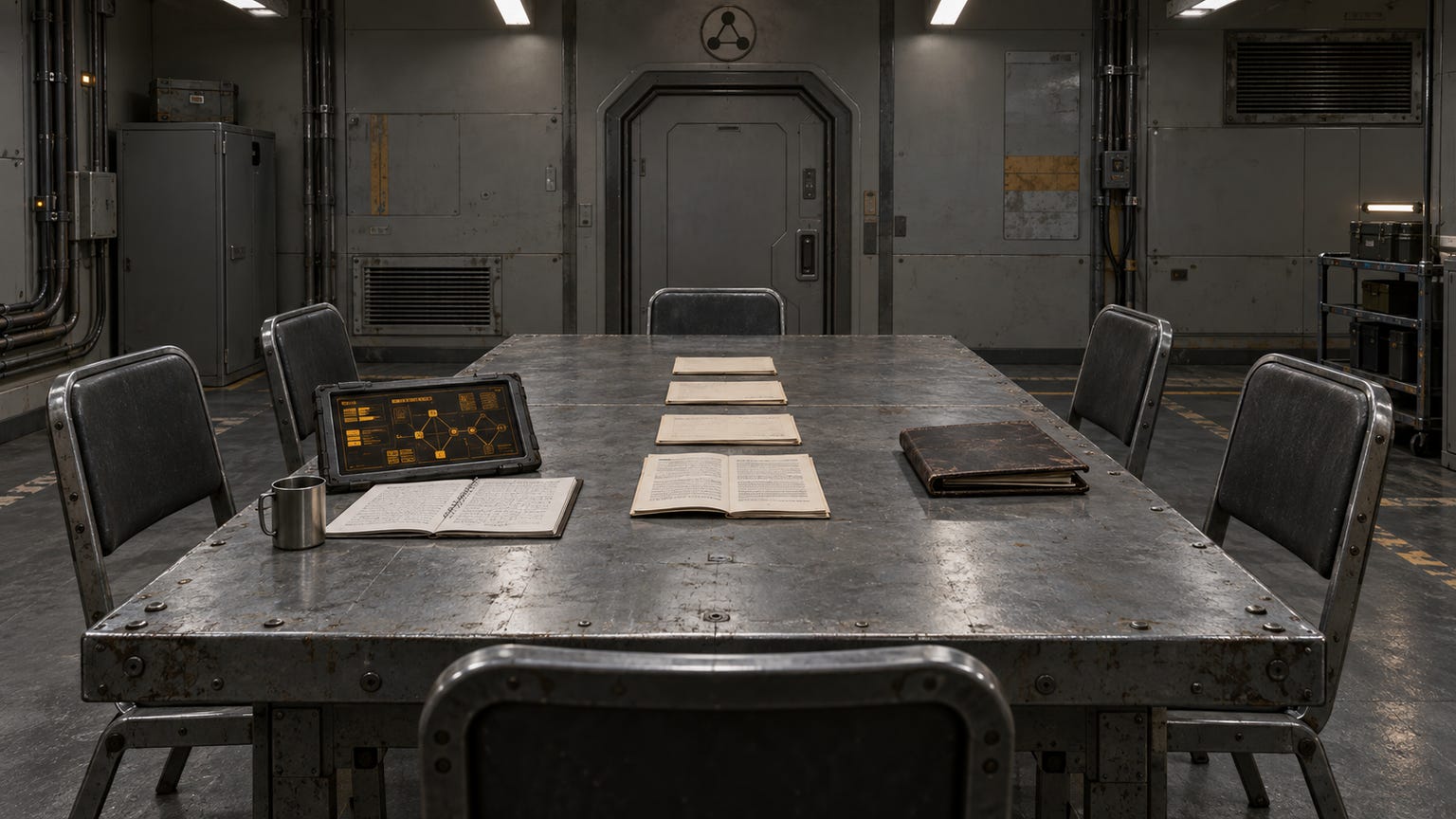
The neutral room occupied the administrative spin ring, where paper stayed flat and a cup could stand without a strap. No Helios mark broke the gray walls. No union motto faced the company side. The station arbitration seal sat above the closed door, proof the room belonged to neither party.
Kavita Nair locked her folder beneath the table clip anyway.
Sigrid remained standing. Helios counsel sat to her right with one hand over a thin packet. Mateusz Zieliński had placed his schedule beside it, the dependency lines reduced to blocks Kavita could read without seeing the restricted destinations. On the union side, the benefits steward kept both palms against a ledger. Lena Vasquez occupied the chair nearest the door, coveralls still carrying dust in the seams.
“Fleet construction lost another receiving window this morning,” Sigrid said. “Pressure-shell work has stopped at one line. More delays will follow. People are also dead because Tunnel 3-Bravo failed, and their families should not have to wait for us to recognize what was taken from them.”
The sentence gave each fact its proper weight. It also put them on the same scale.
Sigrid opened the first packet.
The hazard differential would rise by forty percent, retroactive to the recovery shift. Death benefits would guarantee four years of base pay, eighteen months of station housing, and continued medical coverage for dependents. Helios would endow a permanent 3-Bravo memorial fund. A joint safety committee would receive three labor seats beside engineering, medical, and operations.
The benefits steward’s fingers stopped at the housing line.
Kavita knew three members whose transfers home were already late. She knew a widow whose station account would close at the end of the month under the existing contract. Four years of pay could turn panic into time. Eighteen months of housing could keep a family from packing while the effects bag still sat unopened.
The money was not an insult. That made the packet harder to refuse.
“Who has final authority?” Kavita asked.
Sigrid sat across from her. “On the committee?”
“At a face. A worker documents a dangerous condition. The schedule manager orders another cycle. Who decides whether the drill runs?”
Counsel drew the packet closer. “Operational authority must remain unified under management. The committee reviews disputed decisions and issues formal recommendations.”
“After the cycle?”
“As quickly as the evidence permits.”
Kavita turned to the safety section. The word advisory appeared seven times in three pages. Suspend appeared once, inside a sentence reserving the power to Helios Ceres Operations.
“Can the committee stop the affected operation while it reviews?”
“It can recommend a temporary pause.”
“Can an individual worker call one without retaliation?”
“Existing safety reporting remains available to every employee.”
“That wasn’t my question.”
Counsel’s hand stayed on the packet. “No private employee can hold unilateral production authority.”
Sigrid looked past the legal text to Kavita. “Three labor seats are not decoration. Engineering and medical will sit with them. Every recommendation enters the permanent file.”
“Who controls the file?”
“Helios operates the mine.”
“Who controls access to the original logs?”
Sigrid’s mouth tightened. Not anger. The recognition of a part the package had not solved.
“Protected access for committee members,” Sigrid said.
Counsel shifted. “To authorized incident material.”
“Unedited logs,” Kavita said.
“That language creates exposure beyond this dispute.”
“The original amber hold already had exposure. Someone shortened it to advisory pending validation.”
“The proposal creates a review process for exactly that kind of revision.”
“Inside the chain that made it.”
The benefits steward released the ledger and folded both hands. Kavita kept her eyes on the packet. A room could divide without anyone changing chairs.
Sigrid slid the memorial clause across the center line. “I am not asking you to trade the dead for a shipment. I am asking whether we can recognize the loss, protect the people still working here, and restart under rules stronger than the ones we had.”
The answer deserved more than refusal by reflex. Kavita read the clause to the final sentence. Joint administration. Annual accounting. Names selected by families. Nothing in it purchased silence.
“This stays on the table,” she said.
Sigrid exhaled through her nose. “The safety committee stays with it.”
“The committee can stay when it has authority.”
“You are separating one package into pieces that depend on each other.”
“A memorial does not depend on management keeping final control of a dangerous face.”
Mateusz rotated his schedule toward the center. “There may be an interim path. Forty-eight hours of external observation. Fleet Construction assigns a safety observer to the committee while both sides negotiate permanent authority. The observer receives the incident record and attends operational reviews.”
Counsel answered first. “Fleet Construction has no role in Helios personnel decisions or proprietary mine data.”
“Then use a Council inspector,” Mateusz said.
Sigrid studied the blocked destination lines. “An outside office entering operations without a defined mandate adds another decision point while inventory is already failing.”
Kavita placed one finger on the word observer.
“Can this person halt a face?”
“No,” Mateusz said. “The appointment would be observational.”
“Can this person compel the raw logs?”
“Not without Helios consent under the temporary arrangement.”
“Then labor gets a witness to the same answer.”
His jaw set. The schedule remained open beside his hand. Two days ago he had arrived with sabotage in his report. Today he had brought an outside chair into the room. The distance mattered. It was still not authority.
“It would put an independent record in place,” he said.
“A record is useful after someone can refuse the cycle that creates it.”
Kavita unfastened the technical folder.
“Ms. Vasquez. State what happened before the 3-Bravo alarm. Only what you can establish.”
Lena brought her chair square to the table. Ordinary gravity changed none of her economy. Both boots stayed planted as if the floor might release them.
“The cutter pitch slipped,” she said. “I killed the drill motor. The tool band fell out. A lower pulse remained in the housing and the nearest brace. The inspection tag was two shifts late. I ordered the face clear.”
Counsel opened a note field. “Before a red alarm?”
“Yes.”
“Did the watcher trace exceed the red threshold?”
“I did not have the watcher’s slate.”
“Can you establish what caused the collapse?”
“No.”
“Can you establish intent by any Helios employee?”
“No.”
Kavita did not rescue the testimony from its limits. The limits were part of it.
“What happened after the brace line failed?” she asked.
“Two miners reached the jammed inner door. The inner shift had no return. The main rescue team crossed from the far side of the station. They sent one reel.”
“A second team?”
“The board had one active entry team. The surge roster had three names and two empty slots.”
The numbers entered the room without decoration.
Sigrid leaned toward Lena. “Would this committee have changed your decision to clear the face?”
“No. I cleared it.”
“Would protected reporting have helped?”
Lena considered the packet rather than Sigrid. “Protection after I clear it would help. A committee after I clear it would write down why. Neither matters if someone can put the cycle back on before the brace is checked.”
Sigrid lowered her gaze to the authority clause.
Counsel closed the note field. “Management cannot agree to distributed command of active mining operations.”
“A documented stop is not command of the mine,” Kavita said. “It is authority over one set of hands when the rock has changed. Technical review can answer on a clock. Retaliation protection keeps the person there long enough to be right or wrong in the record.”
“You are asking management to surrender control before an external body even exists.”
“We are asking for the right to survive until it does.”
Silence held through two cycles of the air register. The benefits steward reopened the ledger, then stopped before turning a page. Sigrid’s packet remained spread across the table: money, housing, medical coverage, names, a committee, and no protected hand on the stop control.
Kavita closed her folder.
“The compensation terms can carry forward,” she said. “The memorial fund can carry forward. Bring back an independent authority, unedited log access, and protected stop-work power.”
Sigrid rested both hands beside the offer. “If I return with the same authority language tomorrow?”
“The line remains.”
“The schedules will not.”
“Then bring authority before the schedules run out.”
Kavita rose. The spin floor took her weight in the ordinary way, a luxury the miners outside the room did not have. One turn of the latch would open onto rails, tether points, and seven days of people holding their place while account balances fell.
Sigrid had priced that fall with care. Helios had offered enough money to make refusal hurt.
The packet still left the stop control on the same side of the table.
If you enjoyed this story, you can follow the main story arc in The Exodus Rush, the first book in The Vethrak Requiem series.