


The booth at the back of the mess hall was the same one. Three years ago a different version of Anya had sat in this corner with five other people and traded a number until they had agreed on eighteen. Tonight the booth held three. The number was no longer the question.
The mess hall ran a soft second-shift hum behind the booth’s privacy panels. A galley worker passed twice with crates of recycled trays. The lights at the bar had been turned down to half. The night-shift cook was reading a paper book at the prep counter and would not look at the booth unless one of them raised a hand.
Davit had a glass of station-distilled in front of him. He had not touched it for ten minutes. Bero, twenty years old this month, had a thermos of the cheap caffeine drink the rings sold to teenagers who could not yet stand the taste of anything else. Anya had water. Her water glass was warm because she had not picked it up.
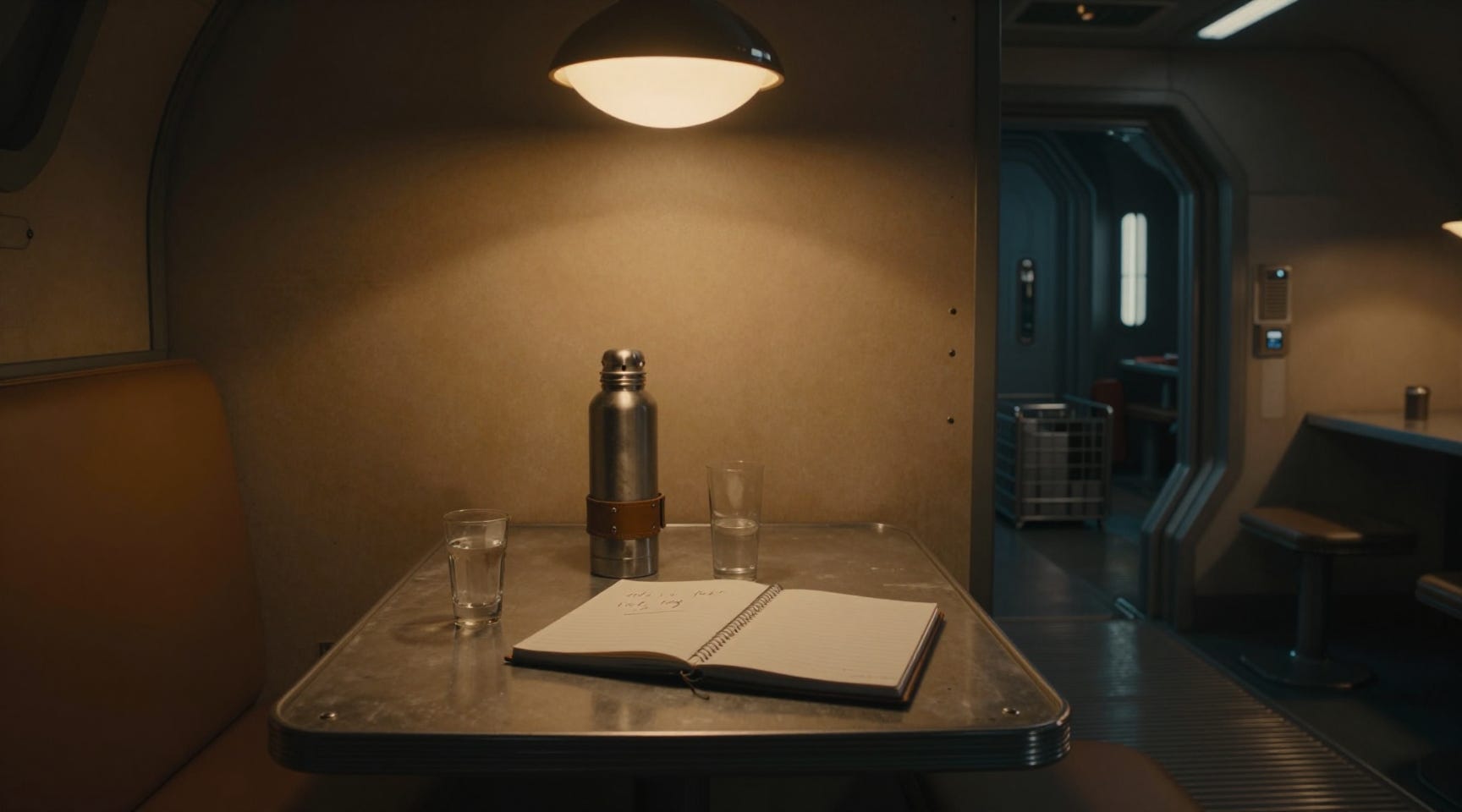
They had been circling the question for an hour.
“It needs to be short,” Davit said. “It needs to be a word a buyer can say without effort. It needs to mean what we mean.”
“It does not need to mean anything to a buyer,” Anya said. “It needs to mean what it means to us.”
“To us, and to the next us,” Davit said. He looked at Bero on the word next.
Bero did not look back. He was watching the rim of his thermos.
Davit had been working on the name for months. Anya had known it without him telling her. He carried notebooks. He wrote in them in a hand she could not read because he had taught himself a private shorthand in his twenties when he ran logistics on Ceres and the work had needed the secrecy. Tonight he had brought the notebooks. They sat in a stack at his elbow, three of them, soft-cornered with use. He had not opened them.
“You have one,” Anya said.
“I have one,” Davit said.
“Say it.”
He did not say it for a moment. He turned his glass on the table by a quarter rotation. The liquid in it caught the half-down bar lights and the booth’s amber overhead and did not move.
“Iron Wake,” he said.
The booth did not change.
The galley worker passed with another crate. The cook turned a page in the paper book. Bero looked up from his thermos and looked at Davit and then down at the table.
Anya sat with it.
She made a habit of letting a thing land before she answered. The skiff had taught her. EVA had taught her. Salvage had taught her. A thing said quickly was a thing said poorly. She let the name move through the booth and through her sternum and through the small chest pocket of her flight jacket where the Polaris fragment and the folded Iso letter sat against each other.
Davit waited. He was good at waiting. It was one of the things he had brought to the work from his Ceres years.
“Tell me,” Anya said.
Davit drew breath. He did not perform the answer. He gave it the way he gave a price quote in a back room: in plain sentences, with the parts laid out for inspection.
“Iron because the work is hard,” he said. “Iron because what we move is hard. Iron because the people we are now are harder than the people we were. Iron because nothing soft in this economy survives.”
He turned the glass another quarter rotation.
“Wake because we follow what is dead and we do not let it stay dead,” he said. “Wake because we pull a ship back into the world when no one else will. Wake because we hold vigil for what we lost. Wake because we leave something behind that the next ship has to read and navigate around.”
He stopped. He looked at the table.
“That is what I have.”
Anya did not answer immediately.
She heard, in the silence after his sentences, the thing he had not said.
Wake because Maren.
She did not say it out loud. She did not need to. Davit had been the one who came to the bay after. He had stayed. He had said nothing useful. He had stayed. He had been in the room when Anya had spoken never again to the empty air where Maren’s gear had been. The word wake in his mouth had four meanings he had laid out and one he had not, and the one he had not was the one that made the others true.
She let her water glass alone.
Bero had not moved.
She looked at him. He was a thin kid still, ring-belt born, born after, the kind of body the low-G colonies grew when a child never spent a year in a centrifuge. His hair was cropped the way ring-belt hair was cropped because helmets ate it. He had been Maren’s age plus one when Maren died. He had not known her. He had been hired four days after the Pact, fetching documents, witnessing without speaking. Now he sat at the booth as a junior partner.
“What do you hear in it,” Anya said.
Bero looked up.
He thought before he answered. He had learned that from her or from Davit or from the booth itself.
“I hear a name for the thing that has been the only steady thing I have had in my adult life,” he said.
He said it plainly. He did not soften it. He did not look away.
Anya took two seconds. She did not let her face change. The small pressure behind her sternum, the one that had been there since the Bonecrack Field and had stayed through the Pact and the Hollow Seam funding and the Enceladus contract and the night she did not sleep, eased by a measurable degree.
She picked up the water glass.
“Iron Wake,” she said.
She said it the way Davit had said it. Plain. The two syllables landing where they needed to land. Her own ring-belt vowels wrapped around it. The name fit the mouth.
“Iron Wake,” Davit said.
“Iron Wake,” Bero said.
They touched glasses. The water and the station-distilled and the cheap caffeine drink met above the table for one second. None of them spoke.
Davit set his glass down. He opened the topmost notebook for the first time tonight. He wrote two words at the top of a clean page in his private shorthand, then crossed out the shorthand and wrote the words again in plain Standard, large enough that Anya could read them from her side of the booth.
Iron Wake.
He underlined the words once.
“We start with the Protocol next month,” he said. “Eight pages. Six clauses. We have most of them already.”
“We have all of them already,” Anya said.
“We have most of them already and we write down the rest,” Davit said.
Bero was looking at the notebook page. The look on his face was not awe. It was something older. He was reading a thing that had a name now that he could speak in daylight.
Anya stood.
She left the water on the table. She gathered her flight jacket from the bench and pulled it on. The chest pocket pressed against her sternum with the fragment and the letter in it, and the pressure was the same pressure it always was, and she walked out of the booth.
The galley worker did not look up. The cook turned another page.
In the corridor she walked the slow loop back to her storage bay. The desalination plant two corridors down vented warm water vapor through the deck plates as she passed and the soles of her boots went briefly damp.
She said the name out loud, low, to no one.
“Iron Wake.”
She tried it in her mouth a second time. Then a third. The shape of it did not change. The name was already a thing she had been carrying for three years and had not known how to call.
She reached the bay. She unlocked the door. She did not turn on the overhead. She stood for a moment in the half-dark with the racks and the shelving and the authentication slab and the inventory she would not want to explain, and the name in her mouth, and the small private quiet of a woman who had built a thing tonight that had not been buildable an hour ago.
She closed the door behind her.
Author’s note: Day Twenty-Four of the Iron Wake Origins arc. Year 3, Month 4. The name itself. Davit Kade has been carrying it in his notebooks for months. Tonight, in the same back booth where the eighteen percent commission was set two years ago, the three people at the table (Anya Rask, Davit Kade, and Bero Kallen, twenty years old this month and the youngest in the room) agree on what they have been building. Iron because the work is hard. Wake because they follow what is dead, and hold vigil for what they have lost, and leave something behind that the next ship will have to navigate around. The Iron Wake Protocol comes next month. The Lurker Core that will reach the Children of Earth a decade from this booth is already drifting somewhere in the outer rings, in a debris pocket the UEN has not catalogued.
If you enjoyed this story, you can follow the main story arc in The Exodus Rush, the first book in The Vethrak Requiem series.