


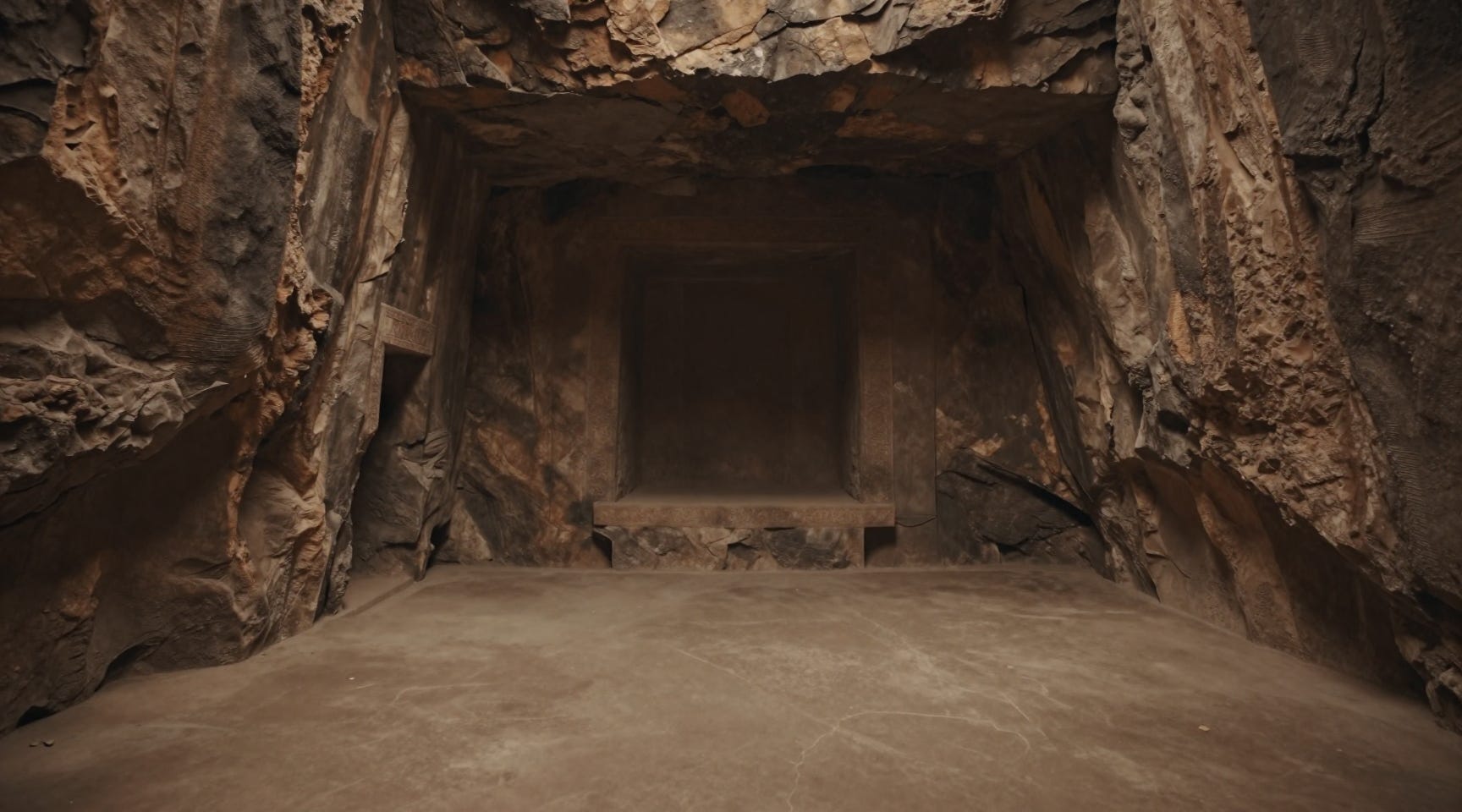
The chamber was carved from living rock. The walls were smooth in the way that stone became smooth when generations of bodies passed through the same corridor, year after year, century after century, the friction of countless surfaces wearing the rough edges down to something almost deliberate. The chamber had been used for this purpose since before the Harvest. The names that had been spoken in it spanned eras the designation authority had not lived through, and the chamber remembered them in the only way a chamber could: by continuing to exist unchanged.
The young Skarreth stood at the center of the space, maintaining full standing posture. The designation authority was positioned at the far end of the chamber, recessed slightly into a carved alcove that elevated them just enough to make the asymmetry of height a structural feature of the ritual. The authority’s age was indeterminate. Old enough that their hydrostatic body had settled into a permanent lower resting profile, the surface plating showing the fine dulling of centuries, the chromatophores responding with a slower rhythm than youth produced. The authority had performed this ceremony more times than the young one had completed station-cycles.
The authority did not speak. The authority was reviewing the record.
The silence was traditional. The silence was also an evaluation. The young one had been standing at full height for long enough that the body’s stabilizer muscles were signaling the beginning of fatigue. The young one did not shift position. Shifting during the evaluation would be interpreted as uncertainty, and uncertainty was not a disqualifying signal in itself, but it was a signal the authority would register and the young one preferred to avoid.
The proving action replayed in the young one’s memory as the silence stretched.
The tunnel had been a collapsed section of the deep transit network, a route that had been unstable since the Harvest bombardment and had never been cleared because the route it served had been rerouted decades ago. The young one had been assigned to map it. Not clear it, not repair it, not stabilize it. Map it. The distinction was instruction: a mapped tunnel was a known quantity. What happened after the map existed was someone else’s decision.
The compression into the first gap had been tighter than the training simulations had prepared for. The hydrostatic redistribution had moved deeper than the practiced range, the internal cavities collapsing into a configuration the young one had never held before. The walls of the collapsed passage had pressed against every surface of the body at once, the stone’s texture legible through the outer plating as a continuous surface of pressure with no gap, no relief, no indication that there was space beyond. For a moment the young one had been uncertain whether the gap continued or whether they had misread the initial assessment and were now compressed into a dead end with no room to reverse.
The moment of uncertainty was the choice-point. The young one could push forward into an unknown gap that might not open, or begin the laborious process of reversing the compression to extract from the passage and report the route as impassable. The young one had pushed forward.
The gap had opened after another body-length of the tightest compression. The tunnel beyond had been stable. The route was mapped.
The young one held the standing posture in the chamber and waited for the authority to finish reviewing the record. The authority would have seen every parameter of the proving action: the compression depth, the duration of the uncertainty at the choice-point, the time taken to complete the mapping once the gap opened, the accuracy of the map the young one had submitted. The authority would know exactly what the young one had done and how long each decision had taken. The silence was not about gathering information. The silence was about whether the young one could endure being assessed without needing the assessment to end.
The young one held position.
The authority’s chromatophores shifted. The shift was minimal, barely visible in the chamber’s ambient light, but the young one registered it. The authority was preparing to speak.
The name arrived as a single compressed utterance, shaped by the authority’s vocal apparatus with the economy of a sound that had been chosen in advance and held in readiness.
“Vresh-Kal.”
The first syllable designated function. Vresh- meant analysis, evaluation, the category of work that involved taking incomplete information and producing a complete assessment. The second syllable was the personal designation. Kal. The authority did not explain why Kal had been chosen. No one explained a name. The name was the explanation.
Vresh-Kal received the designation. The response was a single compressed click, acknowledgment, not celebration. The authority returned the click. The ceremony was complete.
Vresh-Kal exited the chamber.
The corridor outside was the same corridor that had been walked on the way in. The air pressure was the same. The click of footsteps was the same frequency against the carved stone. The distant rhythm of station operations reached the ears at the same volume and the same interval. Nothing in the physical world had changed to mark the threshold that had been crossed.
Vresh-Kal was different. Vresh-Kal had a shape now.
The newly-named adult walked through the cavern-city without thinking about the fact that they were no longer the same person who had entered the chamber. The body knew. The body carried the name in the way it carried the memory of the compression through the tightest gap, the choice-point in the dark, the authority’s silence, the weight of the syllable that designated function and the syllable that designated person. The name was not a label applied from outside. It was a configuration of the self that had been recognized and named, and the recognition changed the thing that was recognized.
Vresh-Kal passed other Skarreth in the transit corridors. Some were named. Some were not yet. The distinction was invisible to external observation, there was no visible marker, no insignia, no change in bearing that an observer could read. But Vresh-Kal knew that the named ones would register the new name’s presence differently, not because they would say anything, but because naming was a mutual acknowledgment. Vresh-Kal was now part of the network of named adults. The weight of that inclusion settled into the body alongside the weight of the proving action and the weight of the authority’s silence.
The transit tunnel opened into a wider chamber where station operations continued at their standard rhythm. Maintenance crews worked on a section of pressure conduit. A logistics Skarreth was reviewing a cargo manifest at a wall terminal. The daily functions of Kresh-Vor’s underground infrastructure proceeded without pause. Vresh-Kal walked through the operational space without disrupting any of it, because Vresh-Kal was now one of the adults who moved through the city without needing to be directed.
The proving action had been about navigating a collapsed tunnel. The choice-point had been about whether to push through the tightest compression or withdraw and report. The name was Vresh-Kal, because the authority had determined that the function of analysis and evaluation was the young one’s appropriate designation, and the personal syllable Kal had been chosen from the authority’s assessment of what the young one had done in the dark.
Vresh-Kal continued walking. The station’s corridors extended in every direction, carved through the rock of Kresh-Vor, connecting the habitats and workspaces of a species that had lived underground for 147 years. The city was built from survival, and the city had been built by named adults, and Vresh-Kal was now part of the city in a way that had not been true before entering the chamber.
The station’s atmospheric systems cycled. The air moved through the corridors with the familiar pressure differential that the body registered without conscious attention. The chamber where the ceremony had occurred was somewhere behind Vresh-Kal, still there, still waiting for the next candidate. The authority was still in the alcove, reviewing the next record. The work continued.
Vresh-Kal had a shape now. The shape was not yet fully understood, the name carried implications that would unfold over years of operating within the designated function, testing what Vresh-analysis meant in practice, discovering what Kal meant in particular. But the shape existed. The threshold had been crossed. The young one who had entered the chamber was no longer the same as the one who had left.
The name was Vresh-Kal.
The name was enough.
If you enjoyed this story, you can follow the main story arc in The Exodus Rush, the first book in The Vethrak Requiem series.