


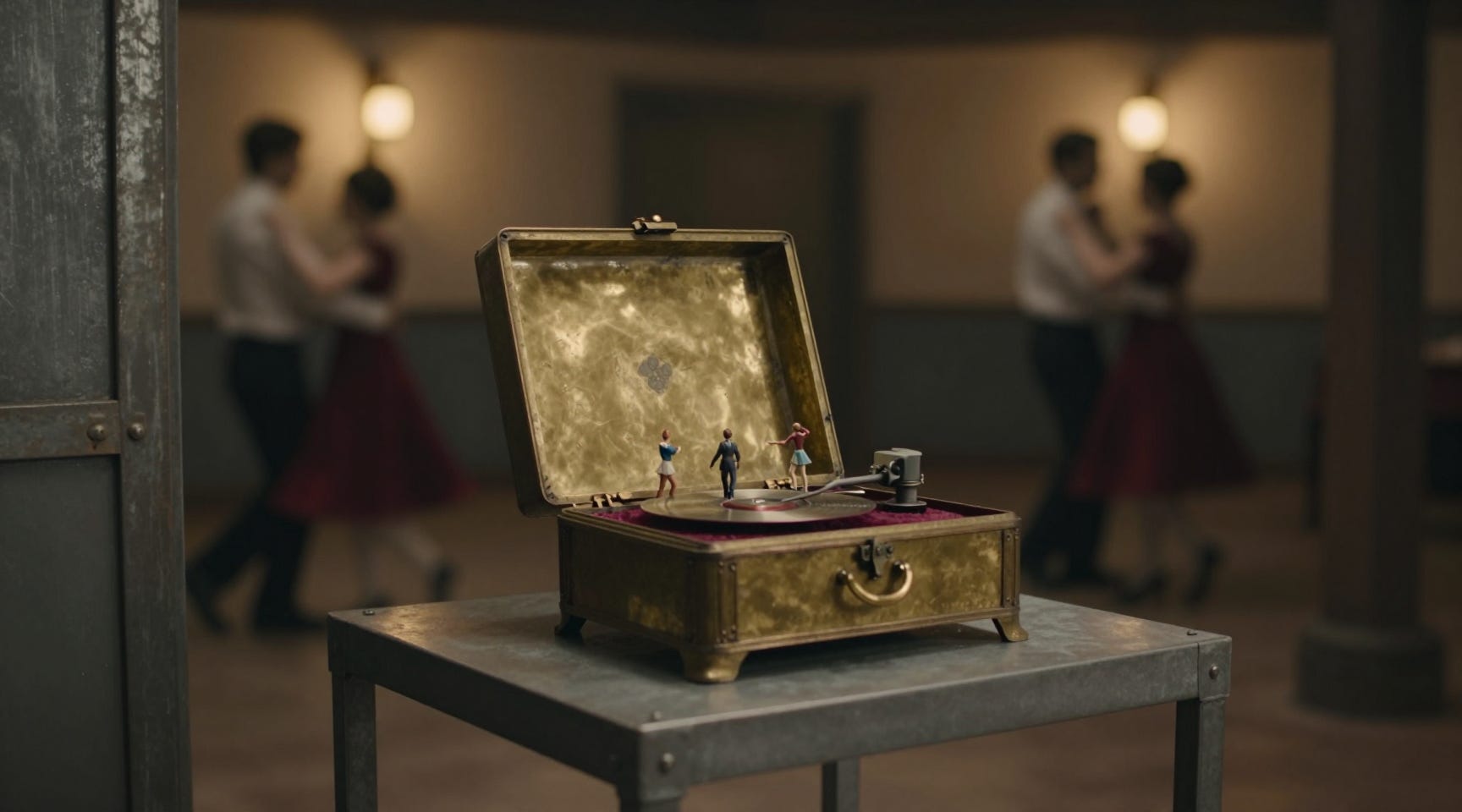
Hazel Murray found it in the salvage shed, wedged between a crate of recycled circuit boards and something that might have been a water filter once. The metal gleamed where her fingers brushed away the dust. Brass. She knew brass from the recycling charts. Old Earth metal, soft enough to bend if you pressed hard.
The box fit in both her hands. Ornate patterns swirled across its surface, flowers and vines carved with precision that made her think of the hydroponics bay’s failed decorative project. A small key jutted from one side. She turned it without thinking.
Click. Click. Click.
The lid lifted on a hinge, revealing a spinning platform covered in faded velvet. Two figures stood frozen mid-pose, paint flaking from their tiny faces. The mechanism beneath them ticked, whirred, then released a cascade of notes that made Hazel’s breath catch.
Music. Actual music.
The melody turned in circles, delicate and strange. Nothing like the work songs people hummed in the filtration tunnels or the rhythm of boots on metal deck plating. This sound had layers, harmonies weaving over and under each other like the braided cables her father spliced for power conduits.
Hazel sat on the shed floor and listened until the mechanism wound down to silence.
She turned the key again.
The colony administrator’s morning count finished before Hazel made it back to the residential pods. Fifty-eight people, same as yesterday. Frontier Settlement Seven, Year Eleven, Kepler System. The numbers never changed much. Nobody arrived. Nobody left. They grew food, recycled water, and waited for supply ships that came when they came.
Hazel’s father worked the mining dredge. Her mother maintained atmospheric processors. Hazel attended school in Pod C with six other children and learned mathematics that might matter someday if they found ore worth shipping or crops worth selling.
The music box lived under her bunk now, wrapped in a spare shirt. She wound it once before sleep and listened to the melody spin through the darkness. The figures turned on their platform. The music rose and fell.
On the third night, her mother looked up from her bunk.
“What is that?”
Hazel showed her. Her mother’s expression shifted through confusion to something Hazel could not name.
“Where did you find this?”
“Salvage shed. Nobody wanted it.”
Her mother sat on the bunk edge and touched the brass lid with careful fingers. “Wind it. Please.”
Hazel turned the key. The music started. Her mother closed her eyes.
When the mechanism stopped, her mother stood without speaking and left the pod. Hazel rewrapped the box and tried to sleep.
The knock came after breakfast. Sunita Menon stood in the doorway, gray hair pulled back in the tight bun she always wore. She ran the colony’s archive, such as it was. Three servers worth of mission documents, agricultural data, and personnel records nobody looked at unless someone died.
“Your mother said you found something.” Sunita’s voice carried an accent Hazel could not place. Rounded vowels. Soft consonants. Different from the flat efficiency of colony-standard speech.
Hazel retrieved the box. Sunita took it with both hands like it might break.
“May I?”
Hazel nodded.
Sunita wound the key and opened the lid. The music played. The old woman’s face transformed, lines deepening around her mouth and eyes. She stood motionless until the last note faded.
“How old are you, Hazel?”
“Nine. Ten next month.”
“You have never known music like this before.”
Not a question. Hazel shook her head.
“Come with me.” Sunita closed the box. “I want to show you something.”
The archive occupied the back corner of Administration Pod A. Three server racks hummed against one wall. A desk held a terminal older than Hazel. The air smelled like recycled plastic and ozone.
Sunita set the music box on the desk and pulled up a chair for Hazel. Her fingers moved across the terminal keyboard with practiced speed.
“Most of what we saved from Earth is practical. Agricultural databases. Engineering specifications. Medical protocols.” She scrolled through directories. “We brought what would keep people alive.”
“That makes sense.”
“It does.” Sunita stopped scrolling. “It also means an entire generation grows up without context for what they are trying to survive for.”
The screen filled with file names. Hazel recognized none of them.
“Music,” Sunita said. “Dance. Art. Literature. Film. We archived what we could in the last weeks, but storage space was limited. Food production data took priority over symphony recordings.”
She opened a file. Sound filled the archive. Strings and horns and instruments Hazel had no names for, building into something vast and complicated.
“Beethoven. Symphony Number Nine. Humanity spent centuries creating this.”
Hazel listened. The music felt bigger than the archive, bigger than the colony pod, bigger than anything she knew how to measure.
Sunita stopped the playback. “The music box you found plays a much simpler piece. A popular tune from the twentieth century. Do you want to know its name?”
“Yes.”
“I do not remember.” Sunita’s smile held sadness. “I recognize the melody. This music was part of my childhood. The name is gone.”
She opened another file. Images flickered across the screen. People in strange clothing moving in coordinated patterns, arms linked, feet striking polished floors in rhythm.
“Dancing. Social dancing. People gathered in spaces designed for this purpose and moved together for pleasure.”
“For pleasure?” Hazel leaned closer. “Not exercise?”
“Not exercise. Not function. Pleasure.” Sunita advanced through images. Couples spun. Groups formed patterns. A room full of people swayed in unison under lights designed to do nothing but look beautiful.
“This seems…” Hazel struggled for the word. “Wasteful.”
“Yes.” Sunita closed the image file. “It was. Gloriously, necessarily wasteful.”
She picked up the music box and turned it over in her hands. “The first six months after invasion, we focused on survival. Food. Water. Air. Shelter. We built the framework for staying alive.”
Sunita wound the key but did not open the lid yet.
“The next six months, people started dying in ways that had nothing to do with starvation or decompression. Despair. Loss of purpose. The mind needs more than nutrients and oxygen.”
She lifted the lid. The music played. The tiny figures spun.
“So we started organizing moments of impracticality. Poetry readings. Talent shows. Someone rigged a projection system and we watched old films on the side of a cargo container.” Sunita watched the figures turn. “It helped. Not everyone. Not enough. It helped.”
The music wound down. Sunita reset the mechanism.
“You have lived your entire life in survival mode, Hazel. You know efficiency. You know rationing. You know how to calculate caloric intake and water reclamation rates.”
“Everyone knows that.”
“Yes.” Sunita met her eyes. “Do you know why those calculations matter?”
Hazel frowned. “So we stay alive.”
“For what purpose?”
The question sat between them like something physical. Hazel opened her mouth, closed it, tried again.
“So we can… keep going?”
“Keep going toward what?” Sunita’s voice stayed gentle. “What are we preserving ourselves for, if we lose everything that made humanity worth preserving?”
She gestured at the music box. “This object is functionally useless. It plays one song. It serves no survival purpose. Someone spent time and resources creating it anyway, because there was a child somewhere who would delight in watching tiny dancers spin.”
Sunita wound the key again. “That impulse, that desire to create beauty for its own sake, is as much a part of human survival as food production. It might be more important.”
The music filled the archive. Hazel listened to it differently now, hearing not just the notes but the intention behind them. Someone composed this. Someone else built the mechanism to play it. Someone purchased it as a gift. The box passed through hands and years and survived the end of one world to surface in another.
“May I borrow this tonight?” Sunita asked when the music stopped. “I promise to return it tomorrow.”
Hazel hesitated, then nodded.
The message went out over colony comms at 1800 hours. All non-essential personnel requested to report to the central commons. Unusual. Hazel went with her parents, curious.
The commons had been cleared. Someone moved the storage crates to the walls. The overhead lights had been dimmed, replaced by a string of maintenance lamps arranged in a pattern that cast soft, indirect glow across the space.
Sunita stood near the center, the music box on a table beside her. Fifty-eight colonists gathered in loose clusters, confused and tired from their shifts.
“Thank you for coming.” Sunita’s voice carried in the metal-walled space. “I am going to do something impractical tonight. You are welcome to stay or leave as you choose.”
She wound the music box and opened the lid.
The melody drifted through the commons. People shifted, uncomfortable with the unfamiliar sound. Hazel watched faces. Confusion. Annoyance. Then something else.
Recognition.
An older man near the front, one of the mining crew supervisors, closed his eyes. A woman from the agricultural team pressed her hand to her mouth. Someone in the back started crying quietly.
Sunita let the music wind down. She reset the mechanism.
“For those who do not remember, this is called a music box. They were common on Earth. Parents gave them to children. They sat on dressers and shelves. They played when you needed to hear something beautiful.”
She wound it again. The music repeated.
“I want to teach you something tonight. A dance that goes with this melody. It requires nothing but space and willingness to look foolish.”
Sunita extended her arms and began to move. Simple steps. A turn. A sway. Her movements matched the music’s rhythm, following the rise and fall of the notes.
“Anyone can join. You do not need skill. You do not need practice. You need to move.”
The mining supervisor stepped forward first. His steps mimicked Sunita’s awkwardly, boots too heavy for the delicate pattern. He smiled anyway, a expression Hazel had never seen on his weathered face.
Others followed. Hazel’s mother took her father’s hand and pulled him into the cleared space. More colonists joined, their movements uncoordinated and self-conscious. Someone laughed. Someone else hummed along with the melody.
Sunita wound the box over and over, keeping the music playing. The dance evolved into something that bore little resemblance to whatever formal structure she had intended. People improvised. They spun. They swayed. They moved for no reason except the music asked them to.
Hazel watched from the edge. Her mother waved her over. She shook her head, content to observe.
The gathering lasted two hours. When the final winding of the music box played out, the commons held a different quality of silence. Not the empty quiet of exhaustion, but something fuller. Satisfied.
People dispersed slowly. Someone touched Sunita’s shoulder in passing. Others nodded. The mining supervisor stood near the table for a long moment before leaving without words.
Sunita found Hazel near the door. She held out the music box.
“This belongs to you. I hope you will share it when you can.”
Hazel took it carefully. “Why did you do that?”
“Because I have watched children grow up in this colony who believe life is only mathematics and rationing. Because I want you to know that survival is not the same as living.” Sunita’s expression carried the weight of eleven years. “Because sometimes we need to remember that humanity created beauty, and we can create it again.”
Hazel turned the brass box over in her hands. The carved flowers caught the maintenance lights. “Will we? Create it again?”
“I do not know.” Sunita touched the box lid gently. “We are still learning how to survive. Maybe someday we will remember how to flourish.”
Hazel walked back to the residential pod with her parents. Her father hummed the melody under his breath, getting half the notes wrong. Her mother’s steps had a different rhythm than usual, lighter somehow.
That night, Hazel wound the music box and let it play while she lay in her bunk. The tiny figures spun. The melody turned through its familiar pattern. She thought about the people who made this, whoever they were, and the chain of choices that brought it across light-years to a salvage shed on a frontier colony.
Someone created beauty once. Someone thought it mattered enough to save.
Maybe it still did.
The music wound down. Hazel did not wind it again. She let the silence settle, carrying with it the memory of colonists dancing for no reason except they could. Tomorrow would bring the usual routine. Recycling quotas. Maintenance schedules. Efficiency calculations.
Tonight, fifty-eight people remembered they were more than their survival functions.
Hazel closed her eyes and slept.
Authors note: This story explores a truth we often forget in crisis: survival without purpose is just prolonged dying. In Year 11, the frontier colonies had mastered the mechanics of staying alive, but an entire generation was growing up without cultural context for why that mattered. Sunita Menon represents the last living link to Earth’s artistic heritage, and her decision to share that heritage through a simple music box becomes an act of preservation as vital as maintaining air recyclers. Small things keep us human during dark times. Sometimes, the most practical thing we can do is something beautifully impractical.
If you enjoyed this story, you can follow the main story arc in The Exodus Rush, the first book in The Vethrak Requiem series.