


0600 hours across the fleet.
Thomas Okonkwo
The gamma-shift relief arrived in engineering at 0558, two minutes early, which meant Lieutenant Park had already been at the reactor console for ten minutes doing the pre-transfer checklist himself.
Thomas was on the far side of the bay, pulling the cooling loop logs from the port manifold display. The numbers were steady. They had been steady for thirty-three days. He logged the readout and closed the panel.
Park looked up from the console when Thomas crossed the bay. His coffee cup was in its usual position, balanced on the edge of the monitoring station where it left a permanent ring on the metal surface.
“Gamma shift is ready,” Thomas said. “Petty Officer Vasquez has the rotation.”
Park nodded. He did not look at the logs. He looked at Thomas, which was a different kind of assessment.
“You are getting faster,” Park said.
“Same route every time. The manifolds, then the secondary conduit readings, then the Cascade stability check. It is not complicated.”
“No. It is not complicated.” Park took a sip of coffee. “But most people take three weeks to learn the route without looking at the schematic. You took eight days.”
Thomas did not know what to say to that. He had not been keeping track.
“You are relieved, Ensign.” Park set the coffee cup down and stood. “Try to sleep before the next watch.”
Thomas nodded and walked toward the lift. Behind him, the engineering bay hummed with the same steady frequency it had held since commissioning. The gamma shift was settling in. The reactors were stable. The ship was operating at nominal levels.
He had been on board for thirty-three days. He was still surprised, every morning, that he knew where to walk.
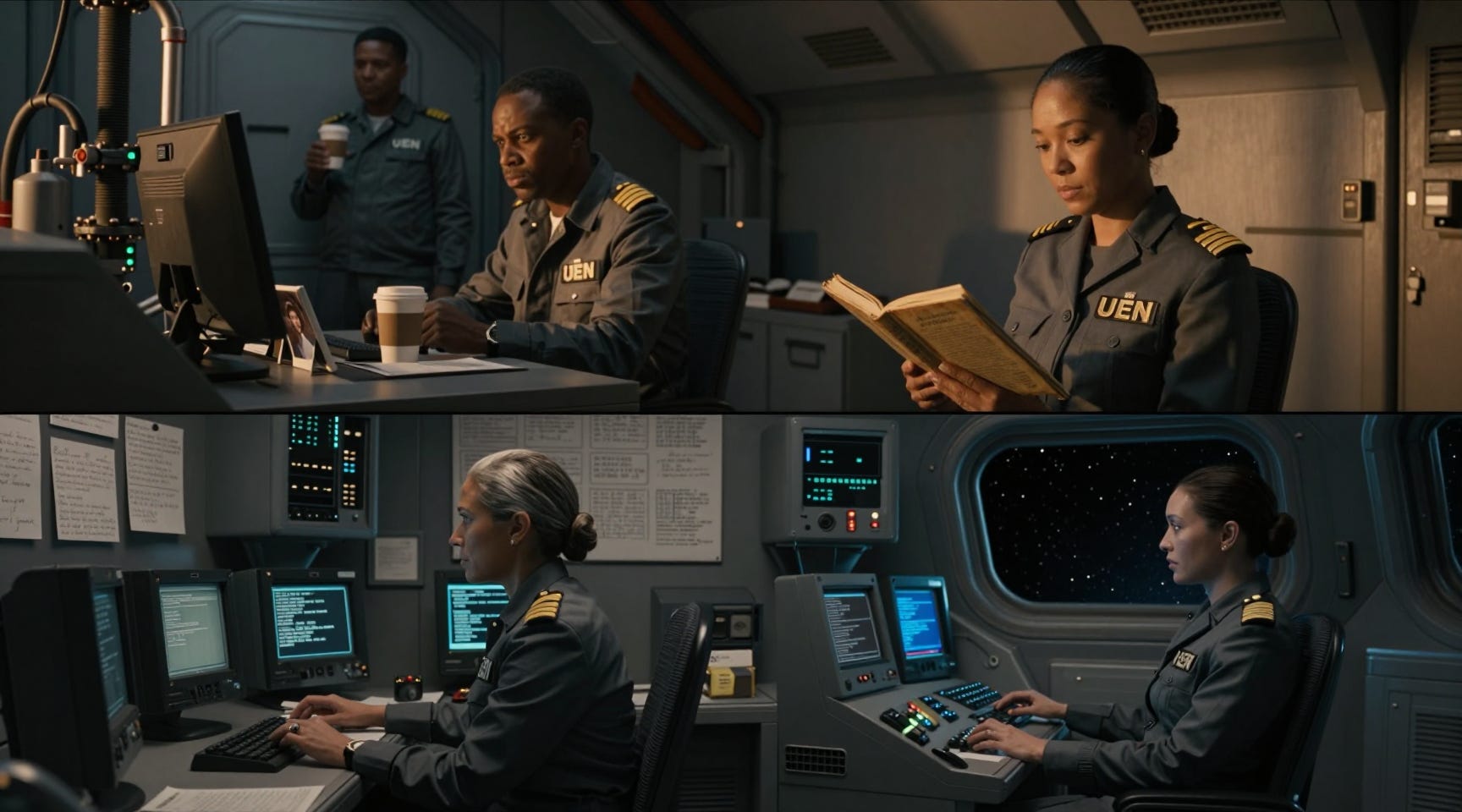
Marcus Rivera
The early walk was a habit he had not discussed with anyone, which meant it was either a secret or something too small to mention. He did not know which.
He walked the Defiant‘s main corridor from the bridge deck forward to the aft cargo bay and back, a route that took twenty-two minutes at a standard pace. He passed the berthing compartments, the mess, the small rec room where an ensign was already reading a logistics manual at the only table. He passed the airlock bay and the maintenance access shaft and the hatch to deck five where a supply pallet was still waiting for relocation paperwork.
He did not speak to anyone. Nobody spoke to him. The crew knew the captain walked in the early hours and knew better than to interrupt.
By 0600 he was back in his quarters, standing at the small desk where his personal items sat in the same arrangement they had occupied since Day One. A datapad. A cup of coffee that had gone cold twenty minutes ago. A framed photograph, creased at the edges, that had been taken fourteen years ago in what was now called the pre-invasion era.
His mother. His father. David at fourteen, grinning at the camera. Marcus himself at seventeen, standing stiffly beside his brother, already trying to look like a man.
He picked up the coffee cup, noted that it was cold, and set it back down. He did not pour a fresh one.
The ship was quiet. The watch rotation was running. The morning cycle was beginning. He had nothing to do for the next forty-five minutes except sit in this cabin and wait for the day to catch up with him.
He sat down. The cold coffee stayed on the desk.
Yuki Tanaka
The book was falling apart.
Tanaka handled it carefully, supporting the spine with one hand while she turned the page with the other. The paper was thin and yellowed, the binding soft from decades of use, and the cover had lost most of its original color somewhere in the years before the invasion.
She did not read from a screen. She had access to the entire Hope library through the ship’s network, every book that had been digitized in the reconstruction, but she kept this one physical. It had been her mother’s. Her mother had received it from her own mother, who had received it from her mother before her, an unbroken chain of women passing a book across generations.
The book was The Tale of Genji, translated into modern Japanese, the pages annotated in her mother’s handwriting in margins so narrow the words ran into themselves. She had been reading it since she was fourteen, which meant she had read it more times than she could count, which was exactly the point. A familiar book held no surprises. It did not demand analysis. It simply existed beside her, steady and unchanged, while everything else in the universe shifted.
She read for twenty minutes. The passage was one she knew by heart, the chapter where Genji visits Akashi in the winter. Her mother had underlined a line in faded pencil: The thought of her waiting, patient and unaware, was more than he could bear for long.
Tanaka closed the book and set it on the ready room desk beside a stack of tactical reports she had read three times.
The clock on the wall read 0603.
She stood, adjusted the collar of her uniform, and walked onto the bridge.
Sarah Vance
The colony was quiet at 0600. It was always quiet at 0600. The recyclers ran on a different cycle during the early hours, a lower hum that the residents had learned to sleep through over eleven years of practice.
Sarah sat at the console in the archive room. The screen glowed with the same transmission log she had reviewed every morning for eleven years. The same words. The same timestamp. The same empty confirmation window showing zero acknowledgments.
She opened the broadcast program.
The signal was automated now. The colony’s systems had been handling the relay for years, cycling through the transmission sequence on a loop that never varied. She did not need to be here. The broadcast would send whether she sat at this console or slept through the cycle or stood at the garden beds and watched the grow lights come up.
She sat at the console anyway.
The words appeared on the screen as they had every morning for eleven years:
Seventeen thousand souls. We are still here. Please. We are still here.
Her hand moved to the transmit key.
The colony had been broadcasting this message for eleven years. The signal had crossed the same empty space every day, reaching nobody, returning nothing. Sarah had watched the transmission window close every morning and logged the result in the same column of the same log sheet, a ritual she had stopped analyzing years ago.
She pressed the key.
The signal went out into the dark.
She sat in the quiet of the archive room, surrounded by the walls of her own handwriting and the glow of salvaged computers and the weight of 2,412 names she had written down by hand.
The console confirmed: Transmitted.
She logged it. Same as every morning.
Kira Vance
The bridge of the Hope at 0600 was transitioning between watches. The night crew was finishing their log entries. The day watch was settling into stations. The lighting had shifted from deep-watch blue to the pale amber that signaled the start of the active cycle.
Kira Vance stepped onto the bridge at 0601.
The watch officer at the tactical station, a lieutenant whose name she had learned on Day Four and now used without thinking, stood as she approached.
“All quiet, Commander. Standard sweep at 0545 returned null. Fold-space monitoring nominal. No anomalies.”
“Any flags on the passive bands?”
“No, sir. Clean sweep across all monitored frequencies.”
Kira nodded. She accepted the turnover pad, signed the log transfer, and settled into the station. Her hands found the console controls without looking.
The lieutenant stepped away. The day watch began its rotation.
Kira ran the preliminary scan check. The displays cycled through their patterns. Hull integrity. Reactor output. Environmental status. Tactical bandwidth allocation. All nominal. The Hope was operating at standard efficiency on the thirty-third day of its first patrol.
She did not open band 7-Beta. Not yet. The rotation came first. The work came first. The discipline of the watch came first.
She logged the preliminary check and began the standard long-range sweep.
The bridge hummed around her. Captain Tanaka was in her ready room, the hatch still closed. The helm officer was running a course verification. The sensor operator was cycling through passive arrays.
Kira watched the displays cycle and thought, briefly, about a dinner table conversation she had remembered in pieces for eleven years and only seen whole in the past two weeks.
She filed the thought and returned to the work.
The sweep continued. The returns were clean.
The morning watch on Day 33 of the patrol was the same as Day 32 and Day 31 and every day before it. Quiet. Routine. The long patience of a fleet that had been waiting for twelve years and had not yet learned that the waiting was about to end.
If you enjoyed this story, you can follow the main story arc in The Exodus Rush, the first book in The Vethrak Requiem series.