


The leasing office on Mimas Station’s lower ring kept its lights at the dim setting that station administration had recommended for energy-conservation compliance and that nobody had ever bothered to change back. The clerk was a man whose face Anya could not have described after the meeting if she had been asked at gunpoint. He wore a station-issue uniform with the sleeve cuff frayed at the right wrist. His comm slate was older than her skiff.
He took her credentials. He took her thermal credit deposit. He fed both into a system that responded with the slowness of a process that had once been instant and was now budgeted by the cycle.
“Bay D-17,” he said. He did not look up. “Ring corridor four, second bulkhead from the desalination plant. Lease runs eighteen months. Renewal is automatic if you keep your account current.”
Anya signed. The pen mark went through three layers of digital authentication and one layer of carbon paper the office had not stopped using because the clerk did not believe in any system that did not produce a physical artifact.
“Anything I should know about the bay,” Anya said.
The clerk looked up for the first time. His eyes were tired in a way she had stopped marking in people, because everyone she met now had eyes like that.
“It’s cold,” he said. “The plant runs warm, but the bay’s two corridors out. You’ll want a heater if you’re storing anything organic.” He paused. “We don’t ask what you’re storing.”
“Thank you,” Anya said.
The clerk handed her a key chip. The chip was the size of her thumbnail, matte black, with a serial stamp on one face and a magnetic strip on the other. Older tech. Reliable.
She pocketed it.
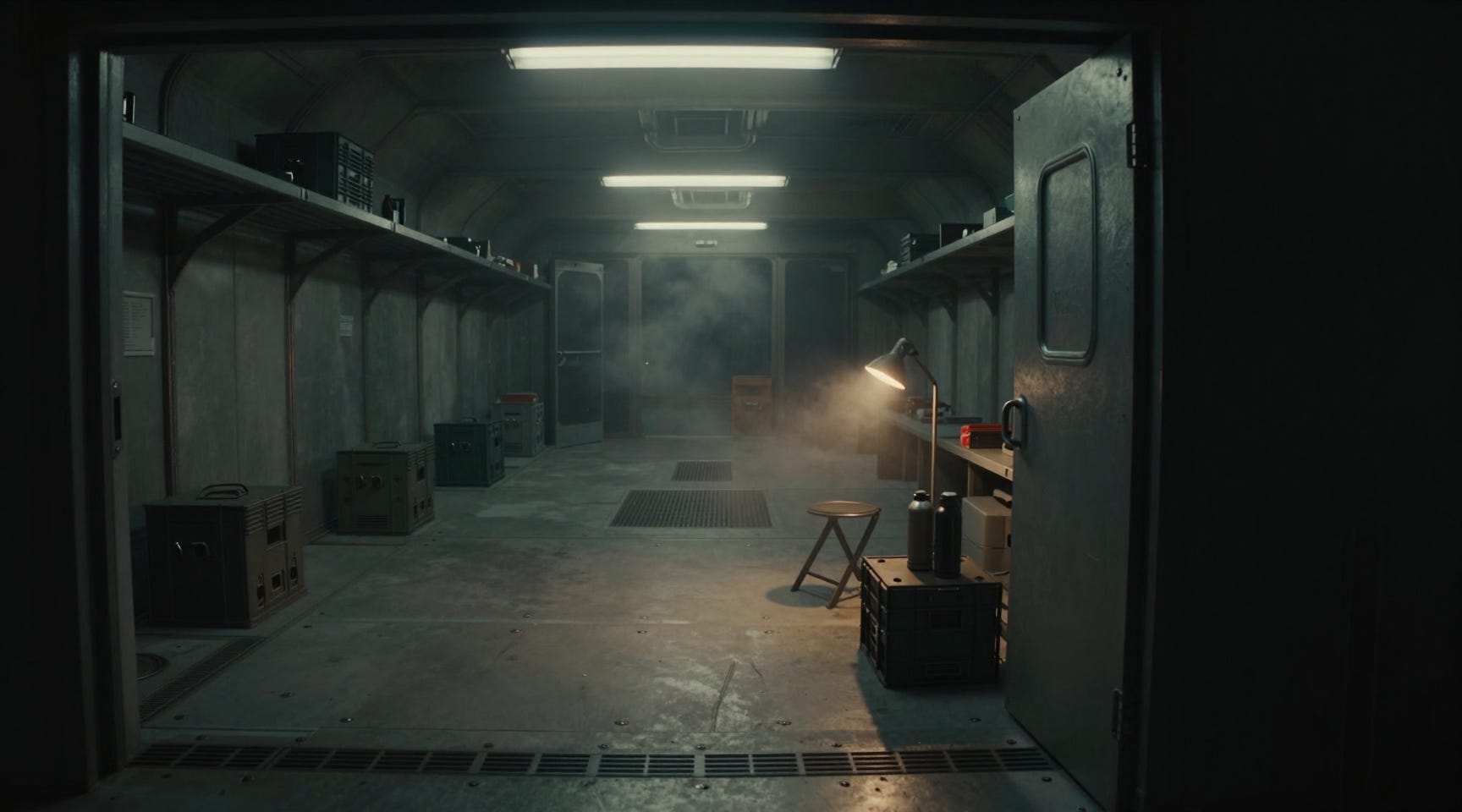
The bay was where the clerk had said it would be. Ring corridor four ran along the inner curve of Mimas Station’s lower ring, lit by overhead strips that turned everything the color of cold tea. The desalination plant’s vibration came through the deck plates as a low constant hum her boots picked up before her ears did.
Twice a shift, the clerk had told her, the plant vented warm water vapor through grates set into the corridor floor every twelve meters. She walked past the first grate as it cycled. The vapor came up around her ankles, condensed on the cold metal of her trouser cuffs, and fell back as small drops onto the deck. The corridor smelled faintly of rust and recycled brine.
D-17 was the second bulkhead from the plant. The door was a plain salvage-grade panel, retrofit installation, with the original station designation painted over in flat grey. Her key chip went into the slot. The door cycled.
The bay was empty.
She stood at the threshold a moment longer than the cold required. The room was perhaps six meters deep and four wide. The ceiling was high enough that she could mount overhead racks without ducking. The lighting was a single bare strip overhead, and she would replace it. The floor was bare deckplate, scuffed in the patterns of equipment that had been removed when whatever business had been here last had quietly stopped operating.
She walked the bay slowly.
Rack space along the long wall. Heavy-duty shelving on the short. An authentication slab she had not yet bought, though she had priced one, would go in the back corner where the deck was flattest. A small desk near the door for her slate, her ledger, her thermos. A second door, internal, would have to go in the back-left wall, leading into a smaller bonded subsection she would not allow visitors to enter.
She had worked salvage debris fields where she could not see her hands in front of her helmet visor and read every contour of them through her boots and her breath. Walking an empty room on a station should not have produced the same focus. It did.
The Vethrak inventory she now kept aboard the Underweight had outgrown the skiff six months ago. She had been moving it through Davit Kade’s chain as fast as she could authenticate it, but the chain had a cadence and her finds did not, and there were always some pieces she wanted to hold while she watched the market.
Pieces she would not have wanted to explain.
The bay would hold them.
The lease was in her name.
Maren found her there an hour later. The bay was no warmer. Anya had set up a portable lamp, a folding stool, and two thermoses of coffee on a crate she had carried in from the Underweight on the assumption that crates would be needed soon enough.
Maren came through the door with the quiet of someone who walked into other people’s spaces by trade. She studied the bay once. She studied Anya. She studied the bay again.
“D-17,” she said.
“D-17.”
“How long is the lease.”
“Eighteen months. Renewable.”
Maren took the second thermos. She unscrewed the lid. The coffee was the recycled kind they all drank now, faintly bitter, faintly metallic, hot enough to cut the chill in the bay if you held the cup close to your face.
She drank. She walked the perimeter slowly, the way Anya had walked it, reading the room by the same instinct.
“Authentication slab back corner,” Maren said. “Racks on the long wall. Shelving on the short. Internal partition for bonded inventory.”
“Yes.”
“Heater near the door so the desk doesn’t freeze the slate.”
“Yes.”
Maren stopped walking. She came back to the crate and sat on a second folding stool Anya had set out, because of course Anya had set out a second stool. She drank coffee and studied Anya across the cold air of an empty room that already had everything in it that mattered.
“You’re not a salvager anymore,” Maren said. “You’re a business.”
The words sat in the cold for a moment.
Anya did not answer. The honest answer was that she had stopped being a salvager the day she had taken Davit’s first credit transfer. The lease was the paperwork catching up.
Maren raised her thermos slightly. The gesture was not a toast.
“To the business,” Maren said.
Anya raised her own. “To the business.”
Maren left first. The corridor cycled the warm vapor again as she walked away, vapor curling around her boots, settling.
Anya stayed.
She walked the bay one more time. She set the lamp where the desk would go, and the stool where the chair would be, and stood at the threshold the way she had stood at it when she had first opened the door.
Then she stepped out, cycled the door behind her, and waited for the lock indicator to turn from amber to green.
She put her hand in her chest pocket. The Polaris fragment was where it always was. The key chip went into the same pocket, settling against the fragment with a small click she could not have heard with her ears but registered all the same.
Two pieces of metal. One that had survived what had been taken from her. One that marked what she had taken in return.
She walked back toward the leasing office, and past it, and out toward the docking concourse where the Underweight was waiting for her to come home.
Author’s note: Day Ten of the Iron Wake Origins arc. Year 2, Month 2. Anya Rask leases her first permanent storage bay on Mimas Station’s lower ring, two corridors down from a desalination plant whose grates vent warm vapor twice a shift. The lease is in her name. The contract is legitimate. The inventory it will hold, increasingly, is not. Maren walks the empty bay with her, reads the unspoken layout in a single circuit, and names what the paperwork has just made formal: Anya is not a salvager anymore. She is a business. Mimas D-17 is the geographic seed of the Iron Wake’s institutional home, the same lower-ring bay that, by Year 14, will sit at the center of the syndicate’s Sol-wide clearinghouse.
If you enjoyed this story, you can follow the main story arc in The Exodus Rush, the first book in The Vethrak Requiem series.