


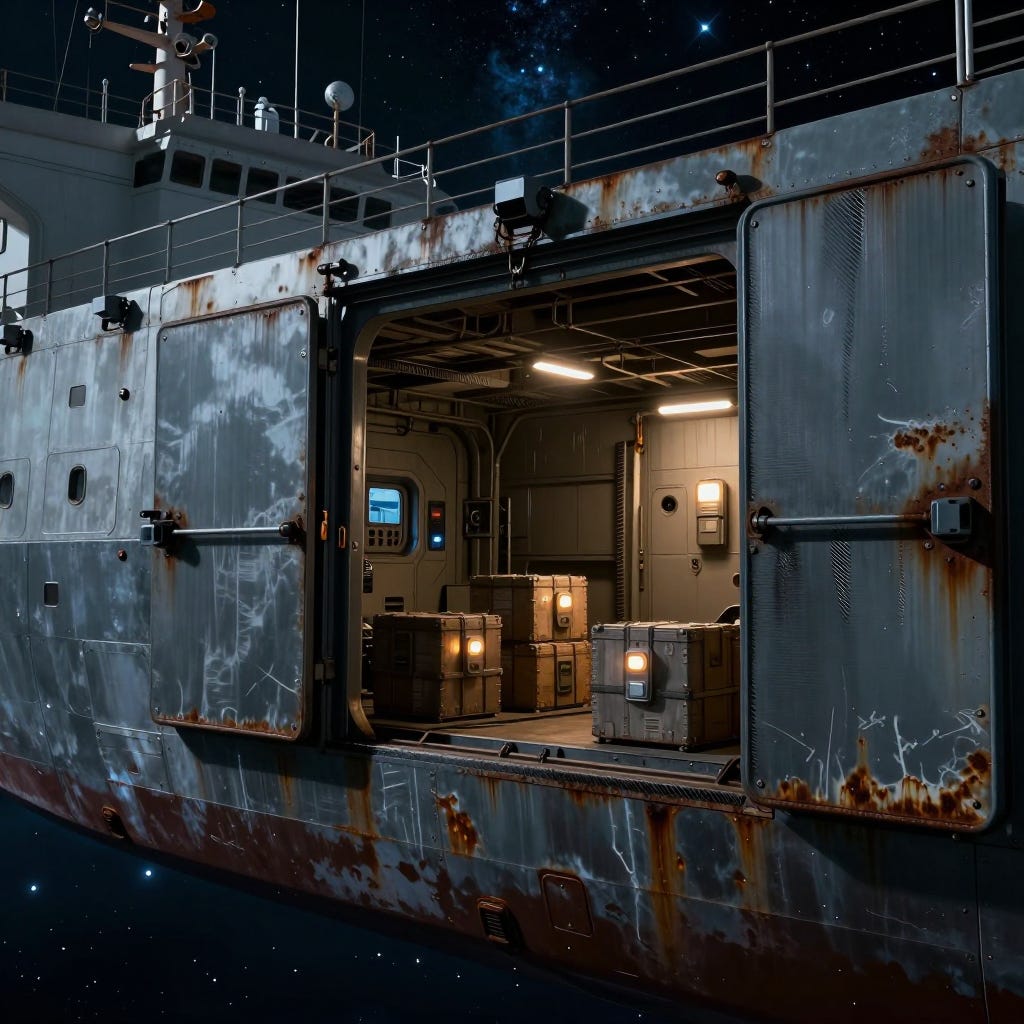
Cargo Bay Seven smelled like hydraulic fluid and old coffee. Marcus Webb had stopped noticing years ago.
He guided the loader arm with practiced ease, settling another crate onto the magnetic pallet. Forty-seven crates down, sixty-three to go. The manifest said medical supplies: antibiotics, surgical equipment, radiation meds. Boring stuff. Essential stuff. The kind of cargo that kept colonies alive and never made the news.
The Perseverance wasn’t a glamorous ship. Thirty years old, patched in a dozen places, running on an engine that wheezed through every Fold transition. She’d never see combat, never make first contact, never do anything that would earn her a mention in the history feeds.
She delivered cargo. That was it.
Marcus finished securing the pallet and checked his handset. Two hours until departure. Enough time to grab food, run the pre-flight checks, maybe catch fifteen minutes in his bunk before the long haul to Cygnus Station.
His boots clanged against the deck plates as he made his way to the mess hall. The Perseverance carried a crew of six: Captain Hendricks, two pilots, an engineer, and two cargo handlers. Small enough that everyone knew everyone’s business, large enough that you could find a quiet corner when you needed one.
The mess was empty except for Lin, the junior pilot, hunched over a bowl of something gray and protein-rich.
“That bad?” Marcus asked, sliding into the opposite bench.
“Tastes like recycled ambition.” Lin pushed the bowl away. “Three more runs and I’ve got enough saved for the Academy application fee.”
“You still on that?”
“Some of us want to do something that matters.”
Marcus thought about the sixty-three crates still waiting in the bay. The antibiotics that would treat infections on a colony where doctors were scarce. The surgical tools that would give some frontier medic a fighting chance. The radiation meds that meant the difference between survival and a slow, ugly death for miners working the outer belts.
“Right,” he said. “Something that matters.”
The Perseverance launched on schedule, sliding out of the station’s embrace and into the black. Marcus watched the departure from the cargo bay window, a small viewport that offered a sliver of stars.
Fold transit was always strange. The universe compressed and stretched, colors bleeding into spectrums that shouldn’t exist. Most crew slept through it, drugged into dreamless unconsciousness. Marcus preferred to stay awake. He’d seen enough transits that the wrongness didn’t bother him anymore.
Twelve hours in Fold space. Then six hours of conventional travel to Cygnus Station. Then the unloading, the manifest checks, the signatures and handshakes. Then back through the Fold to pick up another load.
The milk run. The eternal loop. The job that never ended and never changed.
Halfway through the transit, the ship shuddered.
Marcus grabbed a handhold, muscle memory kicking in. Shudders happened. The Perseverance was old, her frame stressed from countless transits. Usually it was nothing.
The intercom crackled. Captain Hendricks, her voice flat and controlled: “All hands, we’ve got a Fold instability. Dropping to normal space for diagnostics. Stand by.”
The transition hit like a punch to the chest. Colors snapped back to normal, the strange pressure of Fold space releasing all at once. Through the viewport, Marcus could see stars, unfamiliar constellations in an unfamiliar sky.
Wherever they were, it wasn’t the planned route.
He made his way to the bridge, moving through corridors lit by emergency strips. The main lights flickered, steadied, flickered again. Not good.
Hendricks was at her station, gray hair pulled back, face unreadable. The main display showed their position: a red dot in a whole lot of nothing, parsecs off course.
“Navigation’s recalculating,” she said without turning. “Engine’s stable, but we burned out the secondary motivator during the drop. We can make one more jump, maybe two.”
“Can we reach Cygnus?”
“We can reach somewhere.” Hendricks finally looked at him. Thirty years of hauling cargo in her eyes, every delay and disaster and close call. “There’s a relay station about four hours from here. If it’s still operational, we can call for a tow.”
“And if it’s not?”
“Then we get creative.”
The Perseverance limped through normal space, her wounded engine complaining with every burn. Marcus returned to the cargo bay, checked the pallet seals, ran diagnostics on the magnetic clamps. The crates sat in their rows, patient and indifferent. Sixty-three containers of supplies that someone, somewhere, was counting on.
Four hours later, the relay station appeared on sensors. Old, battered, but transmitting.
Marcus watched the docking procedures from his viewport. A different sliver of stars, a different station, the same job waiting on the other side.
The milk run continued.
The UEN Auxiliary Fleet processes over forty thousand cargo shipments annually. Ninety-seven percent arrive without incident. The three percent that don’t are why crews like the Perseverance exist: experienced, adaptable, and stubborn enough to find a way.