


Wanjiku Bett kept her thumb beside the unload control while the cradle stood empty of force.
Article Four filled the remote camera view, its three repaired transitions paler than the surrounding plate. The load actuators were coupled. The enclosure was clear. Nothing on the screen had moved for long enough that she had begun checking the clock against the recorded clock, distrustful of the small comfort of waiting.
Samrawit anchored herself at the adjacent console.
“Interval complete.”
“From the last controlling temperature?”
Samrawit brought up the cooling record. Its measured curve included the slower descent during the power shift, Cho’s reassignment of a tool block, and the eventual crossing of the qualified threshold. The elapsed interval began there. Wanjiku checked the end against the delayed examination’s start.
Nobody had borrowed time from the cooling curve.
The delayed ultrasonic coverage lay beside yesterday’s immediate scans. All three transitions had been examined through the required paths. Their references held; no reportable indication had appeared. Wanjiku signed the examination acceptance and retained the new scans as the pre-proof baseline.
She could now permit a test. That was the whole extent of her signature.
Tuva’s voice came through from the boundary station. “Last person clear. Access secured.”
Wanjiku checked the enclosure view and boundary confirmation, then the fixture calibration and actuator limits. Each strain channel answered its check. The acoustic pickups returned the reference signals in their mapped order. She retained the fixture comparison record beside them, including a small response from a cradle shoe that had been present before loading.
“Same stages,” Cho said from behind her. “Same holds.”
His cuff displayed the remaining transfer window. He turned its face inward before catching a restraint loop.
“Including the way down,” she said.
“Including that.”
She enabled the first stage.
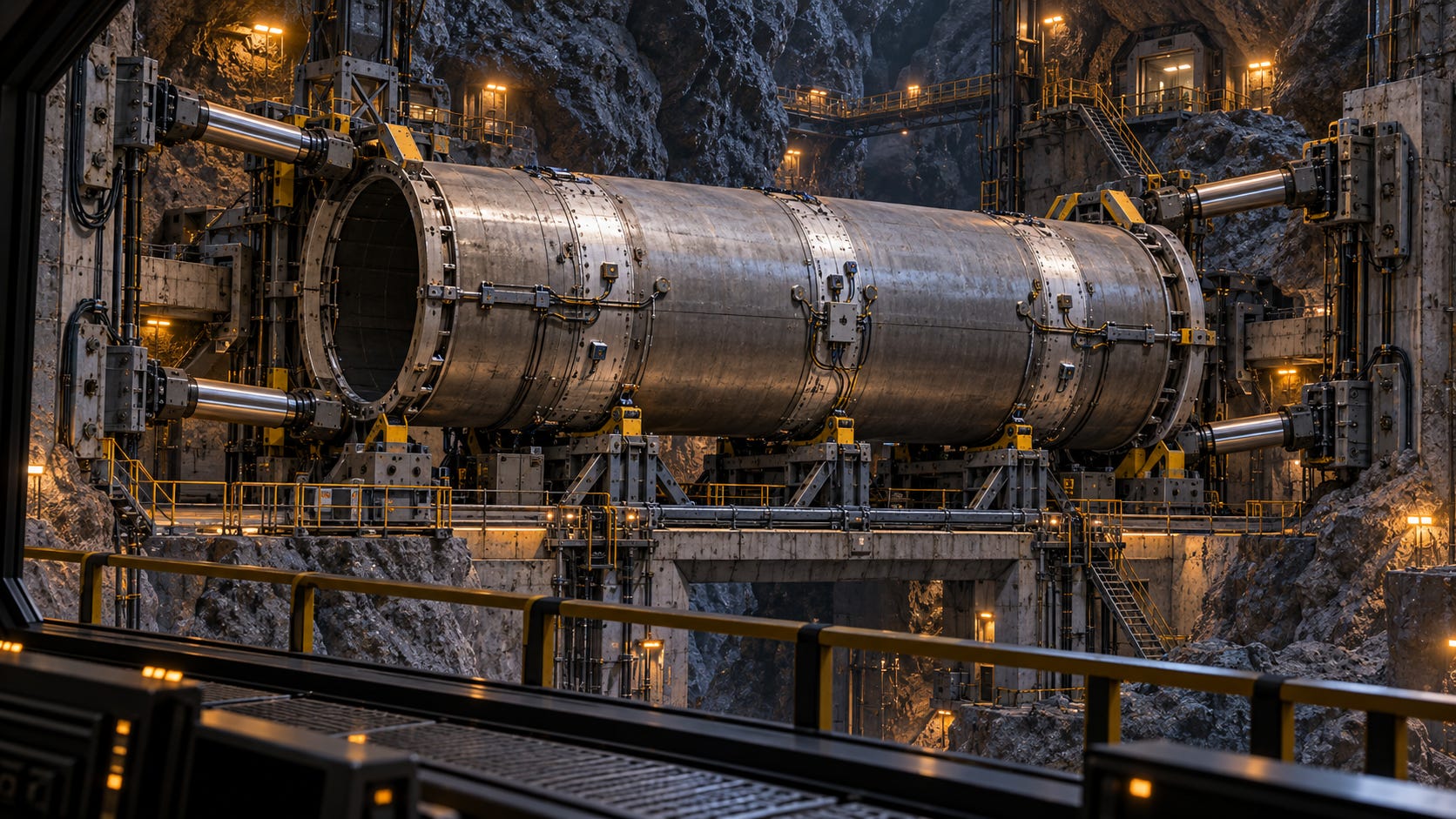
The actuators took up force along the barrel and across its joining interfaces, imposing the prescribed combination of axial load and bending. Camera brackets, a captive lead, the pale repaired bands: everything looked as it had at zero. Only the measured displacements and strain traces showed how much work the ordinary metal was doing.
Wanjiku read across the channels instead of following the smoothest line. Opposite sides of the barrel responded within the predicted distribution. The three transitions carried their share without a channel drifting away from its companions.
The first hold ended. She authorized controlled unloading and kept her thumb where it was.
A brief acoustic mark appeared at the cradle shoe. Its level and timing matched the retained fixture response. She checked the corresponding strain and actuator records before accepting the comparison. No unexplained group followed it across the transition pickups.
At zero, the displacement returned within its limit.
One stage.
Past the enclosure door, Slip Two’s waiting rigging occupied the wall racks. Those slings would carry the barrel toward a hull she would never inspect, at a place she was not cleared to know. Another crew would receive the proof envelope and build against its limits. They would have no access to this camera view, no memory of her thumb poised over a control. They needed a completed record they could use.
She checked the next target against the authorized sequence.
Tuva remained on the boundary circuit. Wanjiku could hear the occasional brush of clothing against the microphone, but the welder offered no interpretation. Her work was inside the enclosure. She had to let someone else put force through it.
Wanjiku advanced the sequence.
During the first proof, the second unloading ramp had produced the repeated arrival groups that made her stop. The subsequent scans had found microcracks beside the weld centers. Since then, every ordinary sound from that cradle had acquired a possible meaning she could not afford to give it.
The second target settled. Strain remained within the predicted band throughout the hold.
“Unloading,” she said.
The force trace descended toward the old failure interval.
Her thumbnail pressed against the edge of the control. She eased it away enough to leave the pad of her thumb free. A stop made too late would damage the barrel. A stop made without cause would leave them with another interrupted proof and no answer.
She watched the actual records.
The shoe response returned at reference level. No unexplained sequence crossed the three repaired transitions. Strain recovered along the predicted paths, without the divergence preserved in the failed test.
The force fell through the interval and continued to zero.
Nobody spoke until the required dwell finished.
“Second stage complete,” Wanjiku said.
Cho released one hand from his loop, flexed it, and caught the webbing again.
The maximum stage had never been reached on Article Four. There was no clean flight-barrel trace from the earlier proof to lay beneath this one, only the test definition and its predicted limits. The representative qualification had earned the repaired structure this attempt. It could not make the attempt for them.
Wanjiku checked the completed stages, then authorized the next ramp.
Load increased. The strain channels spread across the display in their expected order. A slight difference between two traces stayed inside the specified distribution; she read the values rather than willing the lines closer together.
At full qualified proof load, the hold timer began.
Through the camera, a patch of inspection light shone on one repaired transition. Tuva had left a small, even change of surface there. Wanjiku had watched that region opened to sound metal, mapped, rebuilt, and examined. Now she wanted the light to show her something the instruments had not.
It showed only the surface.
She returned to the channels. No divergence. No unexplained emission. The prescribed load held.
The timer completed its interval.
“Maximum hold complete,” she said. “Beginning unload.”
Tuva drew a breath over the circuit.
Wanjiku followed force, strain, and acoustic timing through the descending ramp. The fixture response remained recognizable and bounded. The repaired regions gave her no new sequence to investigate. Each load step passed through the same architecture that had exposed the original damage, with every hold intact.
The final force reading reached zero.
Cho leaned toward the display. “How long left?”
She pointed to the zero-load hold.
“That. Then the scans.”
He checked his cuff. “Keep the bay allocation. I’ll carry it.”
That settled the immediate schedule question. It did nothing for the tightening across her shoulders. She shifted against her restraints without looking away. A successful maximum hold had been so easy to imagine while they were cutting out the damaged metal. The long return to zero had scarcely figured in that private picture. Now it was the only part she wanted to finish.
The timer counted down while the barrel remained captured in its cradle. Wanjiku read the residual strain against the acceptance limits, then checked the quiet acoustic channels again. A dead pickup could also be quiet. The retained references and channel checks mattered as much as the absence of a signal she feared.
She did not open the release record.
After the hold, she confirmed zero force, isolated the actuators, and verified that mechanical capture remained in place. Only then did she clear access for the examination.
Tuva entered on a handrail, stopped at her assigned restraint, and helped clear the approved scan paths. Wanjiku joined Samrawit at the examination station. Waiting behind the safe boundary had left a crease across her palm from the console edge. She rubbed it once against her trouser leg and brought up the baseline.
The post-test examination covered each repaired transition completely. Matching paths returned to matching coordinates. Wanjiku required the reference checks at their recorded intervals and watched the comparison advance beyond the weld centers into the adjoining material.
The first region showed no new indication or growth. The second matched its baseline within the examination’s limits. At the third, she followed the final path through to its recorded end before allowing herself to look at the coverage map as a whole.
Every required path was there. The references remained valid.
Samrawit signed the examination result and moved her hand away.
Wanjiku opened the release record.
The first gate linked the recovered process histories to the confirmed cause: two valid plate conditions had been subjected to an incompatible common treatment after their distinction was lost. The second retained the representative qualification and the executed repair, including the measured cooling curve and power adjustment. The third held the complete repeated proof and its post-test examination.
She checked each link and signed each gate.
Tuva had come back to the enclosure entrance. “You have what you need?”
Wanjiku read the acceptance once more. Structural release. The separate outbound requirements remained open.
“Yes.”
She signed.
The structural-release field turned green beside Tuva’s original conditional signature. Wanjiku left the record expanded, every revision between them still visible.
Author’s note: This story takes place at Site Anvil in late Year 3, inside humanity’s hidden shipbuilding effort. It continues The Yard That Wasn’t There, a sequence about the workers, materials, and records behind an anonymous hull section.
New to The Vethrak Requiem? Start with The Exodus Rush, Book 1, where humanity fights for survival after an alien invasion using technology it barely understands. These short stories explore the wider universe; the novel begins the main story.