


The retired instruments had not touched the network in years. That was the only reason Ji-woo Han trusted the cage.
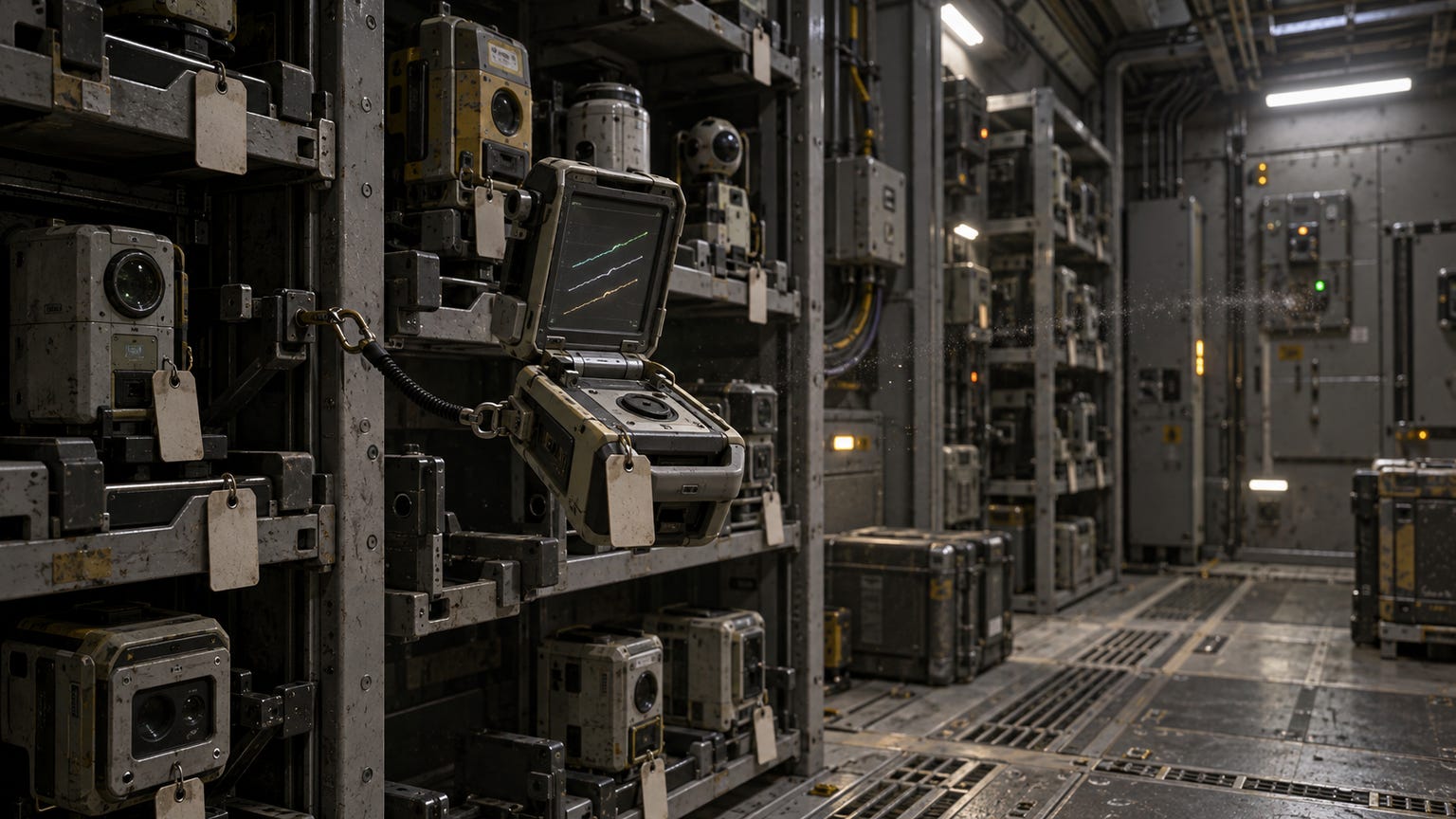
She pulled herself along the rack hand over hand, boots unlocked, letting each grip carry her to the next anchor. Ceres held everything in slow suspension. A tagged spectrometer drifted a finger’s width off its bracket at the end of its tether and drifted back when her passage stopped stirring the air. Every unit here wore a yellow retirement label. None of them reported anywhere. That was why she had chosen the third survey unit from the bottom of the rack eleven days ago, before the collapse, when a local copy was ordinary engineering and not a thing that could end a career.
The charge light held a weak green. She had left the unit asleep, not dead. She unclipped it, braced a knee against the frame, and woke it.
The screen came up gray, then the survey index, then the file she had signed at 3-Bravo before the last cycle. Three raw microseismic traces, the low-frequency pulse climbing at three distances from the brace line. The instrument checksum sat beneath them, the long string she had let the unit generate so the file could never be quietly rewritten. The recommendation carried her name and the phrase she had chosen with care, because care was the only authority a junior engineer held: pause extraction before further loading.
She opened the version history.
The central system held a different sentence. Her hold had left safety engineering as amber and arrived at scheduling recoded to monitor while operating, entered under a production-review account, logged after the recommendation had already left her hands. The words she had refused to write in the control room eleven days ago now sat in the official record with someone else’s authority behind them and her name still fixed at the top.
Her hands were steady. That steadiness unsettled her more than the recoded line. She had rehearsed this moment a dozen times in the dark of her bunk and expected the shaking to arrive with the proof. Instead a cold clarity settled over her, the same flat state she reached when a calibration ruled out tool vibration and left only the rock.
On the way out of 3-Bravo that last morning she had passed Lena Vasquez steadying an old drill by touch and nearly asked what the miner made of the traces. She had decided the formal process was enough. The formal process had recoded her sentence and closed the file.
Security had spent two days turning over union terminals. She was not union. The distinction would not shield her once anyone asked why a Helios safety engineer kept a private copy of a report the company had already closed.
She sealed the unit in her case and locked her boots to leave.
She had considered Kavita and set the thought down. Kavita led the union, and every union terminal was being opened one by one. She had considered Sigrid and could not finish the thought. The engineer who carried proof of a recoded hold to the director whose own chain had recoded it was not brave. She was finished, and the proof finished with her.
Lena Vasquez was neither. Lena had walked out of 3-Bravo with a suit that recorded everything her body could not say, and a suit log answered to no production-review account.
They met in a supply bay off the medical spur, a room of stacked filter media and sealed effects bags where the station feed did not carry. Lena clipped the case to the rail before she opened it, the way she handled anything she did not yet trust.
“You signed this,” Lena said. Not a question.
“I signed the amber. Someone changed it after.”
Ji-woo braced for the thing she had rehearsed against. Accusation, that a hold written plainly enough would have kept the crew off the face. The other answer would be worse: reassurance, offered to settle her and close the matter.
Lena gave neither. She turned the unit until the traces faced her and read the timestamps first.
“Show me mine against it,” she said, and set her own chip on the case.
The suit telemetry loaded in a second column, the raw trace from her glove and helmet across the last cycle. Ji-woo aligned the clocks. Survey traces on the left, suit log on the right, the same minutes running down both.
The central report named that window stable. Extraction proceeded, sensors monitored, nothing crossed a threshold. On the survey unit the low-frequency pulse was already climbing through those minutes. On the suit log, in the same minutes, the vibration Lena had carried through the drill housing and the deck strip rose with it, the half-beat drift she had killed the motor to isolate before any alarm reached her.
Two instruments that had never touched each other. One buried in rock. One a woman’s glove against a machine. They told the same minute in the same direction, and the record had called that minute quiet.
“There.” Lena set a blunt finger below the point where both traces bent. “That is when I cleared my crew. Your hold says pause. Mine says the rock was moving already. The company says nothing happened until the brace let go.”
Ji-woo’s throat drew tight. “The version history is the part they cannot argue away. Traces can be read a dozen ways. A checksum and a changed sentence under a named account cannot.”
Lena studied the columns a while longer. Then she closed the case with the care of someone sealing an effects bag.
“I know what the rock did,” she said. “The rock told my glove before the sensors owed anyone a word. I do not need this to tell me that.” She tapped the sealed case once. “I need the record to tell me what people did. This is the only thing on the station that does.”
“Not through the union,” Ji-woo said. “If it moves through a union terminal, security folds it into the sabotage story. It becomes a stolen file, and the credential trace becomes the whole conversation.”
“No.” Lena unclipped the case and held it out. “To the doctor. Molefe keeps a record no production account can reach, and she has already signed a dissent they buried. Her room, her custody, and the mediator gets a copy the same hour.” She kept her arm extended. “You carry it. You signed the top line. It should leave your hands, not mine.”
The case weighed almost nothing in Ceres gravity and more than anything Ji-woo had ever carried down a tunnel. She clipped it to her belt.
“They will know it was me,” she said.
“They will.” Lena locked her boots to the grid and turned toward the hatch. “The recoded line carries your name either way. This is the version where the name is telling the truth.”
Ji-woo pulled herself toward the medical spur, one hand ahead of her on the rail, the sealed case riding her hip. The dust in the corridor hung almost still, moving only where she moved, and closing behind her the moment she passed.
If you enjoyed this story, you can follow the main story arc in The Exodus Rush, the first book in The Vethrak Requiem series.