


Vikram Kulkarni found the problem at two in the morning.
He had come out for a routine inspection. The final concrete pour was scheduled for 0600, crews needed to be briefed at 0500, which meant he needed to be certain by 0400. Routine. He had run this checklist forty times on forty bridges in three years.
The eastern abutment sensor reading was wrong.
Not wildly wrong. Not obviously wrong. The kind of wrong that could be a sensor fault, a calibration error, a data-entry mistake. He crouched at the edge of the scaffold and read the number on his tablet. Then pulled the original survey data and compared.
A 3.1 centimeter differential settlement since the last reading. Two weeks ago, the number had been 0.4 centimeters.
Vikram sat down on the grating and looked at the eastern bank.
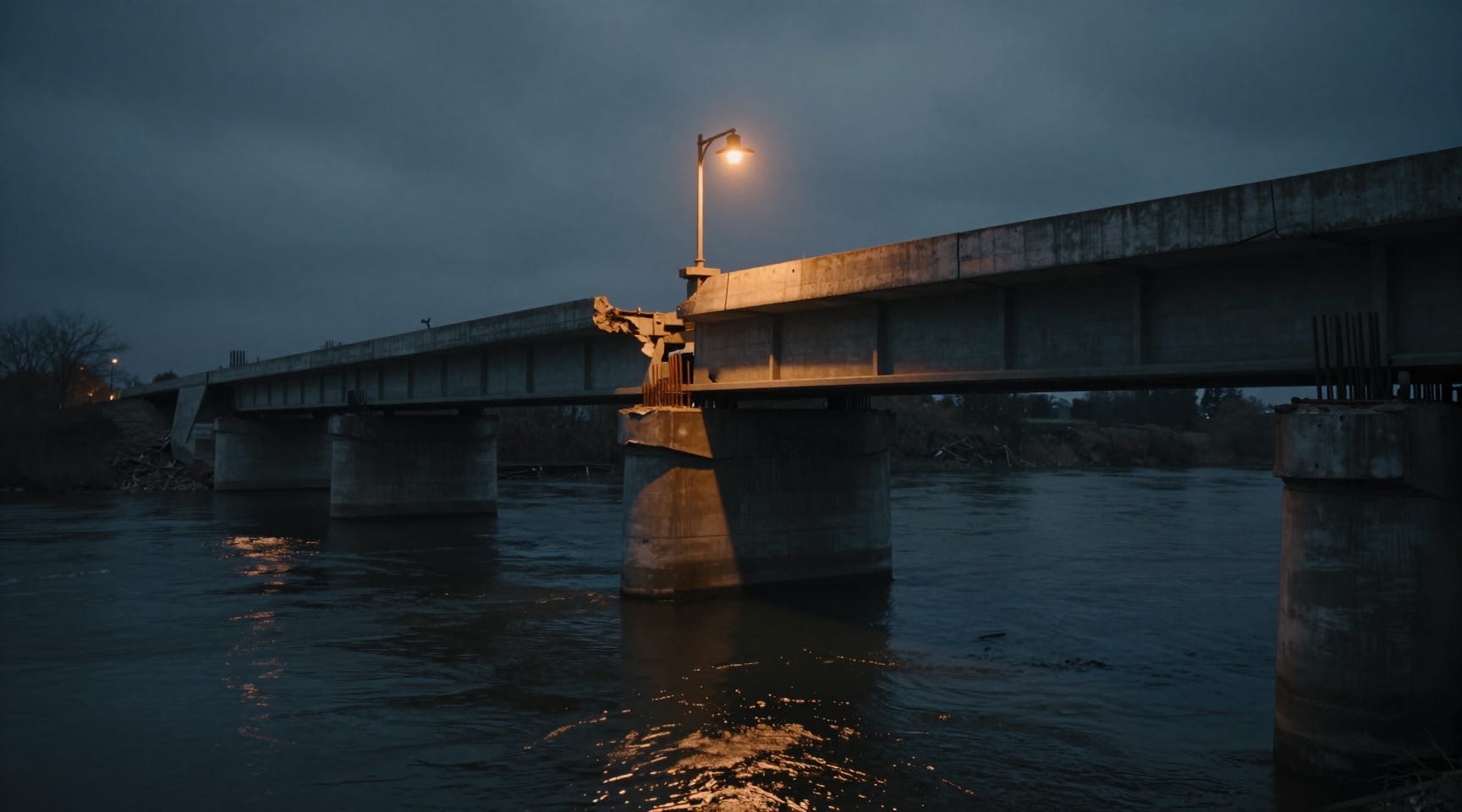
The bridge was almost done. Forty-two meters of reinforced concrete arch spanning the Meuse River, connecting Settlement Maas-Nord on the western bank to Settlement Maas-Oost on the east. Two communities, 4,400 people between them, who had been moving supplies by hand-operated ferry for fourteen months. The ferry took six hours for a full cargo round trip. The bridge would make it a four-minute crossing.
He had been working on this bridge for seven months.
He pulled up his design files and ran the load calculations again. The bridge could handle the settlement if it stopped where it was. The safety margin was 8%. Pre-invasion standards called for 20%. Post-invasion standards, which he and three other engineers had written in a shelter in Brussels during Year 1, called for 12%.
8% was below their own standard.
He ran the calculation three more times. Same number each time.
He called the crew chief at 0230. The man answered on the second ring, which meant he had not been sleeping either.
“I’m looking at the eastern abutment settlement readings,” Vikram said.
A pause. “The sensors could be wrong.”
“They could be. Get Benedetta and check the physical markers on the eastern pier.”
Twenty minutes later, the crew chief called back.
“The markers are consistent with the sensors,” he said. Benedetta’s voice was somewhere in the background.
Vikram looked at the gap between the last finished section of the bridge and the far bank. In the dark, with work lights casting orange pools across the water, it looked like forty meters. It was exactly forty meters. He had measured it himself in February, in the rain, boots in the mud.
“Pull the 0600 pour,” he said.
The pause lasted longer this time. “The settlement isn’t going to bring it down.”
“The margin is eight percent. We wrote twelve into the standard.”
“We wrote twelve because we didn’t know what materials we’d have. These pilings are solid. You know that.”
He did know that. He also knew the soil composition on the eastern bank differed from the pre-invasion surveys, and that those surveys were six years old, and that a great deal had happened to the ground in this region since then. He did not know what he did not know. That was the problem.
“Pull the pour,” he said again. “I’ll file the amended plan in the morning. We shore the eastern foundation before we load it.”
Silence on the line. Then: “Two weeks minimum.”
“Yes.”
“Winter.”
“I know.”
Another silence. The crew chief was not a man who argued without data. He was also not a man who accepted bad news quietly. The silence itself was a kind of argument.
“The ferry can make it through winter,” Vikram said. “The bridge, if it comes down under load in February, cannot.”
“It’s not going to come down.”
“I am not certain enough to stake four thousand people on that.”
The crew chief hung up without another word.
Vikram stayed on the bridge.
At 0400, the site went quiet. Workers he had not realized were still there finished packing up and left without speaking to him. The work lights stayed on. The generator hummed. Below, the river moved in the dark, indifferent to everything it had witnessed in the last three years.
He walked to the end of the finished span and stood at the edge.
The gap was forty meters wide. On the far bank, the eastern abutment sat in its foundations, solid, waiting. Between them: air, dark water, and four percentage points he could not bridge with argument.
Tomorrow he would file the amended engineering plan with the Settlement Authority. He would explain, in precise language, what the sensor readings showed, what the physical markers confirmed, what his calculations required. He would request additional materials. He would receive them within a week, most likely. The shoring work would take two more weeks after that. A revised pour schedule. A final inspection.
The people on both banks would wait.
He had told himself, when they wrote the post-invasion standards in Brussels with borrowed paper and a failing lantern, that the numbers existed for exactly this reason. Not for the easy bridges, where the survey data was clean and the soil was certain and the margins were comfortable. For this one. For the 2 a.m. reading that sat four points below the line.
The wind picked up off the river. Cold. November in the lowlands.
Vikram looked at the gap and thought about the ferry crew working through another winter. The supply convoy that would need six more weeks of six-hour crossings instead of four-minute ones. The medication shipment from Maas-Oost, already overdue, waiting for a bridge that was almost done.
He had made the right call. He was certain of it. Certainty was not, it turned out, the same as relief.
The work light at the end of the span cast a hard circle on the concrete, past which there was only darkness and the sound of water. He stood in it for a while. Not thinking about the bridge. Letting the cold settle into him the way correct decisions do when they have nowhere comfortable to go.
At 0500, he walked back down the scaffold to the shore.
At 0900, he filed the amended plan.
The bridge opened fourteen weeks later, on a morning cold enough to frost the railings. The first supply convoy crossed in twelve minutes. Vikram stood at the western end and watched it go.
Nothing came the way he expected. Mostly he was tired. Then the convoy was across and people were moving and supplies were moving and medication that had been waiting since November was moving, and the tiredness shifted into something quieter.
The bridge held.
That was enough.
Authors Note: Infrastructure reconstruction in Years 3 through 6 was carried out by a small, scattered network of engineers working with degraded survey data, improvised materials, and no margin for error. Most of what they built still stands. Vikram Kulkarni is a fictional version of the hundreds of real people who made those decisions at two in the morning on unfinished bridges, without enough data, knowing that the standard they set in Year 1 was the only standard they had. The Meuse River crossing is invented. The arithmetic is real: post-invasion engineering standards required 12% safety margins because the engineers writing them understood exactly when those margins would be tested.
If you enjoyed this story, you can follow the main story arc in The Exodus Rush, the first book in The Vethrak Requiem series.