


The work order had a seal number. Lena Vasquez locked both boots to the spine strip and held the slate against the wall stencil until the digits matched.
Cargo straps ran rail post to rail post along the access spine, the same webbing that had held nickel a week ago. Miners clipped hip rings to the straps in a spaced chain. Boots locked. Visors up. A gap in the middle wide enough for a stretcher. The gap was the point.
Last night the line had been a stop at shift change. This morning it was a checkpoint. Extraction stayed dark. Medical, habitat, rescue, and stabilization still had work. The spine had to tell those two facts apart without turning into a wall.
Helios security held at the far junction with hands visible and a camera on a chest mount. They had come for a blockade. They found a load plan.
Kavita Nair stood at the checkpoint table with a second slate and empty hands. Logging. The chapter had a leader. The rock still needed a miner who could read a fitting.
“Pressure crew,” Kavita said. “Stabilization. Stressed seal on the inner transfer. You know the map.”
Lena knew the map. She had walked that seal on recovery, glove on the collar, 3-Bravo dust still hanging in the lock lamps. West of the jam. The fitting that had screamed and then gone quiet when the collapse took the run.
The physical seal map lived under a scratched cover on the spine wall, stencil facing the aisle, the kind of chart a glove could read. Inner transfer. West collar. Brace frames every twelve meters in the throat beyond, none of them her problem today. The number on the slate matched the number on the rock. One page. Inspection only. No haulage. No conveyor. No ore.
She traced the west collar with a gloved finger until the stencil and the order agreed.
“Through.”
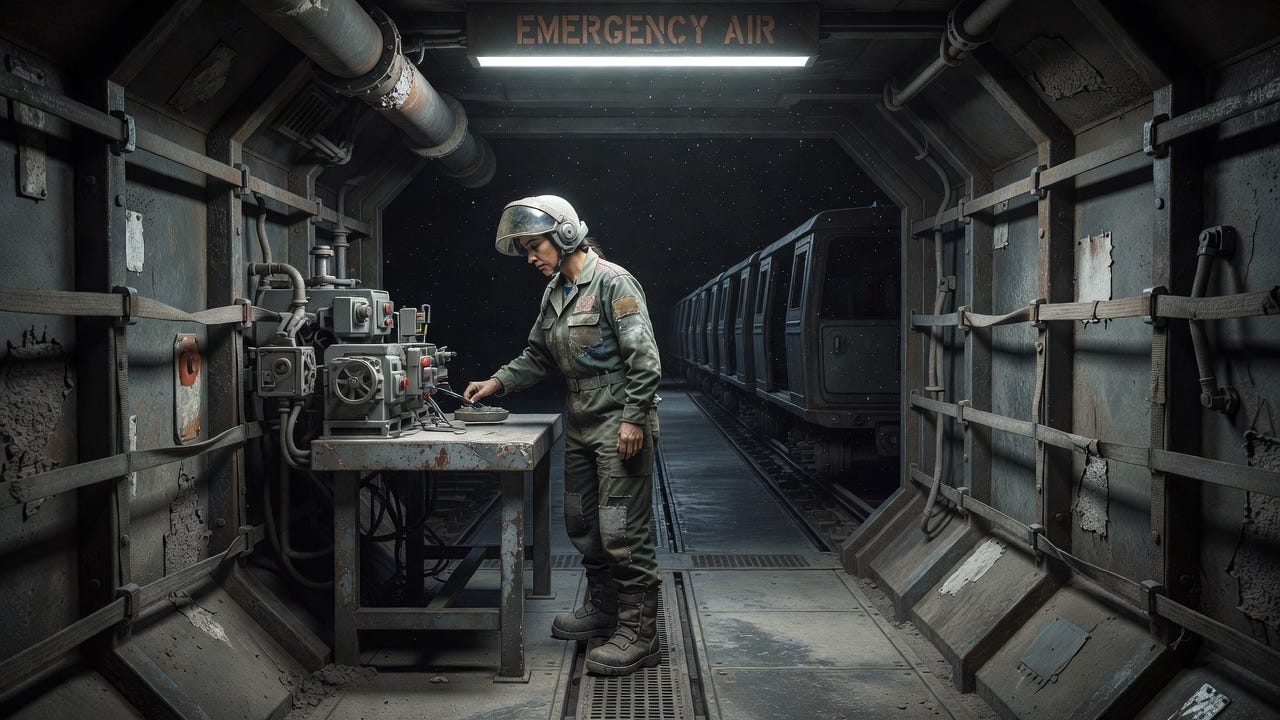
She unclipped the center strap long enough for three bodies on short tethers to pull past, kit bags tagged faded orange, the same stencil as the refuge doors. Emergency air. The line closed behind them. Nobody came off the rock. The chain took the load the way a brace took a cycle: spaced, anchored, able to open without anyone floating free.
The second team arrived on the mag rail with a bundled packet.
Four pages clipped as one. Header: emergency access. Same seal number as the pressure crew. Under the header: conveyor alignment. Diagnostic. A note said a belt could not sit idle without a check. A second note put the alignment in the same pass.
Lena separated the pages.
The first page was the seal. Already moving. The second was a sensor sweep of the transfer lock, legitimate if the collar failed. The third and fourth were conveyor. Alignment of the dogs. Positioning of the empty cars for a live cycle. Maintenance language. Restart minutes.
She knew that machinery. She had fed it for years. The dogs had a habit, the way a bit had a habit. True dogs meant ore could move the hour someone called the face live. False dogs meant a belt that sat. A pressure crew did not need true dogs to read a collar. A restart did.
She marked the conveyor pages with the chapter stamp Kavita had given her at shift change. NONESSENTIAL. Production. Outside the carve-out.
“The seal is live,” the conveyor lead said. Helios collar. No union patch. Voice careful, the way a person talked when a camera was already writing. “If the fitting goes, the belt sits in the failure. Alignment now keeps the run when you let us back.”
“When,” Lena said. “Not if.”
The lead restacked the packet and held it out again.
“Same emergency pass. Operations bundled it. Hedlund’s office signed the header.”
Lena kept the conveyor pages in her left glove. The seal page went back on the table.
“The pressure crew is in. They inspect the fitting. They do not need dogs aligned to read a seal. You wait.”
Security stepped closer along the rail. Not a charge. A record.
“Name of denying witness,” the one with the camera said.
Kavita’s slate was already up.
“Vasquez, L. Chapter technical check, access spine, Strike Day 2. Seal authorized. Conveyor held.”
The camera turned. The lens found Lena’s visor.
She angled her face toward the machinery. Empty extraction cars sat on the mag rail beyond the checkpoint, dark, doors open, dogs unclamped. Her glove found the nearest rail post the way it found a drill housing. Cold metal. No pitch. No haulage thrum. The silence still had mass.
Along the straps, visors tracked the camera, then tracked her. Public attention had a weight the rock never bothered with. She had given the chapter a chip, not a speech. A lens wanted a face. She kept her visor on the cars.
The camera dropped to the stamped pages. Legal liked paper. Paper did not look like a speech.
Kavita logged the hold on two channels at once. Union. Management. Same time stamp.
The conveyor lead locked both boots at the junction beside security. Nobody pushed the strap. The line held because the gap was procedure.
Time in low gravity did not pass the way clocks wanted. Dust hung in the work strips and refused to fall. Recyclers labored somewhere up-spine. Emergency air hissed in the overhead run, faded orange, still moving because habitat still had a pulse. Lena counted the hiss the way she used to count bit pitch. Air was still work. Ore was not.
A corridor screen at the junction still carried yesterday’s sentence. Unforecast localized shear event. The phrase sat in the spine the way a bad pitch sat in a jaw.
Lena kept her glove on the rail. The camera had her name. She had the pages. Attention was a kind of work she had never signed for.
The pressure crew came back on short tethers. Three kits. No ore. The crew lead held a data chip toward Kavita, then toward Lena, because the seal map had been Lena’s check.
“Fitting is stressed. Microfracture on the west collar. Logged. We did not pull ore. We did not touch the belt.”
Lena took the chip. The seal number matched. The conveyor pages stayed stamped in her left glove. Survival work had a result. Production had a stamp. The spine still knew the difference.
“Copy.”
Kavita published the access log before the crew had finished clipping back to the line. Both channels. Time in, time out, task, result. Seal inspection complete. Conveyor diagnostic denied. No ore movement. Witness: Vasquez.
Security recorded that too. The camera did not turn this time. The file already had a name.
Lena clipped the conveyor pages to the checkpoint table under the chip. She did not give the lens her face. The empty cars waited beyond the gap, a row of open mouths with nothing in them. Overhead, emergency air kept moving past the line, toward medical, toward the habitat ring, toward work that was still allowed to be work.
If you enjoyed this story, you can follow the main story arc in The Exodus Rush, the first book in The Vethrak Requiem series.