


The nickel delay crossed into a second day while Mateusz Zieliński was still strapped into the approach shuttle.
He expanded the schedule against his knee. A pressure-shell fabrication line had lost its first receiving slot. The next available slot pushed the forming run behind another contract. Beneath it, hull sections and coded reserve projects changed color, their dependencies carrying the delay farther than the original shipment would travel.
Two pallets at Ceres. Hours at the receiving site. Days by the time an assembled section could leave.
He opened his preliminary report and entered sabotage under suspected cause.
Outside the small window, work lights divided the dark surface into loading aprons and pressure entrances. No distant overview could distinguish a mine from a refuge. Each appeared as a lit opening in stone.
The restraint pressed his shoulder as the shuttle corrected its approach. He tightened the slate’s retaining strap. His authorization covered Fleet Construction cargo priorities, not labor agreements. Release the nickel, establish a dispatch order, stop the delay spreading. The mandate occupied half a page.
The schedule occupied thirty.
He returned to the reserve lines. Their locations stayed hidden even from his clearance; he could trace the material and the completion requirements, not the facilities. Against one code, a scheduler had attached a photograph of a pressure section awaiting its closing ring. Temporary lighting. A worker secured inside the curve, small beside the unfinished seam.
Mateusz enlarged the image until the worker’s tether became distinct. The project office had supplied it to explain why the ring could not wait. He kept it open through the final approach.
His first push out of the arrival lock carried him beyond the next boot strip.
Mateusz reached for the bulkhead. A miner at the junction pointed to the handrail beside his wrist. He caught it, his shoulder taking the pull as the rest of him continued forward. His case swung against its tether and struck his thigh.
The miner waited until his boots engaged before releasing her own grip.
“Vasquez,” the escort said. “Recovery crew.”
Lena Vasquez checked the junction behind him, then moved toward the transfer gallery with short pulls along the rail. No remark about visitors. No smile to require an answer.
Mateusz followed more carefully.
Empty ore cars stood beneath the gallery’s loading chutes. Their restraints remained engaged. A maintenance carrier passed on a separate guide, a scrubber cartridge strapped between its uprights. The technician moving it clipped onto the next anchor before releasing the previous tether.
Sigrid Hedlund waited at a bolted briefing shelf. Kavita Nair held the opposite rail, leaving the passage between them clear. Mateusz recognized both from his packet. He secured his case before opening it.
“Your dispatch office sent the hold,” he said to Nair. “Two pallets of refined nickel.”
“The chapter sent a conditional transit offer.”
“I have it. Independent verification, two custodians, sealed receipt.”
“Then you have more than a hold.”
Hedlund brought up the local dispatch board. “Our office cannot authorize outside access to a restricted contract. I need a receiving requirement we can execute.”
That, at least, was a question inside his authority.
Mateusz turned his slate toward them, closing the restricted project layer first. “One fabrication line runs out before this cargo reaches its next receiving slot. The delay stops pressure-shell work.”
“Occupied habitat repair?” Nair asked.
“Construction.”
“Then demonstrate the immediate life-safety use to a cleared reviewer. The proposal doesn’t require a public address.”
“That line is building the space people will need. We cannot wait until they’re suffocating to classify its walls as essential.”
Nair kept a hand on the rail. “Who absorbs the risk when you keep a mine line active?”
“This material is already refined. Nobody needs to enter a mine for it.”
“An emergency crew on a different route needs a verified emergency. Existing stored-stock dispatch has not become a general cargo ban. Your packet says that?”
He found the relevant paragraph. Available inventory, declining. Exceptional cargo release, refused.
It did not distinguish the routes.
“You know what the nickel serves,” he said. “A continued hold is sabotage in all but name.”
Hedlund’s glove stopped beside the dispatch board. Nair reached for the terminal mounted below the shelf.
“You will inspect the emergency-access log,” she said. “Then the outside of 3-Bravo. After that, we can discuss the cargo.”
“A sealed tunnel doesn’t alter a receiving deadline.”
“No,” Hedlund said. “It doesn’t. You should inspect it.”
Nair turned the terminal toward him. The report on his slate remained open beneath his hand.
Mateusz selected the access log’s source field rather than its summary.
Union entry. Helios acknowledgment. Work-order reference, badge checks, tools admitted, completion evidence. Both channels carried the same record. Nair gave him a read-only export without asking which entries he intended to use.
He chose a pressure-seal repair.
The crew had entered with gasket stock, clamps, and a test instrument. Their exit record included used material, the instrument reading, and the supervisor’s acceptance. A conveyor-alignment order attached to the original request had not passed.
“The conveyor was safe to inspect?” he asked.
“Production work,” Nair said. “The pressure work passed separately.”
He checked a scrubber task next. Authorized entry, replacement media, differential-pressure readings before and after. No ore movement on either work order. He returned to the timestamps and compared them with the stoppage notice.
The crews had performed both jobs during the strike.
He could have called it selected evidence. The full log remained available. He downloaded it.
They left Hedlund at the shelf, answering a processing supervisor’s call. Nair led him through the checkpoint gap. Vasquez checked their temporary access against the route, then joined them past the rail turn.
The gallery’s machinery receded into the hum of ventilation. Brace frames stood close enough to catch a sleeve. Mateusz kept one hand ahead of him and his case tight to his hip. Between the steel foot strips, scuffed stone carried tracks the cleaners had not removed.
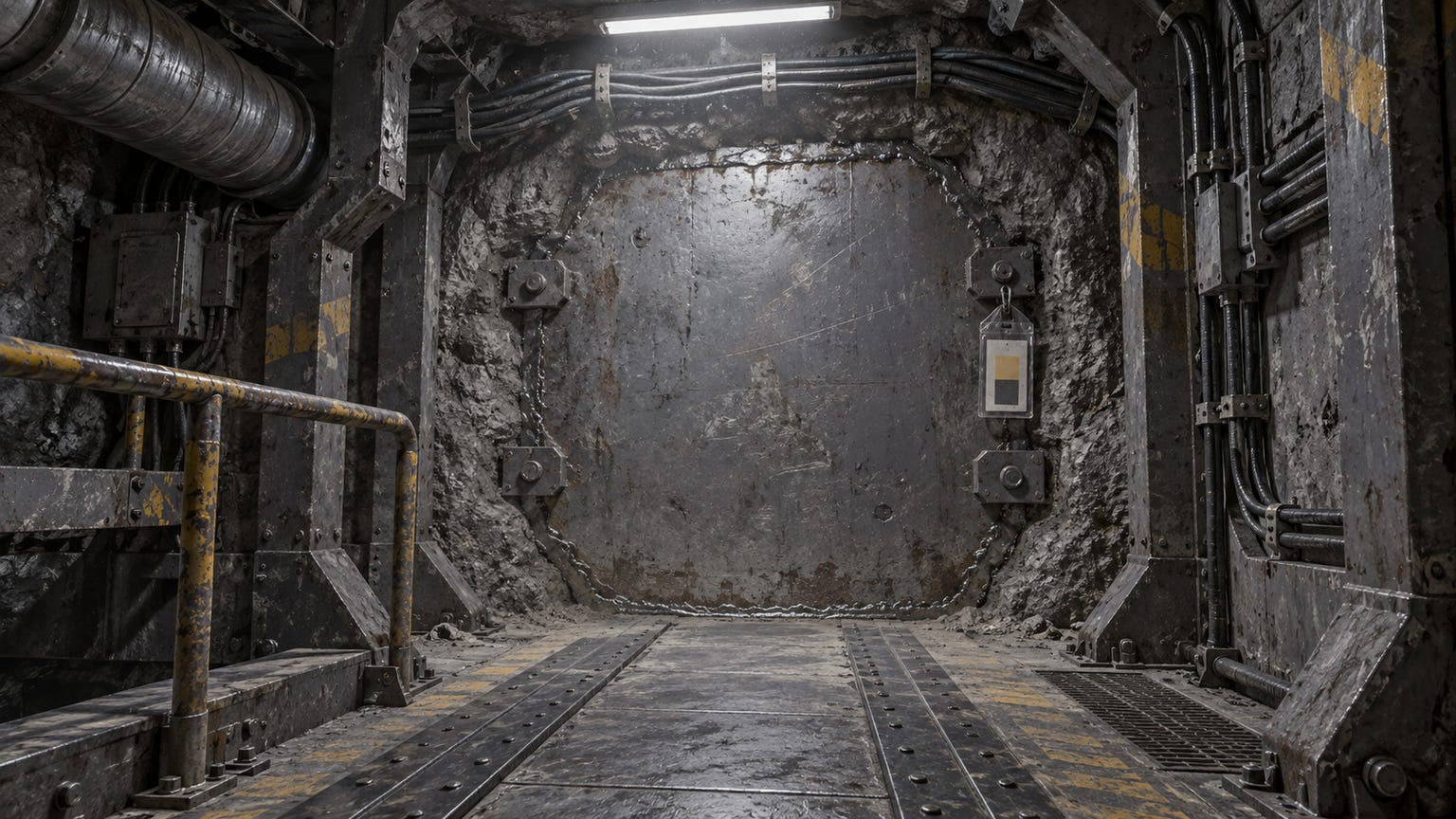
At 3-Bravo the route ended in a welded plate.
The closure did not fit the image in his briefing. That had been a neat rectangle on a tunnel plan, crossed out and reassigned to investigation. Here the weld followed an uneven edge. Cable ends rested in capped bundles above it. Gray dust filled the recessed heads of the nearest brace bolts.
Recovery tags hung from a fixed loop beside the plate. A clear sleeve protected them from the air current. Under the sleeve’s clip, a pale crescent broke the dust where a glove had pressed it clean.
Vasquez set her boots on the strip below the loop. She straightened the sleeve without touching the tags inside.
Mateusz opened the incident attachment. Unforecast localized shear event. Recovery completed. A compensation reference.
“You were on the entry crew?”
“First entry. Recovery after.”
“This closure is permanent?”
“Not my decision.”
Her answer left him with the plate, the caps on the severed cables, and a question about production nobody here had answered. He had expected opposition he could take apart into demands. Vasquez stood beside the closure with one glove hooked under a rail. She had not asked him for anything.
He moved the incident diagram next to his schedule. The rectangle occupied less space than a receiving-slot warning.
“I need the closure record attached to the access export,” he said.
Nair sent the request. No speech followed it.
A ventilation pulse lifted dust from a brace lip. The grains moved slowly across the work light, then caught against the clear sleeve. Vasquez pressed the loose edge beneath its clip again.
Back at the briefing shelf, Mateusz locked both boots before opening his report.
The fabrication deadline had not changed. Neither had the nickel’s release status. He entered the emergency work he could verify and attached the full access log. Beside the shipment he recorded the conditional transit proposal, including the independent review Helios had declined.
His thumb paused over the cause field. He could defend an interruption to supply. He could document the narrowing construction margin. He could not make a pressure crew maintaining the station’s seals fit the word he had entered above their work.
He selected sabotage and deleted it.
In the assessment field below, he left strategic threat in place.
If you enjoyed this story, you can follow the main story arc in The Exodus Rush, the first book in The Vethrak Requiem series.