


The letter sat on Kira’s desk where it had been sitting for three days.
She had placed it there the morning after Hope docked, the envelope handwritten and addressed with the particular economy of a captain who had learned to write reports before he learned to write letters. She had walked past it at 0445 on the first day. She had seen it there at 2130 on the second day, after the diagnostics were run and every task that could be invented had been invented and completed. She had placed a datapad on top of it on the third morning, the way she placed datapads on things she was not ready to look at, and the datapad had stayed there for twelve hours because she had not been ready.
The datapad was on the shelf now. Tanaka’s mug was beside it, the ceramic one with the hairline crack along the handle that Tanaka had given her in the ready room before the depot raid. The command pin lay on the nightstand. The ship hummed around her in standby mode. Docked ships were quiet ships. Kira had learned in the last three days that she hated quiet ships.
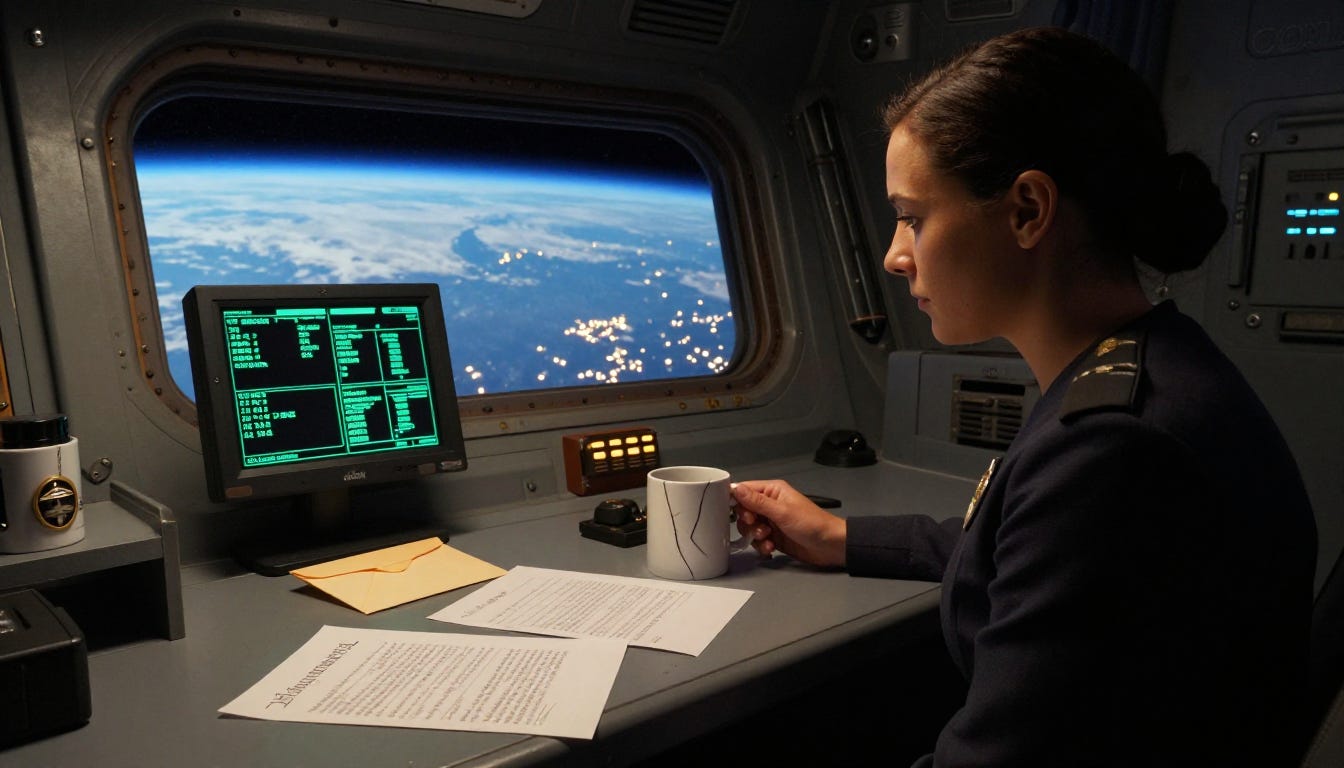
Evening. The chronometer read 2147. Through the viewport, Earth turned beneath them, the lights of the eastern seaboard flickering on in the darkness. Kira had spent eleven weeks in deep space and had not seen those lights once. She had not understood how much she missed them until they were there, constant and unremarkable, the way things were constant until you almost lost them.
She picked up the letter.
The envelope was standard UEN stationery, the kind Marcus would have picked up from the Prometheus supply depot without thinking about it. He had written her name in black ink. Kira Vance. Not Captain Vance. Not Commander. Her name. The rank was for the bridge. The name was for this.
She opened the envelope. Two pages, handwritten. Marcus wrote by hand. His handwriting was precise, deliberate. Every letter was formed completely. Every word placed exactly where he intended it to go. No cross-out. No hesitation. The control of a man who had spent twelve years learning that the things you could control were the only things that kept you alive.
Kira read.
Marcus had followed the depot raid on the tactical feed from Prometheus Station, the data relayed with a seven-minute delay he had counted down on the chronometer beside his station. He had tracked Hope’s approach, the Trojan horse insertion, the moment Revenant’s IFF held. He had followed Kira’s tactical decisions: the Skarreth flanking maneuver authorized thirty seconds ahead of the simulation’s recommended timing, the Keraneth lance volleys coordinated across three separate fire-control channels, the extraction order when reinforcements were sixteen minutes out and the cargo was seventy-three percent loaded. He had annotated the feed the way he annotated simulation runs, marking decisions the simulation had not been designed by someone who had fought at the Kuiper Gap.
He had written, in the careful script of a man who did not praise lightly: You know already that the raid succeeded. You know the cargo was captured. You know the alliance proved it could strike Vethrak territory and take resources instead of just surviving. What you may not know is that your command was the reason.
Kira stopped reading. She looked at the viewport for a long moment. Earth was still there. The lights were still on. She had not expected the sentence to land the way it landed.
She continued.
Marcus had broken down the depot raid into fourteen decision points. The Skarreth flank, advanced thirty seconds ahead of the simulation’s timing, collapsing the garrison’s formation four minutes early. Hope’s position held during extraction while Resolute covered the cargo transfer. Revenant pulled back from the command hub when Vethrak security triggered a counter-intrusion the database had not predicted. Each decision, Marcus wrote, was the right one. Not because the outcome was good. Because the reasoning was sound. The distinction mattered to him. It mattered to Kira too.
He wrote about David: the debris-field approach that masked Defiant’s sensor signature, the point-defense coordination that intercepted seventy-nine percent of incoming fire, the extraction positioning that put Defiant between Resolute and the pursuing corvettes. He wrote with the precision of a captain evaluating an officer and the restraint of a brother observing from the observation room. The pride was not stated but was present in every line. Marcus had observed his brother command a capital ship in combat and had found nothing to correct.
He wrote about Tanaka. The empty chair. The torch. He wrote: I recommended you for Hope’s captaincy because you were the right tactical officer. I did not know then that you would become the right captain. Those are different things. Tanaka knew. I know now. The difference is that you know it too.
The second page was shorter. Kira read it twice.
He had written about command as a burden, not a gift. The weight that did not get lighter, the decisions that would cost lives no matter which option you chose, the particular loneliness of the captain’s chair at 0300 when the ship was quiet and the tactical display was empty. Marcus had written about these things not as warnings but as acknowledgments. He was not telling Kira what to expect. He was telling her that he understood.
The final paragraph was three sentences.
He wrote: You are not filling Tanaka’s chair. You are filling your own. The chair fits you, Kira. I am glad I got to see it.
Kira set the letter down.
The ship hummed around her. Through the viewport, the lights of the eastern seaboard were steady. A species that did not know how to stay dead. Three days ago she had been a woman who could not sleep in a bed that did not hum. Tonight she was a captain reading a letter from a peer, and the letter said the thing that peers said to each other when the formality of rank fell away. I see you. Keep doing it.
She thought about Tanaka. The mug on the shelf. The hairline crack filled with epoxy six years ago. Tanaka had handed it to her in the ready room before the depot raid with four words: It is yours now. Kira had walked past it every morning and not used it. Using it would have meant something she was not ready to mean.
She was ready now.
She stood. Walked to the shelf. Picked up the mug. The ceramic was worn smooth where Tanaka’s fingers had held it through thousands of hours of bridge watches. The crack was still there under the epoxy, visible if you looked for it. She filled it with water. Drank. The water was cool. The mug was familiar in a way that was not yet hers but was closer than it had been three days ago.
She sat back at the desk. The letter was still there, two pages of careful handwriting, fourteen decision points analyzed by a captain who had observed from the observation room and found nothing to correct. She folded the letter along the crease Marcus had made and placed it in the top drawer of her desk. Not hidden. Not filed. Kept. A thing she would read again.
The chronometer read 2214. Kira sat at her desk in the captain’s quarters of a cruiser she commanded, and for the first time since the depot raid, she was not waiting for the next alert.
She did not write back. Not yet. The letter deserved a response, and the response deserved the same care Marcus had given the letter. She would write it tomorrow. There was time. The war was not over, but for the first time in fourteen years, there was time.
She looked at the mug. Tanaka’s mug. Hers now. She had not broken it. She would not break it. The crack was still there. The epoxy was still holding. Some things could be carried for years without breaking. Some people could too.
Kira did not turn off the status display. She left it on, the green indicators scrolling through their standby cadence, the reassuring litany of systems nominal and systems ready. The ship was quiet. She was not. Not anymore.
If you enjoyed this story, you can follow the main story arc in The Exodus Rush, the first book in The Vethrak Requiem series.