


The paper ledger had cost her four thermal credits and a half-hour argument with a Mimas Station stationer who could not understand why anyone would want one.
Anya unrolled it on the bench in the storage bay and weighted the corners with three Vethrak alloy samples and a coffee thermos. The bench was the same one she had bought used in Year 1, the same nicks in its surface from a hundred small recoveries cataloged on it, the same scorch mark on the left edge from a plasma-cutter handle Maren had set down still glowing because Maren did things like that and was usually right that nothing would burn. The bench had outlasted her. The bench would outlast Anya too. That was the kind of night this was going to be.
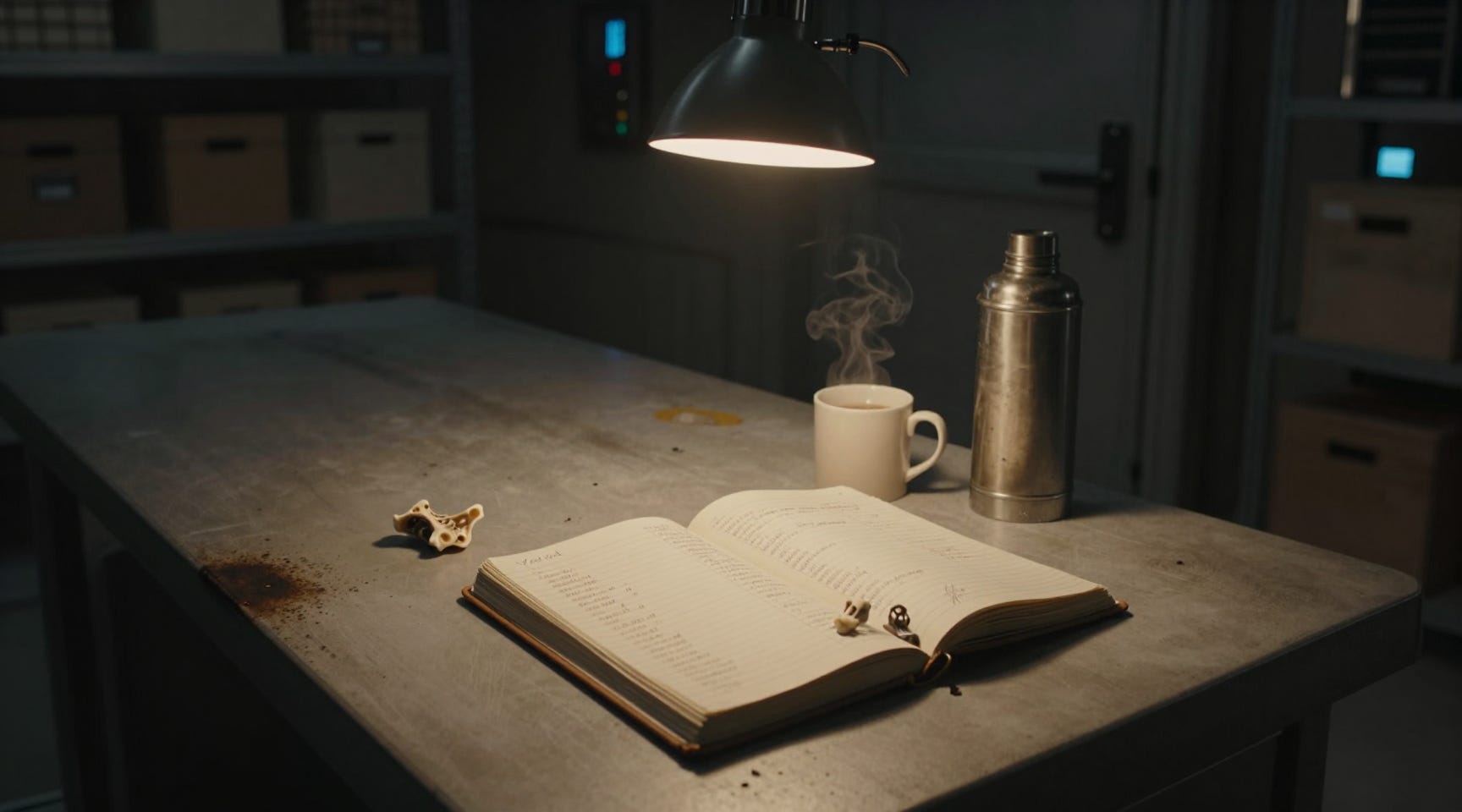
The ledger was a real one. Bound. Cloth spine. Lined paper. The stationer had pulled it from the back of a shelf where it had been gathering dust since before the invasion. Pre-war stock, the stationer had said, watching her count out the credits. Most people use the slabs. Anya had not answered him. She had paid and left and walked the three corridors back to the bay with the ledger under her arm and the small, stupid weight of it had felt like a thing she had been needing for months.
The slabs were not what this was for.
She uncapped a pen, which had also cost her, and looked at the first blank page.
Then she began.
She wrote a heading. Crews. She listed them. Captain by captain, skiff by skiff, in the order she had vetted them. Marek’s crew. The Aronson sisters. The two cousins out of Pallas whose names she had never been able to keep straight until she had spent a long night in their galley after the Bonecrack and learned which was Tomas and which was Pieter. The Saturn-five group. The mixed crew that had come in after the Iso transfer, the ones she still watched a little harder than the others because they had joined when the fleet stopped looking, and the timing of that mattered. She listed them by skiff name, captain name, primary EVA, recovery specialty. Forty-three crews. She had not known the number until she counted it.
She turned the page.
Stations. Mimas, primary. Pallas, certification gateway. Enceladus, courier relay. A small bay on Iapetus she did not own but had standing access to. The Tethys yard she had not used in months because the heat there had thickened. The Hyperion drop-point that was technically a half-cooperative arrangement with one of the Drift Covenant crews, the kind of arrangement neither side had paperwork for. She wrote them down. The geography of a thing she had not known was a geography until she saw it laid out in her own handwriting.
She turned the page.
Routes. She drew them. Not a map exactly. A list of corridors, with their conditions noted in shorthand only she would read. Enceladus cold. Titan hot. Pallas variable, depending which shift was on the customs deck. The new Saltglass-adjacent route Henrique’s people had quietly opened a month ago, that she was not officially using but had budgeted for in case one of the others closed. The fallback through the asteroid belt that no one had ever needed, that she had mapped anyway because that was what an institution did when it grew up: it built fallbacks for failures it had not yet had.
She turned the page.
Buyers. This page was longer. She wrote it carefully. She did not list names she did not need to commit to paper. She listed categories. Tier-one verified, paid in thermal credits, vetted across at least three transactions. Tier-two restricted, military adjacent, the line she had drawn after the Garrick Holm refusal and held since. Tier-three flagged, do not approach, do not sell to even if the offer was triple. She underlined the do-not list. There were six entries on it. Three of them were names that had been Tier-one a year ago and had moved into the dark in ways she had decided she would not follow.
She drank from the thermos. The coffee was cold. She did not notice for another twenty seconds.
She turned the page.
Infrastructure. The eighteen percent commission. The arbitration ledger, currently held by Davit but with three captains rotating witness duty. The authentication library: forty-two cataloged Vethrak alloys, six more pending verification, the Hollow Seam standard. The yellow-pip courtesy, now codified in the courier chain. The Pact, signed two and a half years ago, still binding, still upheld. The cold storage in Bay Three for inventory waiting on Tier-one matches. The shielded subvault that held the drone.
She wrote Subvault and stopped.
The drone was still down there. Sixty meters under the bay floor, in shielded containment, in a room that did not appear on the Mimas Station rental documentation because Davit had quietly bought the deeded lease on the substructure under three layers of corporate cover. The drone had been there for six weeks. She had not moved it. She had not catalogued it on any slab. She was cataloguing it now, in pen, on paper, because she had to inventory what she had built and she had built that too.
She wrote: One intact Lurker drone. Held. Pending vetted buyer.
The pen stopped moving for a long time.
She did not cross it out. She did not annotate it. She wrote the next line.
People.
She wrote Davit. She wrote Bero. She did not write Maren and she did not write Iso, because the ledger was for the Iron Wake that was, not the Iron Wake that had been, and the discipline of that distinction was the thing she had been refusing to do for three years and was doing now.
The bay door chimed.
Bero came in carrying two mugs. He did not say anything. He set one on the bench within reach of her hand and took the cold thermos away without asking. He stood for a moment looking at the open ledger, at the columns of names and routes and buyers in her cramped handwriting, and his face did the small adjustment it did when he was working out what a thing meant and not asking for help with it.
“You’re inventorying us,” he said.
“Yes.”
“All of it.”
“Yes.”
He looked at her. He looked at the ledger. He left.
She drank the fresh tea. It was hot and it was good and it had three more sugars than she would have put in herself and the kindness of that was the kind of thing that would have undone her if she had let it, so she did not let it. She kept writing.
She finished the people page. She finished the contingencies page. She finished the audit page that had no equivalent in any of her slabs because no slab had ever needed an audit page, an institution did, an institution had to be able to ask itself what it was. She wrote until her hand cramped and she put down the pen and shook the hand out and picked the pen back up and wrote the last page.
Then she closed the ledger.
She sat with her hand flat on the cloth cover for a long moment. The desalination plant vented warm vapor through the deck plates the way it had been doing for three years, the way it would still be doing when she was dead.
She uncapped the pen one more time. She wrote on the front of the cover, in her own hand, in the careful block letters her father had taught her when she was six.
Iron Wake. Year 3.
She set the pen down. She looked at the words. Then she looked at the bay around her. The racks, the shelves, the locked door behind which the subvault waited, the bench Maren had scorched, the empty chair Bero had not bothered to sit in. She understood that the woman she had been three years ago, alone in EVA over the rings with her brother’s hull fragment in her pocket and a single cold fragment in the Underweight‘s hold, had not been the founder of anything.
The woman closing this ledger was.
She turned off the bench light and sat in the dark and held the ledger in her lap for a long time, listening to the warm vapor and the small, distant sound of Mimas Station living its night.
If you enjoyed this story, you can follow the main story arc in The Exodus Rush, the first book in The Vethrak Requiem series.