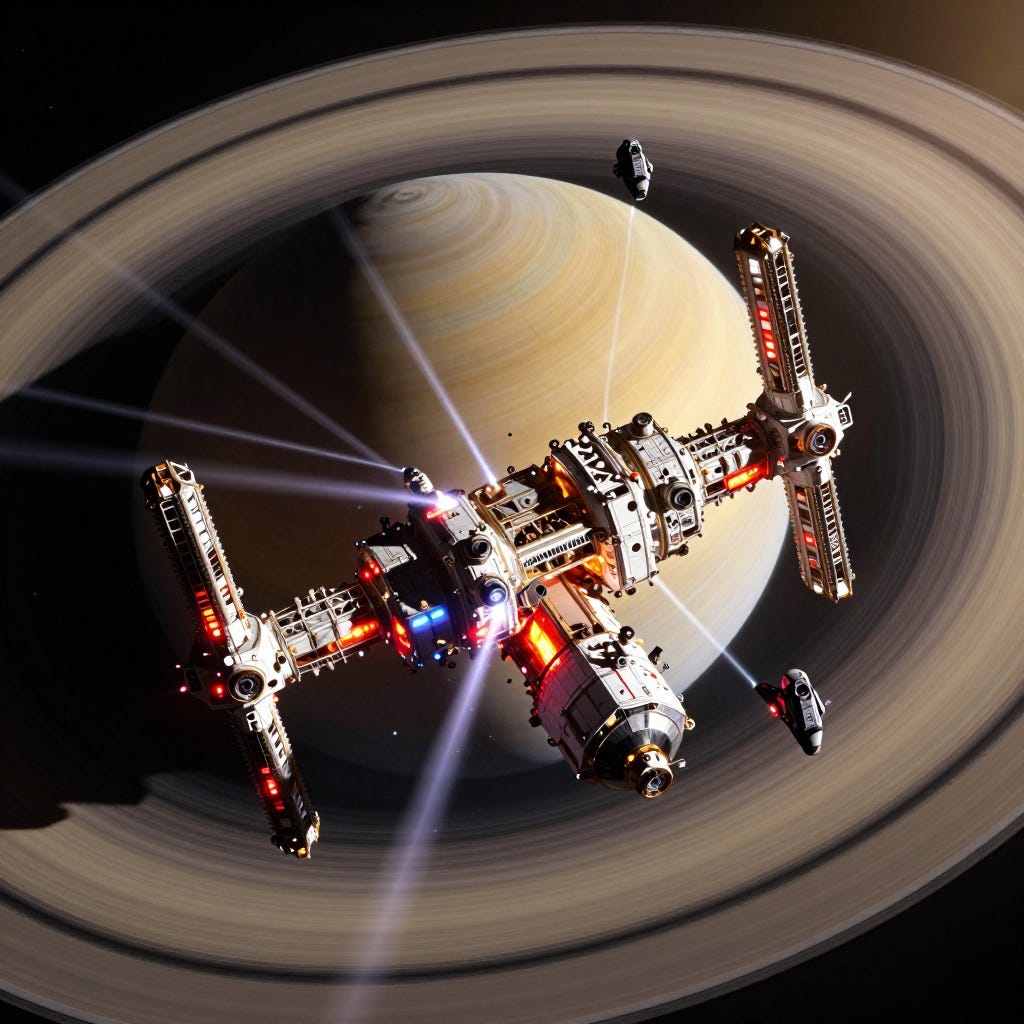
Commander Yusuf Okafor had been awake for thirty-one hours when the signal from Earth stopped.
The communications array registered the loss at 14:47 station time, a cascade of red indicators spreading across Lieutenant Petrova’s console like blood through water. For three long seconds, nobody spoke. The hum of environmental systems filled the silence, the eternal heartbeat of Helios Station continuing as if nothing had changed.
“It’s the relay network,” Petrova said. Her voice was steady, professional, the voice of someone who had spent fifteen years in deep space and learned to package fear into manageable units. “Jupiter stations are still broadcasting. Mars is intermittent. Earth is…” She paused, checking her readings twice. “Earth is gone.”
Okafor stood at the center of the command deck, surrounded by displays showing the station’s vital signs. Three thousand souls depended on those readings: miners, engineers, scientists, administrators, the entire human population of Saturn orbit. For twenty-one years, Helios Station had served as humanity’s farthest permanent outpost. Now it might be its loneliest.
“Define ‘gone,’” he said.
“No signal on any frequency. No automated beacons. No traffic control. Nothing.” Petrova turned to face him, her dark eyes reflecting the amber emergency lighting that had activated when the first warnings came through six days ago. “Commander, Earth’s entire communications infrastructure has collapsed. Or been destroyed.”
The words hung in the recycled air. Destroyed. Six days ago, the deep space monitoring arrays had detected anomalous signals at the edge of the solar system. Five days ago, those signals resolved into ships, dozens of them, moving toward the inner system at velocities that should have been impossible. Four days ago, contact with the outer colonies began to fail. Three days ago, they lost Triton Station. Two days ago, Neptune.
Today, apparently, they had lost everything else.
“Get me everything from Jupiter,” Okafor ordered. “Every fragment, every partial transmission. I want to know what’s happening in the inner system.”
“Commander.” Chief Engineer Ramirez spoke from his station near the environmental controls. His voice carried the careful neutrality of a man delivering bad news. “We should discuss evacuation options.”
“There are no evacuation options.” Okafor kept his voice level. “The nearest functional port is Callisto Station, four months away at best speed. We have transport capacity for maybe eight hundred people. If whatever destroyed Triton is heading our way, we won’t make it halfway.”
“Then we fight.”
The voice came from the back of the command deck. Lieutenant Commander Amara Diallo stood in the doorway, still wearing the vacuum suit she had stripped to its inner layer after her inspection of the station’s defensive systems. She was the ranking military officer on a station that had never needed military officers, a symbolic posting to satisfy bureaucrats who worried about pirates that had never materialized.
“With what?” Ramirez asked. “We have twelve point-defense turrets designed to shoot down debris. Two mining lasers. And the security team’s sidearms.”
“Then we fight with that.” Diallo crossed to the tactical display, pulling up a schematic of the station. “We position the mining lasers to cover the main approaches. We distribute small arms to every volunteer. We make them pay for every meter.”
“Pay with our lives,” Petrova said quietly.
“We’re going to pay with our lives regardless.” Diallo’s voice carried the flat certainty of someone who had accepted unpleasant truths. “The question is whether we die fighting or die waiting.”
Okafor watched the exchange without intervening. Twenty-three years of command experience had taught him when to speak and when to listen. His people were processing fear in their own ways: Ramirez through logistics, Petrova through data, Diallo through action. They would reach the same conclusion eventually. They would have to.
“We’re not going to die today,” he said. “And we’re not going to fight today. What we’re going to do is prepare. Lieutenant Commander Diallo, begin organizing defensive positions. Mr. Ramirez, I want a full inventory of everything on this station that could serve as a weapon or defensive measure. Lieutenant Petrova, keep monitoring. The moment you receive anything, any signal at all, I want to know.”
“And if they come before we’re ready?” Diallo asked.
“Then we improvise.” Okafor met her eyes. “But until they arrive, we assume they won’t. We assume we have time. Because the alternative is panic, and panic kills faster than aliens.”