


The comms bay had two doors, one she had welded shut in Year 3 because a stress fracture had run a long pale vein across the bulkhead behind it, and one she had not. She came through the one she had not, the way she came through it every morning at oh-six-hundred Sanctuary time, and the door slid with the half-second hesitation that meant the actuator needed a rebuild she had no parts for.
She let it hesitate. She had stopped flagging the work order. The work order would only join the others.
The bay was cold.
It had been cold for eleven years. The colony’s habs ran at fifteen Celsius and the working spaces at nine, and on the days she came in early the bay sat at seven because nobody had been breathing in it overnight. She did not bring a heater. The signal did not care whether her hands were warm. The signal cared whether she sent it.
She sent it every morning.
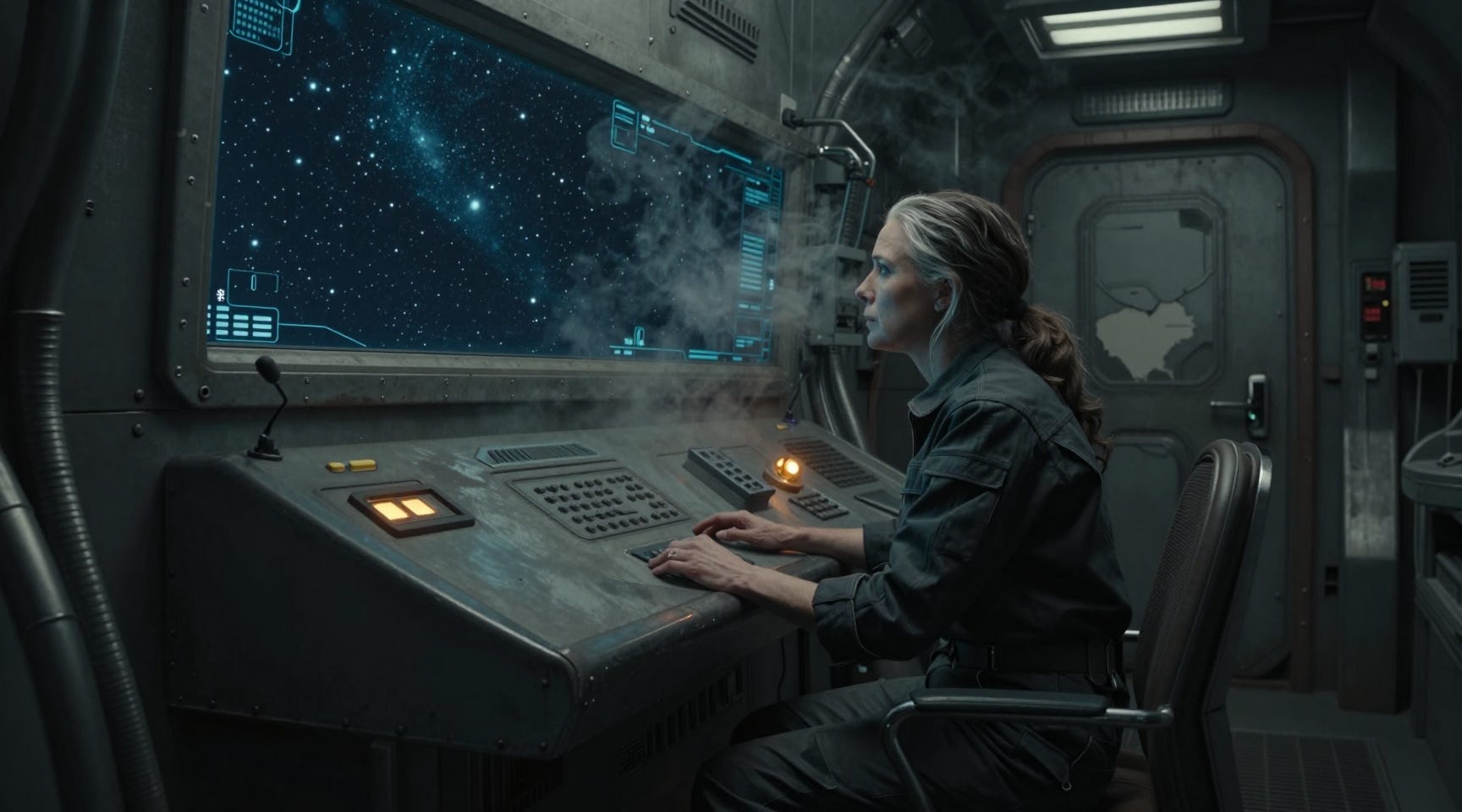
She sat at the console. The chair had been repadded twice with cloth taken from a body bag they had not needed yet, and she did not think about that anymore. She powered up the broadcast array. The diagnostic ran clean. The antenna alignment held to within two arc-seconds of the heading she had set in Year 1.
The green came.
She keyed the recording channel and spoke into the small black hood of the microphone she had bolted to the console rim because the original boom had snapped in Year 4.
“Seventeen thousand souls. We are still here. Please. We are still here.”
She said it the way she said it every morning. Four sentences, in her own voice, no flourish, no tremor she had not learned to take out of it years ago. There were colonists down the corridor who could have done it. She had let three of them try, in the early years. None of them had been able to do it without the second sentence breaking, and the colony had needed somebody whose second sentence did not break. The colony had her.
She added the coordinates. She added the timestamp. She added the same brief catalog of medical needs and the same brief catalog of structural failures she had been adding since Year 5, in case someone, somewhere, was listening and wanted to know what they would be arriving to. She did not believe anyone was listening. She had stopped believing it, in any operational sense, in Year 6. Belief had been replaced by the discipline of the broadcast, which was a smaller thing and a harder thing and the thing that had held.
She sent it.
The transmission window was eleven minutes. There was nothing to do during a transmission. There had never been anything to do during a transmission. She had stopped pretending there was.
The meter ran out. The array stood down. The bay was quiet again.
She wrote the morning’s send into the log. The log was on its forty-second volume. She wrote the date in the Sanctuary calendar and the date in the Earth calendar beneath it. The Earth date she kept up by hand. It was a private discipline, a way of keeping a clock for a person she had not heard from in a long time.
She closed the log.
The hydroponic bay was the warmest space in the colony and the place she came to second.
The hydroponics tech was on shift, the way the hydroponics tech was on shift every morning, and the lights were at the soft green of a quarter-cycle that had been calibrated to a sun nobody in the bay had ever stood under. The lettuces were good. The lettuces had been good for eleven years. The tomatoes were fewer than they had been in Year 8 because she had pulled three of the racks for the medical bay’s antiseptic herbs. The beans were the beans. The beans were always the beans.
She walked the rows. The tech did not need her to say anything. She read the moisture displays and the substrate logs and the small white card pinned to the end of the third rack where the colony’s deaths were tallied in pencil. The deaths were tallied everywhere. The hydroponic bay was the place where the people who had loved the dead came to be near growing things.
The number had not changed since Tuesday.
The number was two thousand four hundred and twelve.
She touched the card with two fingers and went on.
She did the medical stores after the hydroponics and the reactor reserve after the medical stores, the way she had done them for eleven years, and the inventory ticked itself out in her head the way a clock ticked itself out in a quiet room.
Seven months of expired-but-usable antibiotics. Four months of fresh. Eighteen months of nominal reactor load and nine months of the load they were actually drawing, which had been larger than nominal for two years. Thirteen months of half-rations. The water cycle held indefinitely, because the water cycle was the one thing they had built the way it deserved to be built.
She arrived, at the end of the rounds, at the answer she had been arriving at for six months.
A year. Maybe less.
She did not write it in the log. She had not written it in the log in any of the six months she had been arriving at it. She did not say it to the council. She would, eventually. She would, when the number changed by enough that not saying it became the larger lie. She was a woman who had decided, a long time ago, that the colony got the truth in the order the colony could carry it, and not in the order it arrived at her.
She went back to the comms bay.
Eden was waiting outside the door.
Eden was twenty-three. Eden had been born in the colony, in Year 1, ten meters from the corridor she was standing in now, and Eden had grown up the way the colony’s children grew up, which was inside and quiet and without a sky. She had been Sarah’s assistant for eight months. She was good at the work.
“Administrator.”
“Eden.”
“I logged the medical pull from the cold store. The herb count is short by two units.”
“Tell the hydroponics shift.”
“I told them.”
“All right.”
Eden did not move. Eden had something else.
Sarah waited. She had learned, in eleven years, to wait the second sentence out of a colonist who needed to say one. The second sentence was always the one that mattered. The first sentence was the colony. The second sentence was the person.
“Administrator,” Eden said. “Do you ever think no one is coming.”
Eden was holding a tablet at her hip the way a person held a thing she was using to keep her hands from doing something else. Eden was looking back at her with the patient steadiness of a person who had asked a question she had been working up to for a long time.
“Every day,” Sarah said. “And every day I send the signal anyway.”
Eden nodded. Eden did not ask a follow-up. Eden had asked the question she had come to ask, and Sarah had given her the answer she had, and the rest of it was Eden’s to carry.
“Thank you, Administrator.”
“Eden.”
Eden went down the corridor toward the hydroponics, and the corridor light slid off her shoulders, and the door of the comms bay slid the half-second slide behind Sarah as she stepped back through it.
The bay was nine Celsius again. The console was where it had been. The recording channel was dark.
She sat down.
The viewport on the far bulkhead was not a viewport. It was a screen wired to an external feed, a star field they had captured in Year 2 and looped because the actual external camera had iced over in Year 4 and the parts to rebuild it lived on Earth. The colony’s children had grown up looking at the same eleven seconds of sky on a fourteen-minute loop.
Somewhere in the long line of arc-seconds her array had aimed itself at every morning for eleven years there was a person whose face she did not know and whose name she had not been told, who would, on some morning, hear her four sentences and stand up out of a chair to fetch someone.
She did not know when.
She set the timestamp for tomorrow’s window. She powered the console down to standby. She left her hand on the cold edge of the console for a moment longer than the work required.
The bay held its quiet.
She rose, and she went to the next thing.
If you enjoyed this story, you can follow the main story arc in The Exodus Rush, the first book in The Vethrak Requiem series.