


The morning watch aboard the UENS Hope ran on a rhythm Kira Vance had learned to read the way her aunt used to read radio frequencies: by feel, by patience, by knowing when the silence was ordinary and when it meant something else.
This morning the silence was ordinary.
Kira sat at her tactical station, her hands resting on the console, her eyes moving through the scan rotation with the practiced economy of thirty-four days on the same watch cycle. Deep-space tactical. Near-spectrum electromagnetic. Gravitational anomaly detection. Fold-space residual monitoring. Standard rotation. Standard results. The display cycled through each band and returned the same data it had returned for every watch since the patrol began: nothing.
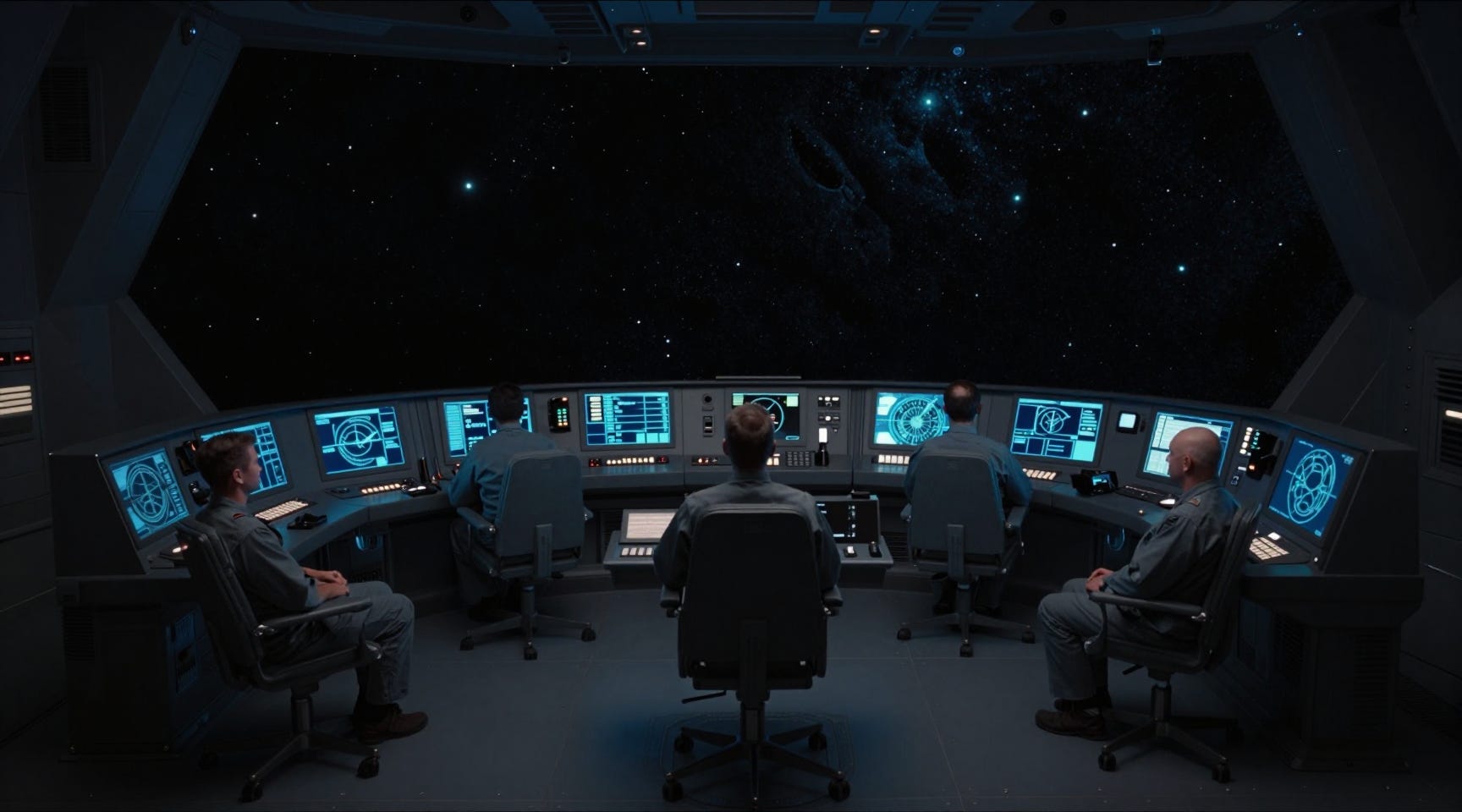
Behind her, the bridge hummed with the low music of a ship at steady state. The helm officer called out position updates in a voice that had settled into the rhythm of routine. The navigator acknowledged without looking up. Tanaka would be on the command deck in twenty minutes for the 1400 status check, as she had been for every status check since Day 1. The deck plates vibrated with the steady thrum of the Cascade Reactor. The air cycled through the scrubbers with the same recycled evenness.
Everything was as it should be.
Kira completed the rotation and logged the results. The display acknowledged with a soft green confirmation. She sat back, slightly, and let her eyes rest on the forward viewscreen for a moment. Stars. The same stars she had been watching for thirty-four days. The same deep black. The same sense of being a small ship in a system of impossible scale with nothing pressing on the sensors.
She tapped the console. Opened a sub-band channel that was not on the standard rotation.
Band 7-Beta. A frequency range that no Fleet tactical doctrine considered worth monitoring. Low-band stellar noise, the sensor manuals said. No tactical application. No intelligence value. Kira had been watching it for two weeks.
The display returned a flatline.
She let her eyes rest on the green line for a moment, then closed the channel and logged the result the same way she logged every result. Neatly. Cleanly. No annotation. No explanation.
Commander.
The voice came from the wall speaker, warm and clear. CLIO. The ship’s AI had been settling into her presence over the course of the patrol, her vocal patterns growing more confident, her conversational cadences more natural.
Yes, CLIO?
Do you wish to log the band 7-Beta scan again today?
Kira’s hands paused on the console. The question was neutral. CLIO was not questioning the scan’s value. She was simply confirming a recurring action, the way a good assistant confirmed a repeated request.
Yes, Kira said. Log it.
Logged.
The word was soft and final. Kira returned to the console and began the next rotation. Deep-space tactical. Near-spectrum electromagnetic. Gravitational anomaly detection. Fold-space residual monitoring. The same sequence. The same results. She moved through it without thinking, her fingers finding the controls the way her hands found the controls every time.
She had been doing this for thirty-four days.
She had been doing this for thirty-four days, and she would do it again tomorrow, and the day after, because this was the work. The work was watching. The work was trusting that the equipment would register something if there was something to register, and the work was also trusting that her own eyes, her own attention, her own private channels were worth the time she gave them.
At 1345 she completed the fourth rotation. The display acknowledged. She sat still for a moment, her hands resting on the console, and thought about her aunt.
It was not a deliberate thought. It arrived the way these thoughts always arrived, in the space between one logged result and the next, when the rhythm of the work was steady enough to let the mind wander without losing precision. She thought about the last time she had seen Sarah, eleven years ago, standing at the door of the research station billet with a bag over her shoulder and a smile that said I will be back before you know it.
She had not been back.
Kira had spent years looking for proof that her aunt was alive. She had searched classified files. She had followed leads that went nowhere. She had spent nights in the archive room at the Academy, running searches on names that matched partial records, cross-referencing manifests from the evacuation ships, trying to find a trace of someone who had been at a research station in the Kuiper Belt when the attack came.
She had never found a body. She had never found a record. She had never found a clean answer.
She had never stopped scanning the bands her aunt had taught her to scan.
Distrust the silence.
The words came in memory. Sarah’s voice, from a decade ago, standing in the backyard of Kira’s childhood home, pointing up at the stars with a hand that was always in motion. The universe is noisy, Kira. Everything broadcasts. The quiet you should worry about is the quiet that is being maintained.
Kira had been nine years old. She had not understood what her aunt meant.
She understood now.
At 1400, the bridge hatch cycled open and Captain Tanaka stepped through. She moved with the composed ease that Kira had first registered on Commissioning Day, her steps deliberate, her eyes already scanning the bridge as she walked. She reached the command position and stood for a moment, her hands resting lightly on the back of the chair.
“Status,” she said.
The helm officer answered first. “All systems nominal. Position within predicted parameters. Fold drive standby at green.”
“Navigation,” Tanaka said.
“Course stable. No trajectory adjustments required.”
Tactical. Kira turned slightly in her station. “All deep-space bands clean. No contacts. No anomalies.”
Tanaka nodded. “Good work.”
She did not leave. She stood at the command position for a moment longer, her eyes on the forward viewscreen, her expression unreadable. Then she walked to the tactical station and stood beside Kira, close enough that her voice would not carry.
“The band 7-Beta scan,” Tanaka said. “You logged it again.”
Kira did not flinch. “Yes, Captain.”
“May I ask why?”
She had been asked this before, by CLIO. She had answered then with a quote from her aunt. But CLIO was the ship’s AI. This was Tanaka. Kira’s commanding officer. The woman who had trusted her with a tactical station on humanity’s first warship.
She did not know how to answer in a way that would sound professional. So she did not try.
“Someone once told me to distrust the silence,” she said.
Tanaka was quiet for a moment. Her eyes did not leave Kira’s. When she spoke, her voice was soft.
“Was she right?”
Kira considered the question. She had been scanning band 7-Beta for two weeks. She had logged results that returned nothing. She had no evidence, no pattern, no reason to believe she was doing anything more than performing a ritual her aunt had taught her a decade ago.
“Yes,” Kira said. “She was right.”
Tanaka held her gaze for a moment longer. Then she nodded, once, and returned to the command position.
At 1418, Kira completed the fifth rotation.
She closed the standard bands. She opened the private ones.
Band 7-Beta.
The green line traced across the display. Flat. Clean. A channel that held nothing but the background noise of the universe, the low hum of stellar radiation that no Fleet analyst had ever found reason to question.
She held position over the display anyway.
At 1421, the standard sweeps returned null.
At 1422, she began the band 7-Beta sweep.
At 1423, the story ended.
1423 hours.