


The reactor warning had been flashing for six hours. Elena Vasquez ignored it, the same way she’d ignored the evacuation order three days ago.
Someone had to keep the beacon running.
Kepler Station hung at the edge of the Tau Ceti shipping lanes, a waypoint for freighters that no longer came. Eight years since the Invasion, and traffic had dwindled to nothing. The convoy routes had shifted, rerouted around systems that might hold Vethrak presence. Kepler wasn’t on anyone’s map anymore.
The beacon didn’t care. It pulsed every thirty seconds, broadcasting coordinates and safe harbor to ships that would never arrive. Elena had maintained it for eleven years, through three station commanders and two wars. She wasn’t about to stop now.
Reactor core temperature exceeding nominal parameters.
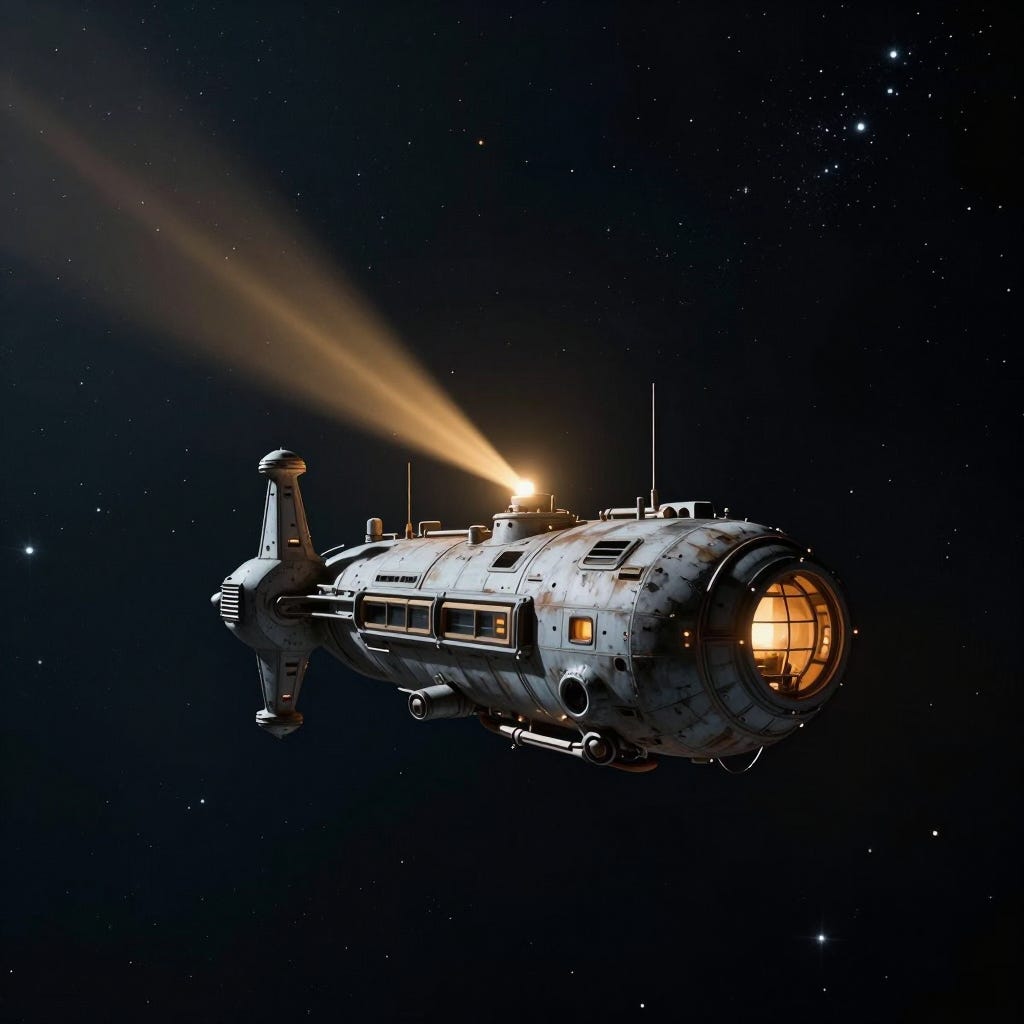
The automated voice had given up on urgency months ago. It delivered warnings with the same flat tone it used to announce meal schedules. Elena pulled herself along the central corridor, her magnetic boots clicking against the deck plates. Artificial gravity had failed in Section C last week. She’d cannibalized the parts for the beacon array.
The reactor room smelled like ozone and old fear. Duct tape covered half the warning labels on the main console. Elena had applied most of it herself, covering alerts for systems she couldn’t fix with parts she didn’t have. The station was dying by centimeters, bleeding atmosphere through micro-fractures and hemorrhaging power through corroded conduits.
She checked the core temperature. Four hundred degrees over recommended limits. The cooling system was failing, had been failing for months. She’d bypassed three safety protocols to keep the reactor online. A fourth bypass would buy her maybe two more weeks.
Two more weeks of the beacon. Two more weeks of the light.
Her fingers hovered over the console. The smart move was obvious. Shut down the reactor, seal the sections, wait for rescue that would probably never come. The escape pod had enough supplies for sixty days. Someone might find her. Probably not, but someone might.
The beacon would go dark.
Elena thought about the Meridian, the last ship to dock at Kepler. Three years ago, a family of refugees fleeing the outer colonies. Their navigation computer had failed two jumps back, and they’d been flying blind, burning through supplies, hoping for a miracle.
The beacon had been their miracle.
She’d fed them, repaired their nav system with parts from her own shuttle, sent them on their way with coordinates to the nearest safe harbor. The mother had cried. The father had offered to pay, as if credits meant anything anymore. The children had drawn her a picture: a yellow circle with lines radiating outward. A sun. A star.
A light in the darkness.
Elena initiated the fourth bypass.
The console protested, warnings cascading across the screen. She acknowledged each one, her hands steady. The reactor temperature stabilized, settling into a new equilibrium that the original engineers would have called catastrophic. The station groaned around her, metal flexing against metal, systems straining at the edge of collapse.
The beacon pulsed. Thirty seconds. Another pulse.
Broadcasting on emergency frequencies, the computer announced. Signal strength nominal.
Elena allowed herself a small smile. Nominal. The most beautiful word in the engineer’s vocabulary. Everything working as intended, even when nothing was.
She pulled herself back toward the observation deck, past the sealed doors of empty quarters and abandoned cargo bays. The station had housed forty people once. Now it housed one stubborn woman and a light that wouldn’t quit.
Through the observation window, stars scattered across the void like frozen sparks. Somewhere out there, ships were running. Families were fleeing. Children were drawing pictures of hope.
The beacon pulsed.
Elena settled into her chair, the same chair she’d occupied for eleven years, and watched the darkness. The reactor would fail eventually. The station would go cold. The light would die.
Not today.
Today, someone might need a miracle. Today, a ship might be flying blind, burning through supplies, praying for a sign that the universe hadn’t forgotten them.
Today, the beacon would answer.
Elena closed her eyes and listened to the pulse, steady as a heartbeat, reaching across the void. Thirty seconds. Another pulse. Thirty seconds. Another.
The last light of Kepler Station, burning against the dark.
This story takes place in Year 8 of the Post-Invasion calendar, four years before the events of The Exodus Rush. Kepler Station’s fate remains classified in UEN records.