


The cadets filed into the auditorium with the nervous energy of young people who knew they were about to meet a legend. Commander Elias Rehn watched them from the stage, counting heads out of habit. Forty-two. A good class. Probably half of them would wash out before graduation. The other half would spend their careers trying not to die in the black.
He’d agreed to give this lecture as a favor to Admiral Okonkwo. One hour, she’d said. Just tell them what you know. Make them understand what they’re signing up for.
As if anyone could understand until they’d lived it.
The room settled. Forty-two faces looked up at him, eager and terrified in equal measure. They saw the medals on his chest, the prosthetic arm he no longer bothered to hide, the scars that webbed the left side of his face. They saw a hero of the invasion, a man who’d survived the Battle of Mars and the defense of Ceres and a dozen smaller engagements that history had already forgotten.
They didn’t see the nights he still woke up screaming. They didn’t see the bottle he kept in his desk drawer. They didn’t see the faces of everyone he’d failed to save, the ones who visited him in dreams and asked why he’d lived when they hadn’t.
“My name is Elias Rehn,” he said. “Twelve years ago, I was sitting where you’re sitting now. Young. Stupid. Convinced I was going to save the world.”
A few nervous laughs. He didn’t smile.
“Six months after I graduated, the Vethrak came. They killed eleven billion people in forty-seven days. They destroyed ninety percent of Earth’s orbital infrastructure. They harvested human beings like cattle.” He let the words hang in the air. “I watched my commanding officer get torn apart by something that looked at us the way we look at insects. I held my best friend’s hand while she bled out in a corridor because we couldn’t get to medical in time. I made decisions that got people killed, and I made decisions that kept people alive, and most of the time I couldn’t tell the difference until it was too late.”
The eagerness had drained from their faces. Good. They needed to hear this.
“You’re here because you want to serve. You want to protect humanity. You want to make sure what happened twelve years ago never happens again.” He stepped forward, his prosthetic hand gripping the podium. “Those are noble goals. They’re the right goals. They’re also not enough.”
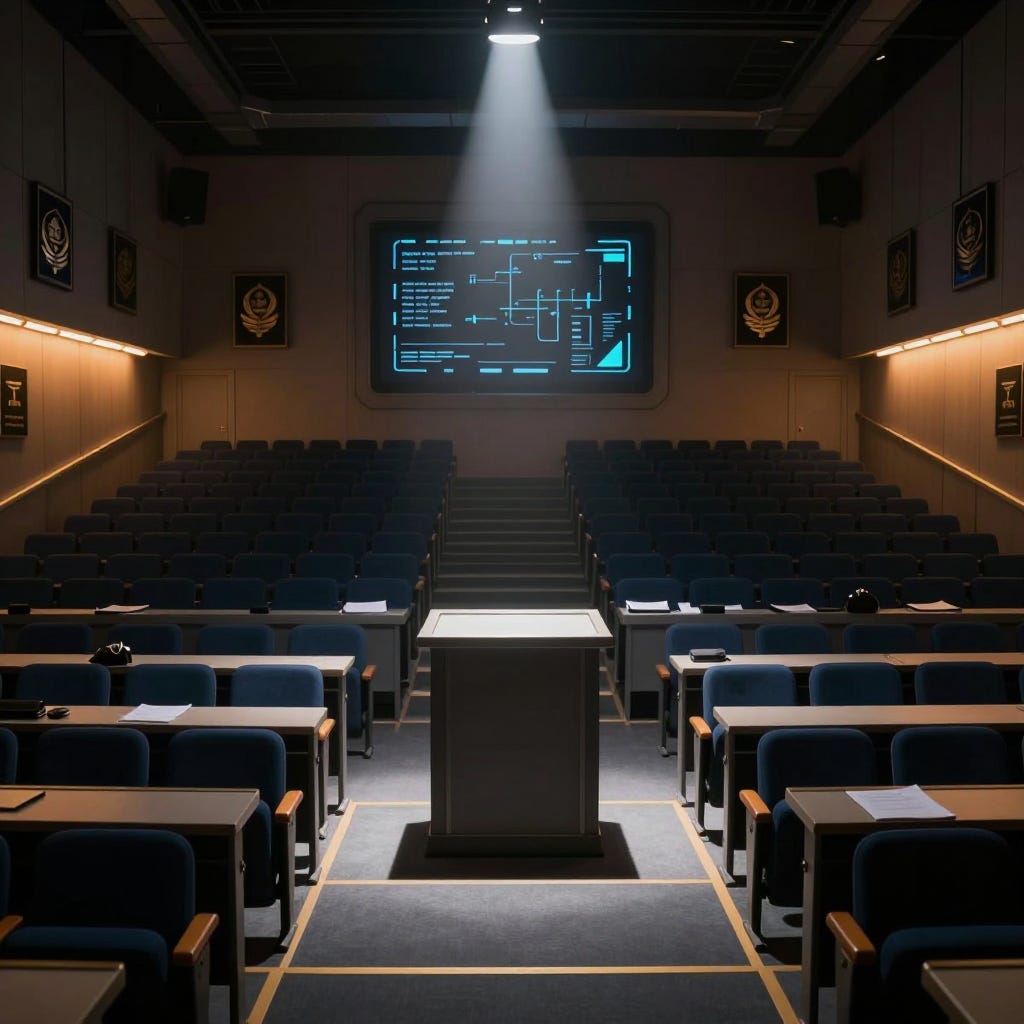
He pulled up the holographic display behind him. A star map appeared, Sol at the center, the scattered points of human settlement spreading outward like a fragile web.
“This is what we’ve built since the invasion. Forty-three permanent colonies. A fleet of two hundred and seventeen combat-capable vessels. Mining operations across the belt. Research stations pushing the boundaries of what we know about Fold technology.” He highlighted each point as he spoke. “It looks impressive. It feels like progress. It is progress.”
The display shifted, zooming out. The human settlements shrank to insignificance against the vastness of the galaxy.
“This is everything we’ve explored in twelve years. A sphere roughly fifty light-years in diameter. Do you know how big the galaxy is?” He didn’t wait for an answer. “One hundred thousand light-years across. Four hundred billion stars. We’ve mapped less than one percent of one percent of what’s out there.”
The cadets stared at the display, their faces pale in the holographic light.
“The Vethrak came from somewhere in that darkness. They found us, they studied us, they attacked us, and then they left. We don’t know why. We don’t know when they’re coming back. We don’t know if there are other species out there who might want to do the same thing, or worse.”
He shut off the display. The auditorium lights came up, harsh and unforgiving.
“What I’m trying to tell you is this: you cannot prepare for what’s coming. None of us can. The enemy doesn’t fight fair. The universe doesn’t care about your training or your courage or your good intentions. You will face situations that have no good options, only less terrible ones. You will lose people you care about. You will make mistakes that haunt you for the rest of your life.”
Silence. He could see some of them reconsidering their career choices. That was fine. Better to reconsider now than to freeze in a firefight.
“The question isn’t whether you’re ready. Nobody is ever ready. The question is whether you’ll keep going when everything falls apart. Whether you’ll make the hard call when there’s no time to think. Whether you’ll put the mission and your crew ahead of your own survival.”
He looked at them, one by one, trying to see which ones had that spark. The thing that couldn’t be taught, couldn’t be trained, couldn’t be faked. Some of them met his gaze. Others looked away.
“I’ve served with cowards who found their courage when it mattered. I’ve served with heroes who broke under pressure. You never know what someone is made of until the moment arrives, and by then it’s too late to change.”
A hand went up. A young woman in the front row, her face set with determination.
“Sir, what made you keep going? After everything you saw?”
Rehn considered the question. He’d asked himself the same thing, countless times, in the dark hours when the memories wouldn’t let him sleep.
“Spite, mostly.” A few startled laughs. “I watched those things slaughter everyone I loved. I decided I wasn’t going to give them the satisfaction of breaking me.” He paused. “Later, it became something else. I kept going because the people next to me were counting on me. Because every day I survived was another day I could train someone else, pass on what I’d learned, give the next generation a slightly better chance.”
He stepped away from the podium, walking to the edge of the stage.
“That’s the real lesson. It’s not about being fearless. Fear keeps you alive. It’s not about being perfect. Perfect people don’t exist. It’s about showing up. Doing the work. Being there for the person next to you when everything goes wrong.” He looked at them one last time. “You want to honor the eleven billion who died? Don’t become a hero. Become reliable. Become the person your crew can count on when the hull breaches and the lights go out and death is clawing at the airlock.”
He checked the time. Forty-three minutes. Close enough.
“That’s all I have. Dismissed.”
The cadets rose slowly, filing out in subdued silence. A few lingered, working up the courage to approach him with questions. He answered them patiently, one by one, until only the young woman from the front row remained.
“Commander Rehn? I wanted to thank you. My mother served at Ceres. She talked about you.”
“What was her name?”
“Lieutenant Yuna Park.”
Rehn felt the familiar ache, the weight of memories he could never set down. Yuna. Quick with a joke, steady under fire, the best damn pilot he’d ever served with. She’d died covering his evacuation, buying time for his damaged shuttle to reach the hangar.
“She was a hero,” he said quietly. “One of the best.”
The young woman nodded, her eyes bright. “She said the same about you.”
She left him alone on the stage, surrounded by empty seats and the ghosts of everyone he’d survived. Rehn stood there for a long moment, remembering Yuna’s laugh, her steady hands on the controls, the way she’d looked at him in that final transmission before her ship went dark.
He’d told the cadets to be reliable. To show up. To be there for the people counting on them.
Yuna had done all of that. It hadn’t saved her.
Nothing saved anyone, in the end. The universe was too big, too dangerous, too indifferent to human hopes. All you could do was keep moving forward, keep fighting, keep teaching the next generation what you’d learned.
Rehn straightened his uniform, checked that his prosthetic was calibrated correctly, and walked out of the auditorium. Tomorrow there would be another class, another lecture, another chance to pass on what he knew.
It wasn’t much. It was everything he had.
Commander Elias Rehn (ret.) served in the United Earth Navy from Year -2 through Year 10, participating in seventeen major engagements including the Battle of Mars, the Defense of Ceres, and the Jovian Interdiction. Following medical retirement, he accepted a position as guest lecturer at the Naval Academy’s Tactical Studies program. His course, “Lessons from the Invasion,” became required curriculum for all command-track cadets. He passed away in Year 14, two years after this lecture was recorded.