


The cargo manifest flickered on Tomas Varga’s console, a list of items that would have seemed ordinary three years ago. Medical supplies. Water purification tablets. Protein concentrate. Seed stock. Now eathch line represented someone’s survival, someone’s hope.
He ran his calloused fingers across the display, checking the numbers for the third time. Seventeen crates bound for Settlement 14, what used to be called Portland before the bombardment turned it into a crater surrounded by refugee camps. The Steady Hand could carry twenty, but fuel rationing meant he’d been running at reduced capacity for months.
The cockpit was cramped, built for function rather than comfort. Tomas had flown this ship for eleven years, first hauling electronics between orbital factories, then medical supplies during the outbreak of ‘21, and now whatever the Recovery Authority deemed essential. The work hadn’t changed. The stakes had.
“Traffic control, this is CSV Steady Hand requesting departure clearance from Luna Station Alpha,” he said into the comm.
Static crackled before a tired voice responded. “Steady Hand, you’re cleared for departure on vector seven-niner. Safe travels, Tomas.”
“Thanks, Yuki. See you in six days.”
He eased the throttle forward, feeling the familiar vibration of the fusion torch engaging. Luna’s gray surface fell away beneath him as the ship climbed toward the black. Through the viewport, he could see Earth hanging in the void, blue and white and scarred with darkness where the great cities had burned.
He tried not to look at it too long.
Twelve hours into the transit, Tomas reviewed the cargo list again. The Recovery Authority’s seal marked each item, authenticating its origin and destination. Black market cargo moved without seals, commanding ten times the price. Tomas had been approached twice this month alone.
He’d turned them both down.
The comm chimed. An incoming message, tagged priority. He opened the channel.
“Tomas.” The voice belonged to Director Chen, Recovery Authority logistics. Her face appeared on the secondary display, lined with exhaustion that had become permanent over the past two years. “We need to redirect your cargo.”
His stomach tightened. Redirections meant someone else’s supplies were being delayed. It meant the calculus of survival had shifted somewhere, that one group’s needs had been judged greater than another’s.
“Where?” he asked.
“Settlement 7. They had a contamination event in their water processing system. Forty thousand people without clean water.”
“Settlement 14 is expecting these supplies tomorrow.”
“I know.” Chen’s expression didn’t change. “Settlement 7 has children dying today.”
Tomas closed his eyes. Settlement 14 had children too. They were stretched thin, rationing food, making do with equipment held together by hope and salvage wire. His cargo would keep them going for another month.
“Send me the new coordinates,” he said.
Chen nodded. The display went dark.
Tomas adjusted his course, watching the numbers shift on the navigation console. Two days added to his transit time. Settlement 14 would have to wait. He’d tell them himself when he made the delivery. He always did.
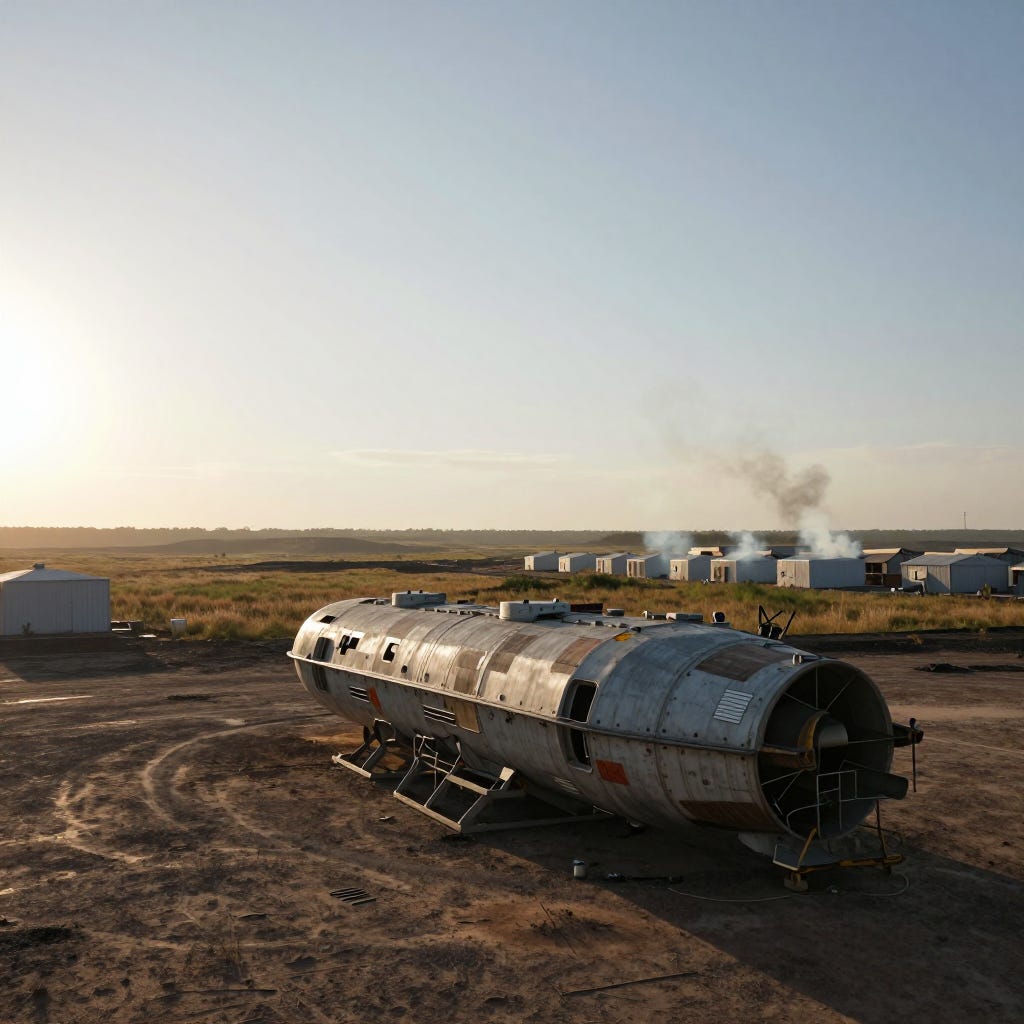
Settlement 7 emerged from the Kansas flatlands like a wound trying to heal. Prefabricated shelters stretched across what had once been farmland, arranged in precise grids that somehow made the chaos of forty thousand displaced lives look organized. Smoke rose from the communal kitchens. Laundry hung from lines strung between housing units.
The landing pad was packed earth stamped flat by a hundred descents. Tomas brought the Steady Hand down gently, mindful of the dust that would billow into the processing areas nearby.
A woman waited at the edge of the pad, clipboard in hand. She wore the gray jacket of a settlement coordinator, and her hair was cut short in the practical style that had become universal among those who worked with limited water rations. Her name tag read ANNA BECK.
“You’re Varga?” she asked as he descended the cargo ramp.
“I am.”
“We weren’t expecting you for another week. The regular supply run.”
“Director Chen redirected me. The water situation.”
Anna’s professional composure cracked for a moment. Her eyes glistened before she blinked it away. “We lost eight yesterday. Three more this morning. All under ten years old.”
Tomas said nothing. There was nothing to say.
“Your cargo,” Anna continued, her voice steady again. “Water purification tablets, correct?”
“Tablets, filters, and replacement membranes for your processing unit. Should get you running at half capacity within six hours.”
Anna made a note on her clipboard. “Half capacity. That’s enough. That’s enough to stop the dying.”
Tomas began unloading, carrying the crates himself rather than waiting for the settlement’s overworked labor crew. Anna helped, despite his protests that coordinators didn’t do manual labor.
“Everyone does manual labor now,” she said, lifting a crate of filters. “Titles don’t mean much when there’s work to be done.”
They worked in silence for an hour, moving seventeen crates from the Steady Hand to the settlement’s central distribution center. When the last crate was secured, Anna signed his manifest and handed it back.
“Thank you,” she said. The words carried weight.
“I’m just the delivery driver.”
“No.” Anna shook her head. “You’re the man who brought water to forty thousand people. That’s not nothing, Mr. Varga. That’s not nothing at all.”
Tomas slept in the Steady Hand that night, parked at the edge of the landing pad. He could have stayed in the settlement; they’d offered him a bed in the coordinator’s quarters, even a meal from their own rations. He’d declined both.
Through the cockpit viewport, he watched the lights of Settlement 7 flicker in the darkness. Forty thousand people, crammed into a space meant for ten thousand, making do with salvaged equipment and rationed supplies. Three years ago, they’d had homes, jobs, lives that made sense. Now they had this: a grid of prefab shelters on scorched earth, waiting for supplies that might or might not come.
His comm unit buzzed. A text message from Settlement 14: “Heard about the redirect. We understand. Stay safe.”
Tomas stared at the words for a long time.
The morning brought clear skies and a new manifest. Anna walked him to his ship, her stride purposeful despite the dark circles under her eyes.
“The processing unit is back online,” she said. “Sixty percent capacity. Better than we hoped.”
“Good.”
“We’ve been allocated additional supplies for next month. Medical equipment, mostly. Construction materials.” She paused at the base of the cargo ramp. “The Authority says we’re one of the success stories. A model for recovery.”
Tomas looked back at the settlement: the cramped shelters, the shared kitchens, the children playing in the dust between housing blocks. Success was a relative term now.
“Keep building,” he said. “That’s all any of us can do.”
Anna nodded. “Safe travels, Mr. Varga.”
He climbed into the cockpit, ran through his preflight checks, and lifted off. Settlement 7 shrank beneath him, becoming first a grid, then a smudge, then a memory. Earth’s wounded face filled the viewport again, blue and white and scarred.
Settlement 14 was expecting him. He had six days of transit ahead, and the cargo hold was empty.
The Steady Hand climbed toward the black, toward Luna Station Alpha and the next manifest, the next list of supplies, the next chance to make the numbers matter. Somewhere behind him, children drank clean water. Somewhere ahead, others waited.
Tomas Varga flew on.
Author’s Note: This story takes place in Year 2 of the Post-Invasion calendar, during the early days of the Recovery Authority’s efforts to coordinate humanitarian aid across the devastated Earth. The Vethrak invasion killed eleven billion people and destroyed much of human civilization. In the aftermath, ordinary people like Tomas Varga became the lifeline connecting the scattered survivors.
If you enjoyed this story, you can follow the main story arc in The Exodus Rush, the first book in The Vethrak Requiem series.