


The council chamber was the coldest room in Sanctuary.
Sarah had never insulated it. The walls were the same bare asteroid rock from when the colony was carved out eleven years ago. The heating ducts had been rerouted to the medical bay three years in. She had approved that herself. Every degree of heat in this room was a degree taken from someone who needed it more.
The five council members sat at the same salvaged table they had used for eleven years. Its surface bore the scars of a decade of meetings: coffee rings, tool marks from the time it was used as an operating table during the outbreak of Year 3, a scratch from the chair Caelen had dragged across it during the water recycler argument in Year 7.
Sarah took her seat at the head of the table. The chair creaked. It always creaked.
“The agenda has two items,” she said. “The next ration cut and the contingency plan. You all have the numbers.”
They did. She had distributed them the night before, handwritten copies because the printer had failed again and nobody had the parts to fix it. Each of the five members held a sheet of paper that had been recycled at least three times.
Haru spoke first. He was the oldest on the council, sixty-three years old, a former orbital engineer who had been on the original construction crew when Sanctuary was nothing but a hull and a dream. “The ration cut from last month is down to three months at current calorie levels for the general population. Medical staff are already at the lower tier. If we cut again, medical goes to five months, general stays at two. That is the math.”
“It is not sustainable,” said Mira, the colony’s physician. She was forty-one. She had been twenty-nine when the colony sealed its doors. “We are already seeing vitamin deficiencies in the youngest children. Another cut and we will start losing people to preventable conditions.”
“We are losing people anyway,” Caelen said. He was the youngest on the council, forty, the colony’s chief engineer. His voice was quiet. It was the quietest voice in the room and it carried the most weight because he was never wrong about the colony’s physical limits. “We have been losing people for eleven years. The question is whether we lose them by inches or by choice.”
The room went quiet.
The ration cut passed four to one. Only Mira voted against it, and she voted against it because her job was to keep people alive, not to make the arithmetic that said some of them could not stay alive.
Sarah called the second item.
She read the proposal aloud from the sheet Caelen had given her three weeks ago. The language was clinical, written by the colony’s medical ethics committee at Caelen’s request. It described a protocol for voluntary cessation of care for residents over sixty and those with chronic conditions that required ongoing medication. It described a tiered system, a schedule, a set of criteria for who would be offered the option first. The words were careful. The words were designed to make what they were describing sound like a medical decision rather than what it was.
Sarah finished reading and set the paper down.
“The founding charter gives the administrator a veto on irreversible decisions. I am telling you now that I will use it.”
“We know,” Caelen said.
“Then why are we voting?”
“Because the charter requires a recorded vote. So we can say, when the history is written, that we considered every option. Even the ones we could not take.”
The vote was three to one. Caelen. Haru. Mira. Sarah cast the only no. She recorded the tally herself, in her own hand, because she was not going to ask anyone else to write those words.
After the meeting, Caelen caught her in the corridor.
She was walking toward the hydroponic bay. She was not ready for her quarters yet. She wanted green, light, the slow stubborn growth of things that had not given up.
“Sarah,” he said.
She stopped. She did not turn around.
“We cannot keep saying no forever,” he said.
She turned. Her face was still, the face of a woman who had been saying no for eleven years, to worse proposals than this one, to the silence of a colony that had not received a human voice from Earth in over a decade.
“I know,” she said. “We can say no this time.”
Caelen held her gaze. Then he nodded and walked toward engineering. She tracked him until he turned the corner. He was a good engineer. She carried that thought with her through the hydroponic bay, twenty minutes among the seedlings, and back to her quarters.
The box was at the bottom of her footlocker.
She had kept it there for eleven years. The footlocker had survived three colony moves and two floods from a faulty water reclaimer. The box was a simple metal tin, the kind that had once held imported tea from a region of Earth that no longer existed.
Inside: letters.
Sixteen of them, written between Year minus five and Year zero. Her sister’s handwriting. Anya had been the one who wrote letters the old way, with paper and a pen, believing that handwriting carried something typed words did not.
She had read them in order the last time, five years ago. This time she pulled one from the middle of the stack, the one dated Year minus three.
The paper was soft at the folds, creased white from being opened and refolded too many times.
Sarah.
You will not believe what Kira did yesterday.
She refused to come inside from the rain. It was raining hard, the kind of rain that floods the street drains and sends the neighbors scrambling for sandbags, and she was standing on the porch with her arms out, soaked to the bone, grinning. I told her she would catch cold. She told me the rain was her personal friend and she had promised to visit it.
I asked her why. She said: “Because no one else was outside. The rain needed someone to talk to.”
I think she gets that from the Vance side of the family. The part that talks to things that do not talk back.
She is seven years old and she already understands something I am still learning: that the universe does not need to answer you for you to be right to have spoken.
I miss you. Send a signal when you can.
Anya
Sarah folded the letter. The paper made the same sound it had made the first time she folded it, eleven years ago, in a different room on a different colony that had not yet learned what it meant to be a sealed can of human life at the edge of the solar system.
She did not cry. She had done that years ago, in the first years, when the silence from Earth was still something she thought would break any day. The tears had stopped around Year 4, the way certain muscles atrophy when you stop using them.
She put the letter back in the tin. She closed the lid. She returned the tin to the footlocker, pushed it to the back, and stood.
The colony hummed around her. The recyclers. The air circulation. The ambient vibration of a structure that had been inhabited beyond its design life, held together by Caelen’s ingenuity and the desperate will of seventeen thousand people who had no other option.
She walked to the communications bay.
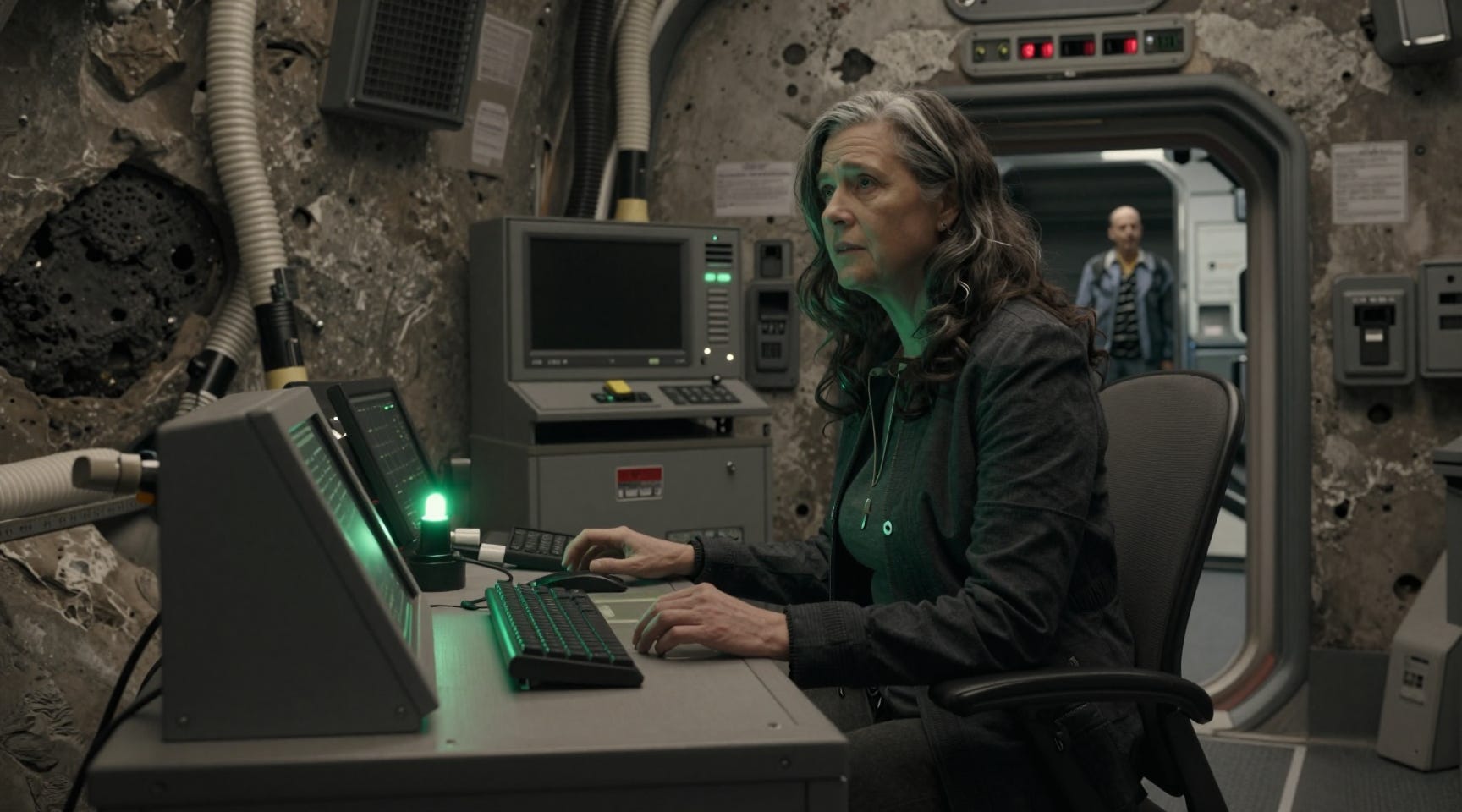
The console was the same. The microphone was wrapped in tape because the plastic had cracked in Year 6 and nobody had a replacement.
She sat down. She pressed the transmit key. The recording light came on, a small green glow that had been the most constant light of her adult life.
“Seventeen thousand souls,” she said. “We are still here. Please. We are still here.”
Her voice was the same voice it had always been. The same words. The same cadence. The same message she had recorded twelve thousand times across eleven years.
She released the key. The signal cycled into the transmission queue. It would go out at the next window. A message in a bottle that nobody had ever answered.
The assistant on shift that night was a young man named Iosef, born in the colony the year after the invasion. He had never stood on a planet. He had never seen a sunrise. He had never known a world where the ceiling did not end less than a hundred meters overhead.
“Administrator,” he said. “Is it different tonight?”
She looked at him. He was observant. He had been in this chair for six months and had learned to read the small differences in her voice.
“Every night,” she said. “And every night I send it anyway.”
She stood. She touched the console once, a gesture that had become habit, and walked out.
Behind her, the colony’s broadcast cycled toward its transmission window. Twelve thousand times. The words did not change. The voice that spoke them had become something different over those eleven years. Something that could carry seventeen thousand lives and the memory of two thousand four hundred twelve deaths and the face of a seven-year-old girl standing in the rain, speaking to something that did not answer.
If you enjoyed this story, you can follow the main story arc in The Exodus Rush, the first book in The Vethrak Requiem series.