


The gap sat between the second column and the third, a blank cell in a matrix that already ran forty-seven rows.
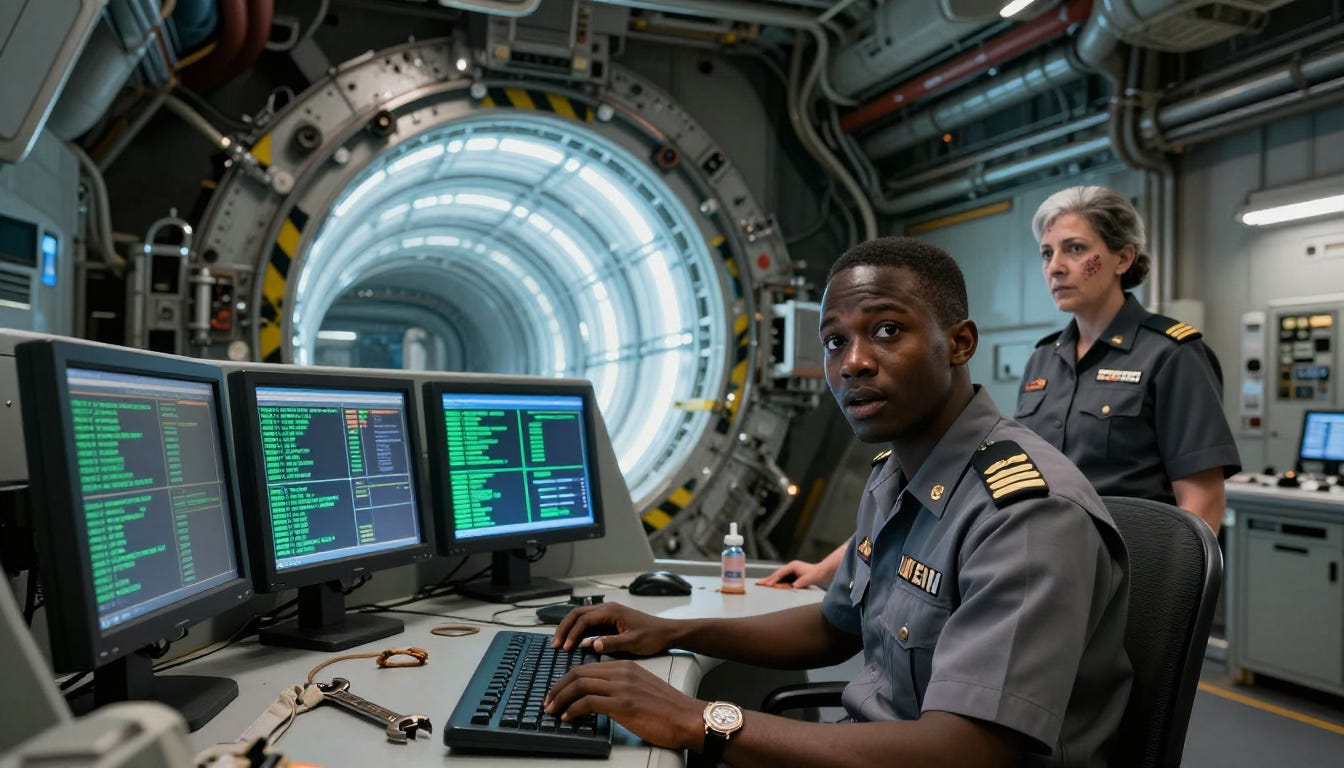
Thomas Okonkwo sat at the mid-deck engineering console on UENS Vanguard with three columns open and a fourth he refused to add. Human. Skarreth. Keraneth. The filled cells were the easy work. Naming conventions. Unit conversions. Error codes that named the same fault in three incompatible alarm languages. The blank cells were the job.
Behind the blast bulkhead, the Cascade Reactor held habitation idle. Low vibration in the deck plates. Status board green down every line, the same green that had sat empty of meaning in the weeks after Kaath-Seven. Tonight the green was only background. The work lived in the gaps.
The bay smelled of coolant and warm insulation. Post-repair clean, not the ozone of a fight. Yellow and black stripes marked the plating around the Cascade housing. Conduits ran the overhead in parallel, thick as a torso where the main bus came through. A working room. His room, for a few more weeks.
Row twelve carried the Skarreth phrase in its own cell, copied from Kresh-Vol’s session notes with the pressure-grammar mark attached. Acceptable variance. The human cell beside it held three dead attempts, each struck through. Tolerance band. Spec window. Close enough. A Skarreth shop that stamped a human part outside acceptable variance was not picking a fight. The shop was reading a record the way Skarreth shops read every record. Measurement first. Courtesy never. Human mills could not hold that band. A file that ordered them to pretend they could would sit unused in three languages.
Thomas typed a fourth line and deleted it. The conversion could not crown the tighter shop. It also could not dress the wider shop as elegant. The interface had to take the difference. The same rule as the grease-pencil diagram on Prometheus. The same rule as the coupling. Write the band. Write who can hold it. Write what absorbs the rest.
He entered it.
Declare the holding band. Name the shop that can hold it. Specify the interface that absorbs the remainder. Do not treat any band as the unspoken default.
The cell filled. Row twenty-three stayed empty.
Century-tolerance.
Keth-Miren’s notes occupied the Keraneth column in the flat English the collar always produced. The light would have been amber-to-copper, patience stacked on duration, a register the collar threw away as a matter of design. Humans built for campaigns. Keraneth built for the case that decided whether anyone remained when the hull around the part was scrap. A five-year housing, to a species that had waited eight hundred years, was not finished. It was a postponement with fasteners.
The human cell wanted a word the language did not keep. Practical. Durable. Overbuilt. Each one was an argument wearing a noun. None of them was a grade.
Thomas sat back. The wrench lay on the cloth to the left of the keyboard, the old bend in the handle catching the console light. His father had put this tool on systems meant to last a deployment. Park had used the same class of tool on systems meant to last a hull. Neither of them had needed a name for a part meant to outlast the people who installed it.
He opened a header above the matrix and put three lines under it.
Campaign-Grade. The part works for the operation it was built for. Openable with tools the receiving crew already carries. Replaceable from mixed stores.
Generation-Grade. The part outlasts the people who installed it and remains serviceable for the people who inherit it.
Century-Grade. The part is specified against a failure case measured in centuries, not deployments.
He sat with the names. Campaign-Grade was already how humanity shipped a year. Century-Grade was already how the Keraneth refused to call a campaign complete. Generation-Grade was the band neither side had owned. The alliance needed a word for work that had to survive the installers without pretending the work would outlast the Monument.
He documented each grade as valid. Named. Not a compromise wearing two other coats.
A spec that did not declare its grade was not a spec. It was an argument waiting for a repair bay.
The hatch cycled.
Shaw’s cadence crossed the plates before she reached him. Right foot lighter. The limp from the Battle of Earth, present and undiscussed. Thomas kept his eyes on the header. Captains who wanted a report asked for one.
She stopped at his left shoulder. The tremor in her right hand put a faint irregular tick against the console edge, then went still under her palm. Silver in her hair at the edge of his vision. The scar from temple to jaw catching the same light as the wrench.
“You are not fixing anything,” she said.
The matrix held forty-seven rows and the new header nobody had signed.
“I am building something,” Thomas said.
“I know.”
She stood through one full environmental cycle. Pride in the set of her shoulders. Loss in the trip down from the bridge to a file that would not stay on her ship. Both held the way she held the tremor. Present. Controlled. Not offered.
“Chen will want a name she can put in a citation,” Shaw said. “Do not make her invent one.”
“I will not.”
“Then finish it.” She shifted her weight off the bad knee. “Reyes has the mid-watch in forty minutes. I want you out of this bay before she has to step around you.”
“Yes, Captain.”
Shaw left the way she had arrived. The hatch sealed. The Cascade held idle. The wrench stayed where it was.
Thomas scrolled to the top of the file. Filename empty. Version empty. Author already carrying his name because the console defaulted to the logged-in officer, a smaller claim than the work and the only honest one the system would take.
He typed the name.
Alliance Engineering Standard v1.0
The 1.0 was the point. A first version implied a second. A second implied crews who would still need the grammar after he was off the watch. After Reyes had the bay. After Chen had the rest of his hours.
He saved.
The wrench sat beside the keyboard, cloth worn soft, initials scratched shallow, handle bent from a repair nobody still living could name. Version one. Of many.
If you enjoyed this story, you can follow the main story arc in The Exodus Rush, the first book in The Vethrak Requiem series.