


Inside the suit gloves her hands were dry. That was the first thing. The suit ran its humidity loop a hair too cool, and after a decade of working in pressure gear Rosalie Mercado had stopped registering the cool, but the dryness still reached her, every morning, the way her knuckles were paper when she first flexed them and then were skin again after she had moved them a hundred times.
She flexed them a hundred times.
The torch was racked at her right hip. The seam was twenty centimeters in front of her visor, two plates of structural alloy butted along a centerline that ran four hundred meters into the dark of Slip 1, and on the long axis of that centerline, when the welds were done and the inspection bots had passed every joint, there would be the keel of UENS Vanguard, CV-001, the first warship the human species had laid down since the night the sky stopped working.
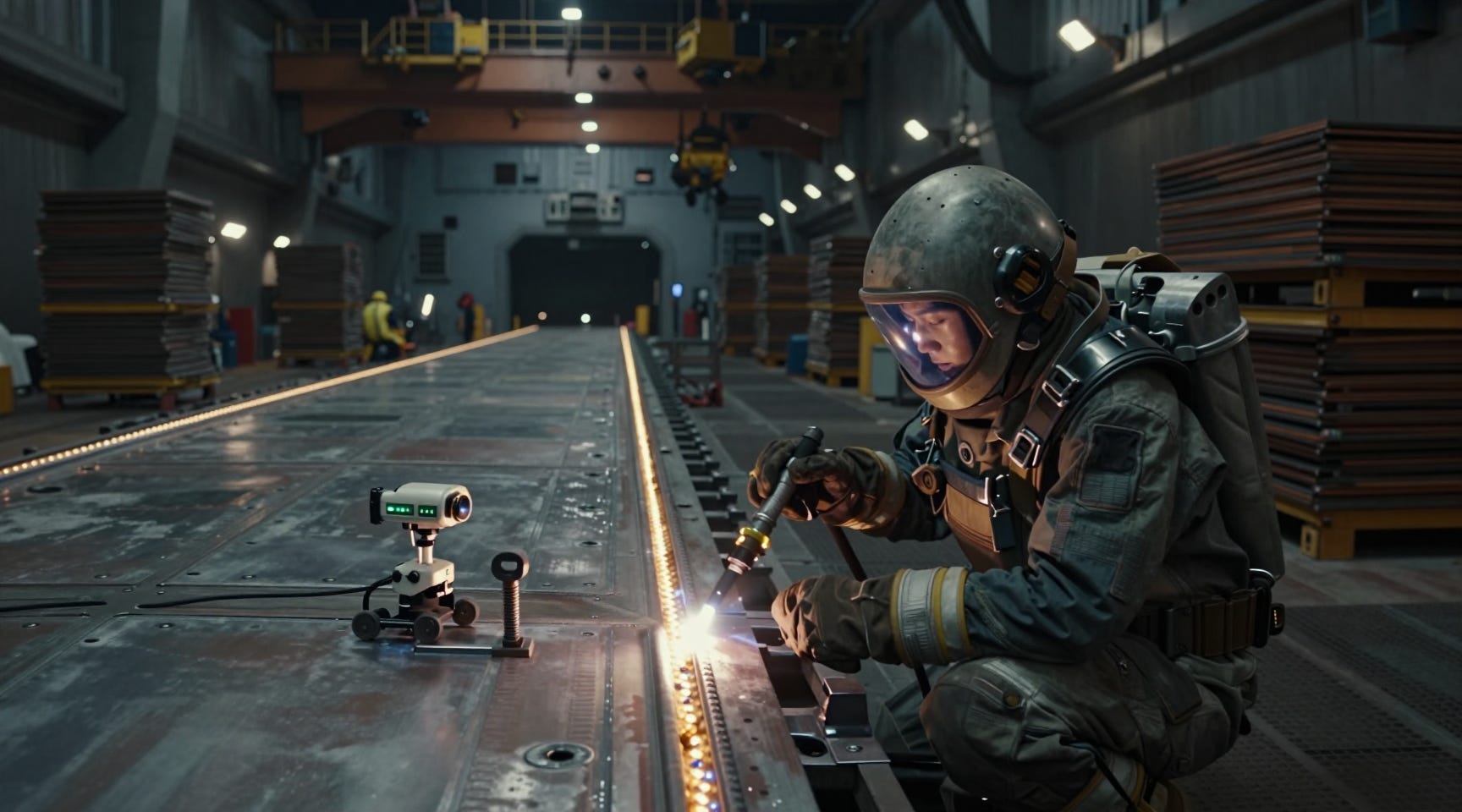
The seam was thirty-eight centimeters of her morning. It was not the keel. The keel was a word for a thing she would not finish today, or this month, or this season. The seam was the keel the way a single stitch was a coat. She put her left glove on the plate to feel its temperature through the haptics, which was a habit her father had taught her on a fishing boat in Subic Bay when she was nine years old and learning to sand a hull, and which the orbital welding instructors had told her to break and which she had not broken.
The plate was cold. Three degrees above absolute floor. The slip ran its thermal floor low to keep the alloy in spec until the seam was fused. Rosalie liked the cold. The cold was honest. The cold did not pretend the metal was already a ship.
Her suit comm clicked.
“Mercado.” Emmanuel Bautista’s voice came through dry and close, the way it always did when he was running the shift board from the supervisor bay sixty meters above her. “Slip One. Centerline.”
“On the centerline, sir.”
“You good?”
“I am good.”
A pause on the comm. Three seconds. Bautista had been her supervisor for four years. They had grown up in the same district of Olongapo. They had ridden the same shuttle up to orbital welding school in Year 4. He did not need to say the date. He had not said the date all morning. The shift was about to begin and the date was about to mark the eleventh year and the second month since the morning Rosalie Mercado, age thirteen, had stood on her grandmother’s porch in Olongapo and watched the smoke from Manila walk up the western sky.
“All right,” Bautista said. “Burn it clean, Rosa.”
“Burn it clean.”
She brought the torch up.
The arc struck at eleven hundred amps and held. The seam took the heat the way good alloy took heat, sullen at first and then willing all at once, the puddle forming along the joint in a thin bright line that was not the color of any color a person ever saw on Earth. The bead followed her hand. Her hand followed the seam. The seam followed the keel. The keel was the spine of a thing she would not live to see scrapped, and that was the right way around: a person built a ship she would not live to see scrapped, or she did not build a ship at all.
Halfway along the seam her vision flickered, not on the visor, behind it. The porch. The smoke. Her grandmother’s hand on the back of her neck, dry and warm, the smell of fish sauce from the kitchen behind them. Her grandmother had said something. Rosalie did not remember what. She had remembered for ten years and then one morning she had not remembered, and the not-remembering had been worse than the remembering, and she had stopped trying to fix either one.
The bead held.
She let the porch go. The porch was not the seam. The seam was the seam.
At thirty-eight centimeters the puddle closed. She lifted the torch a degree. She held for a count of two so the trailing edge would not dimple. She killed the arc.
The seam cooled in front of her in a band of red that climbed up the visible spectrum the way it was supposed to climb, the way her instructors had drilled into her in Year 4, the way her father had never seen because her father had been on a fishing boat in the wrong part of the wrong sea on the wrong morning. The red walked up to orange, the orange to a thin straw, and the straw went silver, and the silver went the color of the plate.
The inspection bot came in along the rail and crawled the bead.
She waited.
The bot put a green tag on the joint and crawled on.
“Slip One.” Bautista’s voice. Flat, the way he always pitched it when he was looking at the manifest and pretending he was not also looking at her. “Bead one of six hundred forty-two. Logged.”
“Logged.”
“Take ten.”
“I do not need ten.”
“Take ten, Rosa.”
She stepped back from the slip.
She did not look at the bead. She had welded ten thousand beads. The bead was a bead. The bead was the keel. She turned a quarter rotation in her boots and faced down the centerline, four hundred meters of empty space lit by the slip’s working lamps in long staggered columns, the alloy plates stacked on the racks along the bulkhead and the gantry cranes already moving the next pair into position for the next weld and the next one after that, and she looked at all of it the way her father had once looked at a hull he was sanding and had said, without looking up, this is going to be a boat.
This was going to be a ship.
She knew what it was going to be a ship for. She had known what it was going to be a ship for since she was thirteen. There was a kind of knowing that did not need to be said and so she did not say it, not on the comm, not to Bautista, not to herself.
She said the other thing instead.
“We are going to do this anyway,” she said, inside the suit, where no one heard her, and she said it the way a person said grace, and she meant it the way a person meant grace, which was that the thing being said was not negotiation with the universe but a small honest acknowledgment of the universe’s terms.
The slip’s working lights stepped down for the cooling cycle. The plate in front of her went from cold to colder.
She racked the torch.
Bautista’s comm clicked again. He did not say anything. He was on the channel, breathing, sixty meters above her, and she knew the breath. They had ridden the same shuttle. They had watched the same sky. They were both still here.
“Ready when you are, sir,” she said.
“Burn the next one, Rosa.”
“Burn the next one.”
She picked up the torch.
If you enjoyed this story, you can follow the main story arc in The Exodus Rush, the first book in The Vethrak Requiem series.