


The courier was a young man Anya had never met, and the envelope in his hand was paper.
He stood in the open hatch of her storage bay on Mimas, the corridor light cold behind him, his courier sleeve unbranded, his ID badge a one-day temporary pass. He held the envelope flat across both palms as if the way he had been told to carry it was the way it would be safe. Paper bent. Paper tore. Paper smudged. The young man knew none of that yet because the young man had never carried paper before in his life.
“Captain Rask?”
“Yes.”
“For you. Hand-courier. No countersignature required. I was told to confirm receipt and then to forget I was here.”
She took the envelope. The weight of it was the weight of three folded sheets and an envelope flap, and her hand had not held that weight in twenty years. The hands of the cooperative did not carry paper. The hands of the UEN did not, either. The choice of paper was a signal, and she read the signal before she read the address.
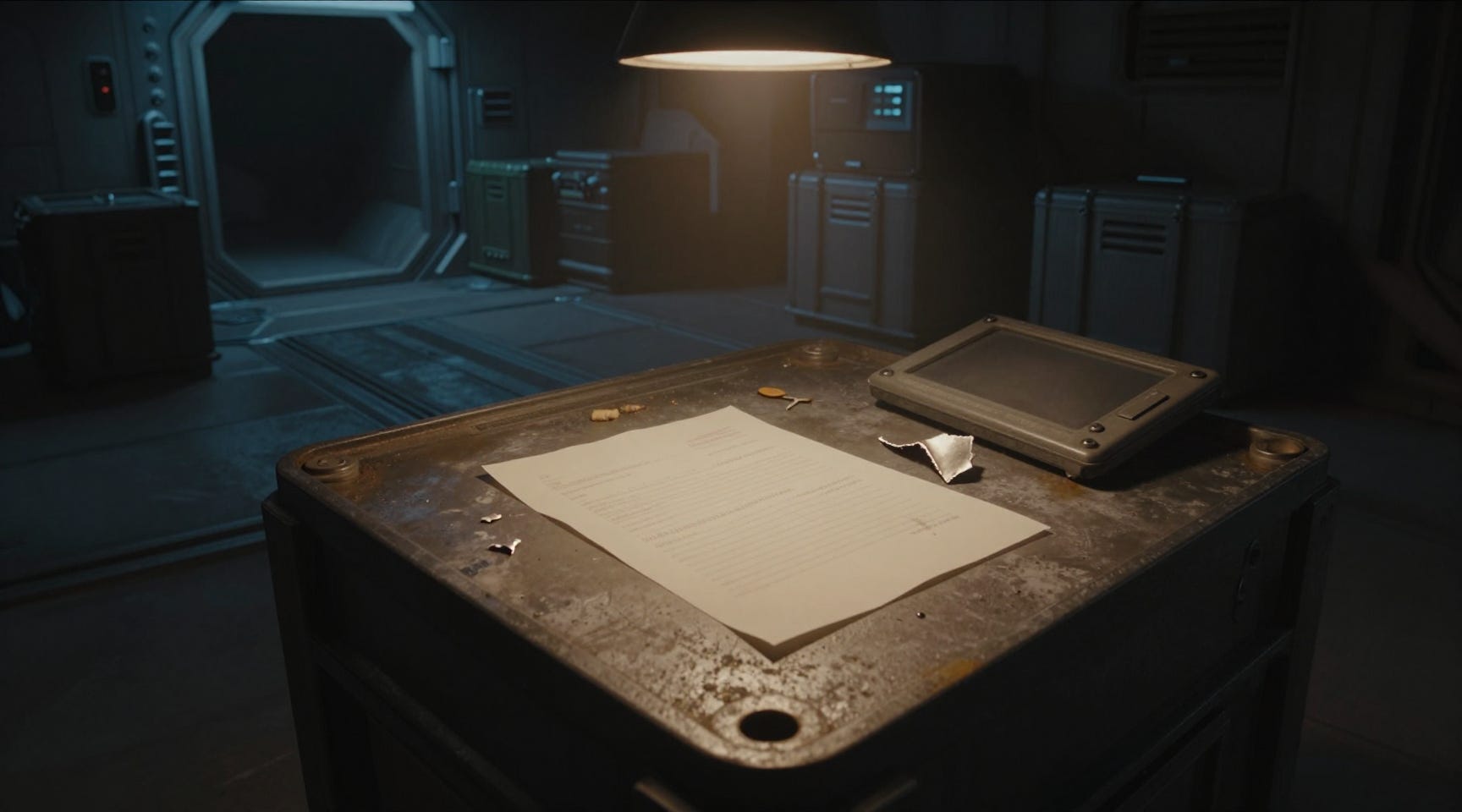
The address read A. Rask, Mimas storage 7B, in handwriting she had seen exactly twice before. Once on a release notice. Once on the chain-of-custody log for crate three.
“Confirmed,” she said. “Receipt confirmed.”
The courier nodded. He turned. He did not ask her to sign anything. He walked back up the corridor at the unhurried pace of a man who had been paid not to remember the door he had stood at.
Anya closed the hatch.
The storage bay was a working space, not a place for reading, and the working space had no chair. She sat down on the welding crate by the inner wall. The crate had been her chair for two years, since the day she had moved into 7B and stopped pretending she was going to upgrade. She set the envelope on her knee.
She did not open it for a full minute.
The flap was glued, not sealed, and it gave under her thumb without resistance. The three sheets inside were station-issue typing paper, folded once, hand-creased. The handwriting was Iso’s. The handwriting was the same handwriting that had said Crate three on a release notice four months ago, in ink, on a counter the color of bone.
She read.
Captain Rask,
I was transferred to Tethys Station two weeks ago. The new posting is inner-system enforcement, attached to the Salvage Protocol’s regulatory directorate. My remit is the writing and revision of inspection procedure for ring-station and inner-belt operations. I am not in the field. I will not be in the field again for the foreseeable future.
I am writing to inform you, as one professional to another, that the working arrangement between us is over. There is nothing for me to look the other way on from a desk on Tethys. The officers who will board you next will not be officers I have trained or briefed, and the procedures they follow will not be procedures I have written for several years yet. By the time my work reaches your skiff, the officers boarding you will already have changed.
I am not asking you to stop what you do. I have never asked that. I am telling you that the room you and I shared no longer exists, and that whatever comes next will not be made by the two of us.
You will need clean routes. I expect you have them. You will need clean papers. I expect you have those too. You will need people in the boarding cohorts who understand the conventions of the work without having to be told. I cannot tell you where to find those people. I can tell you that the conventions will hold for another eighteen months on the ring stations, by my estimate, before the new procedure manuals begin to displace them.
I will not write you again.
I regret one thing, and I will not name it, because to name it would be to ask you to share the regret, and I do not have the standing to ask.
Walk safe.
Lieutenant Commander Iso Pruvit, UEN Salvage Protocol, Tethys Station
She read it twice.
The second reading was slower than the first, the way the second reading of any letter that mattered was slower than the first, and on the second reading the line that stopped her was the second-to-last. I regret one thing, and I will not name it. She read the sentence three more times. She did not need to know what he was regretting. The shape of the regret was visible in the sentence itself, in the way the sentence refused to do the work of naming, in the way the refusal was the whole of the apology a man like Iso Pruvit was permitted by his own self to make.
She folded the letter back along its creases.
She set it on the welding crate.
She pulled the working pad from her jacket pocket and opened a blank reply. She typed:
Iso,
Thank you for
She deleted the line.
She typed:
Lieutenant Commander Pruvit,
Acknowledged. The arrangement is closed.
She deleted the line.
She typed:
Iso. Walk safe.
She held the line on the screen for a long minute, the cursor blinking behind the e of safe, the storage bay quiet around her in the way storage bays were quiet on Mimas at the end of a shift when the corridor traffic outside had thinned to the sound of the air handler.
She deleted the line.
She closed the working pad.
The reply Iso wanted was no reply, and the reply he would understand was no reply, and the reply she could give him without naming what he had not named was no reply. She set the pad on the welding crate beside the letter.
She picked up the letter again. She folded it once more, tighter this time, into a quarter the size of the original sheet. She opened her chest pocket. The pocket held one item already, a thin curl of Polaris alloy the size of a child’s thumbnail, the edge of which was the cut edge of the Polaris observation deck where Maren’s chair had been bolted to the deck plate. The fragment had ridden her chest for two years, four months, and eleven days.
She slid the letter in beside it.
The pocket sat heavier against her chest by perhaps a single gram. The gram registered as a presence rather than a weight, the way the fragment had registered for two years.
She stood. The welding crate creaked as she stood off it. The bay’s outer hatch indicator showed clear corridor. The shift was changing on the level below her. The cooperative had a meeting in forty minutes on the question of the courier consortium based out of Enceladus, and Davit was already on the way, and the meeting would not wait for her.
She left the working pad on the crate.
She walked.
Author’s note: Day Twenty-One of the Iron Wake Origins arc. Year 3, Month 1. Four months after the impound at Mimas, a hand-courier delivers a paper letter to Anya Rask’s storage bay. The handwriting is Iso Pruvit’s. The transfer to Tethys is confirmed. The arrangement that ran between them for six months is closed in three folded sheets of station-issue typing paper, in the voice of a man who has never written anything he could not also have signed in an official log. The line that stops her is the second-to-last. The reply she does not send is the only reply he will accept. She folds the letter and puts it in the chest pocket beside the Polaris fragment, and the two pieces of paper-and-metal she now carries weigh almost nothing and almost everything. The cooperative meets in forty minutes on the Enceladus relay. The work is constant. The work is constant.
If you enjoyed this story, you can follow the main story arc in The Exodus Rush, the first book in The Vethrak Requiem series.