


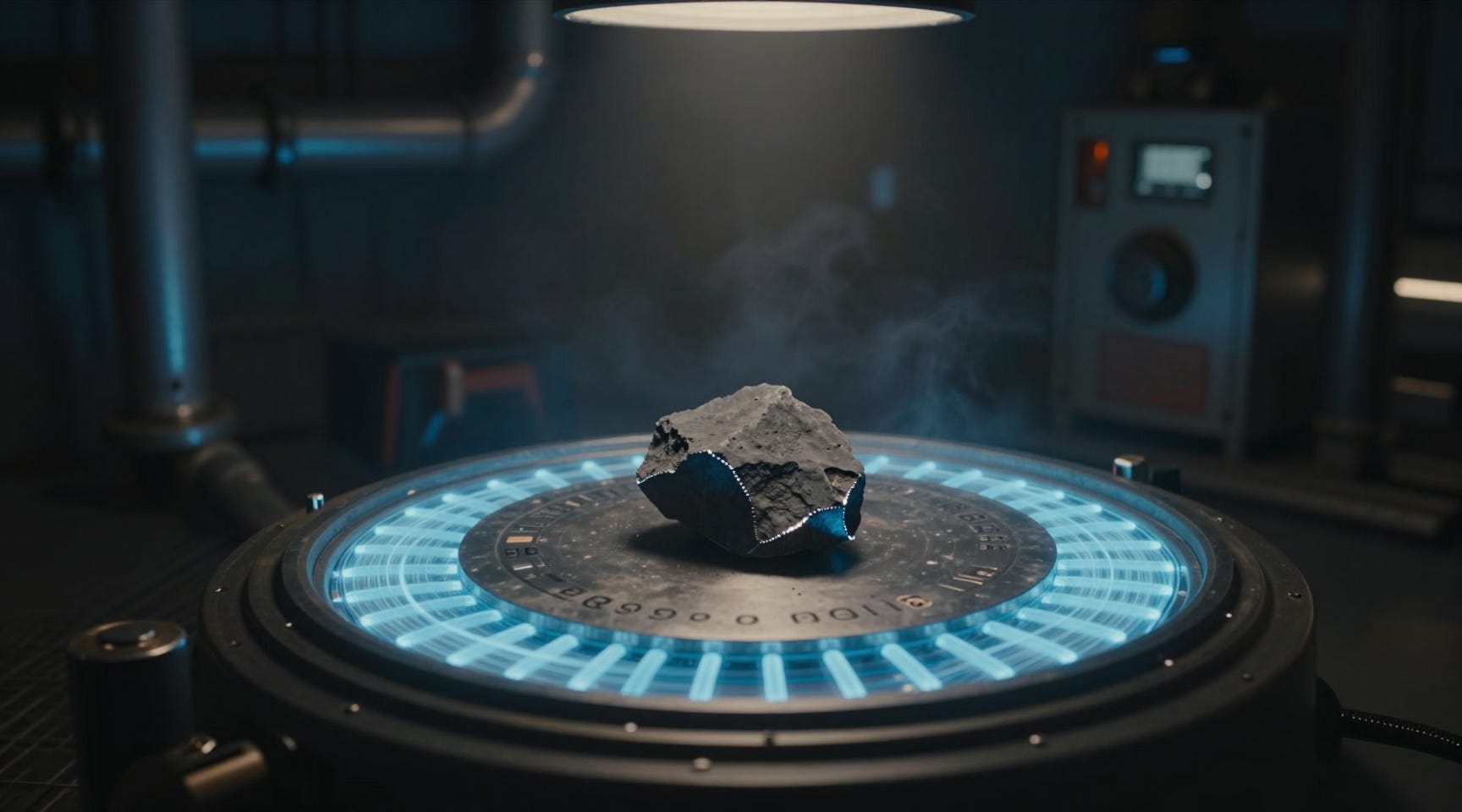
Cyrus Khosravi laid the fragment on the authentication slab and waited for the slab to decide whether the thing on it was real.
The slab took its time. It always did with Vethrak material. The induction coils hummed at three different frequencies, building a resonance signature, and the readout panel cycled through metallurgical comparisons against Iron Wake’s reference library: forty-eight cataloged Vethrak alloys, each with its own decay curve, each with its own way of refusing to behave like anything human metallurgy could explain.
The fragment was the size of his thumb. Charcoal gray. The cut edge looked clean enough that whoever pulled it from the wreck had used a plasma lance with proper containment. Most amateurs left a slag halo. This piece had no halo at all.
His shop occupied a maintenance bay on the lower ring of Mimas Station, two corridors down from a desalination plant that vented warm water vapor through the deck plates twice a shift. The vapor wrecked his electronics on a six-month replacement cycle, which was why he kept the shop here. Nobody else wanted it.
The slab chimed.
Cyrus read the signature line, and his stomach dropped a centimeter.
Lurker Core. Seventh-generation lattice. Authenticity confidence: ninety-six percent.
He pulled the fragment off the slab and turned it under the worklight. A piece of the thing humanity had pried out of Helios-Beta with seven hundred dead and a fold-drive prototype the engineers later admitted shouldn’t have worked. The UEN had every active Lurker Core fragment cataloged, sealed, and assigned to the combat research division on Tethys Yard. Every active fragment.
Which meant this one had never been cataloged. Which meant somewhere in the salvage chain between the Saturn ring debris fields and his back-room slab, somebody had pulled it before the manifest checkers got eyes on the haul.
Iron Wake did not ask where. Iron Wake asked how much.
A knock on the shop door. Two short, one long. Selamawit’s pattern.
“Open.” His voice carried enough across the bay to trip the door release.
Selamawit Hagos stepped through, breathing thin Mimas air through a rebreather she had not bothered to fully seal at the cheek line. She was twenty-three, ring-born, with the rangy frame of someone who had grown up at one-twentieth standard gravity and still made the trip down to Mimas’s spin-deck once a week to keep her bones from forgetting what compression was.
She set a cargo wafer on his bench. “Your buyer cleared the second escrow.”
“On the original price?”
“On the revised price.” Her gaze tracked to the fragment in his hand and lingered there. “I told them you would want twelve percent more after authentication. They paid eleven. I can split the difference.”
He set the fragment back on the slab. The induction coils held it gently in their resonance field, the way a careful person held a thing that could kill them if dropped. “Who is the buyer?”
“You don’t ask.”
“I am asking.”
She pulled the rebreather down. Her mouth was set the way it got when she had already worked through her own version of this conversation on the shuttle ride over. “A research syndicate. Ceres consortium. They have a private lab and a metallurgist who used to work for Tethys Yard before the budget cuts.”
“Tethys Yard does not do budget cuts on Lurker Core research.”
“He told them he was cut. They believed him.” She tapped the cargo wafer. “Nine hundred thousand thermal credits. Half on transfer, half on delivery confirmation. Iron Wake takes its eighteen percent. You and I split the rest after the courier chain costs.”
Nine hundred thousand. The number sat on the bench between them like a weight neither of them wanted to be the first to touch.
His salvage crew worked the outer debris fields on a barge that needed reactor shielding replaced before the next thermal cycle. The shielding alone would cost two hundred and forty thousand. Crew payroll for the next eight months ran a hundred and ten. A used fold-coil capacitor for the barge’s emergency drive ran sixty.
The math worked. The math always worked. The math was not the problem.
“This fragment belongs to the UEN combat research division,” he said. The words came out thin in the recycled air. “Whatever the Ceres consortium does with it, the people on Tethys Yard who are trying to figure out how to fight the next Vethrak incursion will not have it.”
Selamawit studied him.
“They have forty-seven other fragments,” she said. “I checked. The Tethys Yard manifest is in the public oversight database. They have forty-seven cataloged Lurker Core lattice samples, three of them seventh-generation. One more would be marginal.”
“Marginal is not zero.”
“Marginal is the difference between your barge running another year and your crew getting reassigned to a Copperline labor contract.” She did not raise her voice. She did not need to. “Lukas’s daughter is six. If he loses the barge berth, he goes into debt servitude on a Titan refinery within three months. That is how the math works for him. I am not saying it should be that way. I am saying it is.”
Cyrus looked at the fragment again. The slab’s worklight caught the cut edge. Whoever had pulled this piece had known what they were holding. The clean cut was not amateur work. Somewhere up the salvage chain, a person with proper Vethrak-handling certification had decided that nine hundred thousand thermal credits mattered more than what the combat research division might learn from one more lattice sample.
He had told himself, when he opened the shop, that he would work scrap. Hull plating. Drive components. Reactor casings. He had told himself that the line he would not cross was Vethrak material that belonged in a research lab.
The line had moved. He had not noticed when it moved. Perhaps he had noticed and had simply written a smaller line, somewhere closer in.
“Take the deal.” His voice came out steadier than he expected. “Iron Wake protocol. Standard chain. Tell the courier to use the Enceladus relay, not Titan. Titan is hot this month.”
Selamawit nodded. She picked up the cargo wafer and slid it into her chest pocket. Her fingers stayed there a moment, pressed flat against the wafer through the fabric, as if she were checking that her own heart was still in the right place.
“The barge will run another year,” she said.
“The barge will run another year.”
She left through the bay door. The deck plates hissed a breath of warm vapor as she crossed them. Cyrus stood at the slab and watched the fragment in its resonance field, a piece of something that had killed seven hundred people on a station nobody talked about anymore, waiting for a courier to carry it to a private lab on Ceres where it would teach the wrong people the wrong lessons.
He shut down the slab. The induction coils released the fragment with a soft mechanical click.
He picked it up and slid it into the shielded carrier with hands that were steady because he had practiced steadiness for a long time. The math worked.
He did the math anyway.
Author’s Note: By Year 14, the Iron Wake salvage network had grown from a loose confederation of ring-belt scrap crews into one of the most efficient black-market pipelines in the outer system, specializing in Vethrak-derived materials pulled from debris fields the UEN could not patrol with its remaining fleet. Lurker Core fragments commanded the highest prices on the gray market, and their diversion from official combat research repositories represented one of the quiet costs of the postwar economy: a system where survival math and strategic math rarely shared the same answer.
If you enjoyed this story, you can follow the main story arc in The Exodus Rush, the first book in The Vethrak Requiem series.